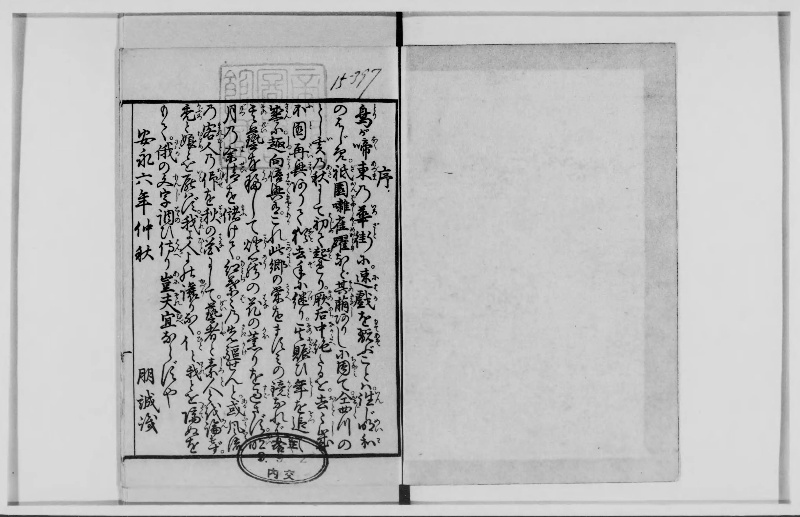
翻刻
序
鳥(とり)が啼(なく)東(あづま)の華街(いろざと)に。速戯(にはか)を翫(もてあそ)ぶことは。往(いん)じ明和(めいわ)
のはじめ。祇園囃(ぎおんばやし)雀躍(すゞめおどり)など其萌(そのきざし)ありしに因(ちなみ)て。同(おなじく)四つの
とし亥(い)の秋(あき)にして初(はじめ)て起(おこ)れり。厥后(そののち)中絶(なかたへ)たるを。去々歳(おとゝし)
不図再興(ふとさいこう)ありて猶(なを)去年(こぞ)に継(つげ)り。其(その)賑(にぎは)ひ年(とし)を追(をつ)
盛(さかん)に。趣向(しゆこう)倍(ます〳〵)興(きやう)有(あり)。これ此郷(このさと)の栄(さかへ)をますみの鏡(かゞみ)なれば。□
其(その)芸(げい)を移(うつ)して燈籠(とうろう)の花(はな)の薫(かほ)りを過(すご)さず明(めい)
月(げつ)の余情(よせい)を儲(まふ)けて。紅葉々(もみぢば)の先駆(さきかけ)せんと。或(あるは)風流(ふうりう)
の客人(まれびと)の仰(おふせ)を秋(あき)の花(はな)にして。芸者(げいしや)と素人(しろと)とを論(ろん)せず。
禿(かぶろ)と娘(むすめ)とを厭(いと)はず。我(われ)よ人(ひと)よの譲(ゆづり)りなく。イ(ひと)と。我(われ)とを隔(へだて)ぬを
もて。俄(にはか)の文字(もんじ)調(とゝの)ひ侍(はんべ)り豈(あに)夫(それ)宜(むべ)ならずや
安永六年仲秋 朋誠識
現代語訳
序
鳥が鳴く東の遊郭において、即興芸(にわか)を楽しむことは、昔の明和年間の初めに、祇園囃子や雀踊りなどその兆しがあったことに由来して、同じく明和四年の秋に初めて始まった。その後中断していたが、一昨年ふと再興があって、なお去年に続いた。その賑わいは年を追うごとに盛んになり、趣向もますます興味深い。これはこの里の栄えを増す美の鏡であるから、その芸を移して灯籠の花の香りに劣らず、明月の余情を設けて、紅葉の先駆けをしようと思う。ある風流な客人の仰せを秋の花として、芸者と素人とを区別せず、禿と娘とを厭わず、自分も他人も譲り合いなく、他人と自分とを隔てないことをもって、にわかの文字が整ったのである。どうして適切でないことがあろうか。
安永六年仲秋 朋誠識
英語訳
Preface
In the pleasure quarters of the eastern capital where birds sing, the enjoyment of impromptu performances (niwaka) originated from the early years of the Meiwa era, when there were signs of this in Gion-bayashi and sparrow dances. It first began in the autumn of the fourth year of the same era [Meiwa 4, 1767]. After being interrupted for some time, it was suddenly revived the year before last and continued through last year. The festivities have grown more prosperous with each passing year, and the artistic concepts have become increasingly entertaining. Since this serves as a mirror reflecting the flourishing beauty of this quarter, I have decided to transfer those arts and, without falling short of the fragrance of lantern flowers, to create lingering emotions of the bright moon and serve as a herald of autumn leaves. Taking the request of a certain refined patron as an autumn flower, without distinguishing between professional entertainers and amateurs, without rejecting either young apprentices or daughters, with no yielding between myself and others, and by not separating others from oneself, the words of niwaka have been arranged. How could this not be appropriate?
Autumn, An'ei 6 [1777] - Identified by Hōsei