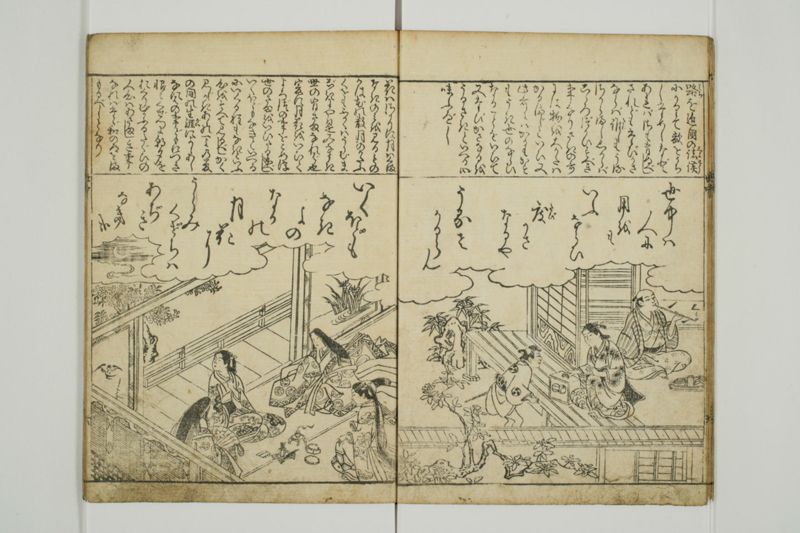
翻刻
【右丁】
【上段】
路(みち)を近国の諸侯(しよこう)
にかりて敵をうち
しためしなど
あればさも有ぬべし
されどもたびかさ
ならば誰(たれ)しもうる
さからまししからば
こゝろづかひすべき
事なりさきの哥
には物を大かたは
かるまじといひ又
此哥にはかるもかす
もうき世のならひ
なることをいひて
又たびかさなるを
うるさきといへる心
味ふべし
【下段】
世中は
人に
用をも
いふ
ならひ
度(たび)
かさ
なるや
うるさ
かるらん
【左丁】
【上段】
花はさかりに月はくま
なきのみを見るもの
かは花の散月のかたふ
くをもふかくはうらむま
じきにや是みなうき
世の有さまなれば也
爰に月花をいひて
よろづの事をこめ浮
世のさまをいひたる成べし
いくほどもなきといへる
にいくる程もなきといふ
心をそへて見るべしかく
みじかきあしの一よの夢
の間の生 涯(がい)によしあし
なにはの事どもにつき
恨みくぜつに朝夕を
おくりむかふるたぐひの
人心はあさましき事
なればたゞ和の道をま
もるべしとなり
【下段】
いくほども
なき
よの
なか
の
月
花
に
うらみ
くぜちは
あぢき
なき
哉
現代語訳
【右丁】
【上段】
道(領地・街道)を近隣の諸侯に借りて敵を討ったという例などもあるから、そのような場合もあることだろう。しかしながら、たびたび重なれば、誰もが煩わしく思うであろう。ならば、十分に心配りをすべきことである。前の歌では「物はだいたい借りるべきではない」と言い、また、この歌では「借りることも貸すことも浮き世の習いである」と言って、さらに「たびたび重なれば煩わしい」と言っている心を、よく味わうべきである。
【下段】
世の中は
人に
用をも
言う
ならひ
度(たび)
かさ
なるや
うるさ
かるらん
(世の中というものは、人に頼み事を言うのも習いのことだ。しかしそれがたびたび重なれば、煩わしいと思われることだろう。)
---
【左丁】
【上段】
「花は盛りに、月は曇りなく(満月のみ)を見るものであろうか(いや、そうではない)」——花が散り、月が傾くのを、深く恨むべきではないのではないか。これはすべて浮き世のありさまだからである。ここに月と花を挙げて、あらゆることを込め、浮き世のさまを言っているのであろう。「いくほどもなき(さほど長くもない)」と言っているのに、「生きる程もない」という意味を加えて読むべきである。このように短い、葦のひと節のような、夢のような短い生涯の間に、良いことも悪いことも、難波のことども(様々な出来事)について恨んだり愚痴をこぼしたりして朝夕を過ごすような類いの人の心は、嘆かわしいことである。ただ、和の道(穏やかな調和の道)を守るべきである、ということだ。
【下段】
いくほども
なき
世の
なか
の
月
花
に
うらみ
くぜちは
あぢき
なき
哉
(さほど長くもないこの世の中で、月や花(をはじめとする無常な世の事柄)に対して、恨みや愚痴を言うのは、何とも味気ない(むなしい)ことだ。)
英語訳
[Right folio]
[Upper section]
There are historical examples of borrowing roads (territories or highways) from neighboring lords in order to strike an enemy, and so such cases may indeed arise. However, if such requests are repeated too often, anyone would find them tiresome. In that case, one ought to exercise proper consideration and thoughtfulness. The preceding poem said that "one should generally not borrow things," and now this poem says that "borrowing and lending are the ways of this fleeting world," while further expressing the sentiment that when such requests become too frequent, they are a nuisance. One should savor and reflect deeply on this meaning.
[Lower section]
In this world,
telling others
of one's needs
is common custom —
but when it is
repeated
again and again,
how tiresome
it must become!
(*It is the way of the world to ask others for favors, but when such requests pile up repeatedly, they will surely come to be regarded as a nuisance.*)
---
[Left folio]
[Upper section]
"Is it only the cherry blossoms at their peak and the moon perfectly unclouded that one should admire?" — surely one should not deeply lament the scattering of blossoms or the declining of the moon. For these are all the natural conditions of this fleeting world. Here, by invoking the moon and the flowers, all manner of things are encompassed, and the nature of the ephemeral world is expressed. Where the text says *ikuhodo mo naki* ("not lasting very long"), one should also read into it the sense of "not even enough time to live out one's life." In this way, within the brief span of a life as short as a single joint of reed — a span no more than a dream — to spend one's mornings and evenings consumed in resentment and complaint over all manner of good and bad happenings, over the various affairs of this world: such is the state of mind that is truly pitiable. One should simply uphold the way of harmony (*wa no michi*).
[Lower section]
In this world
that lasts
not long —
over
moon
and flowers,
to harbor
resentment
and complaint
is how
tasteless
a thing!
(*In a world that does not last long, to waste one's time in resentment and grumbling over the moon and flowers — over all the transient things of life — is truly a hollow and futile thing.*)