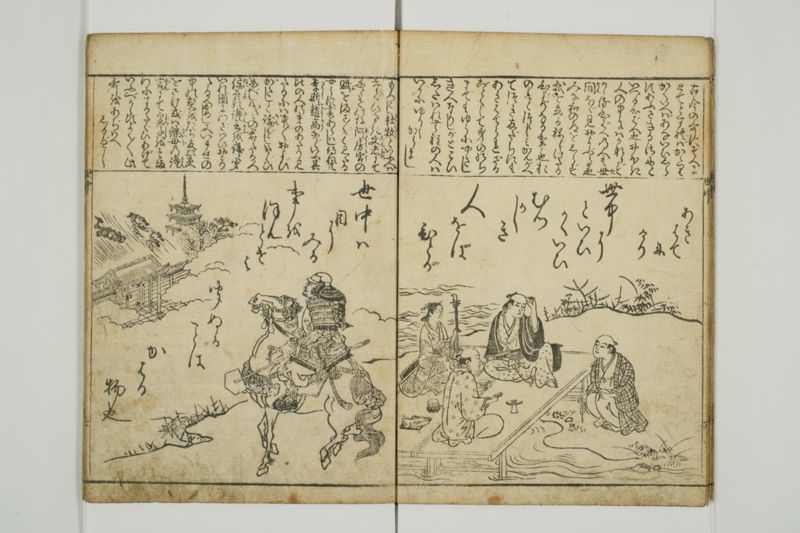
翻刻
【右丁】
【上段】
古今の哥にそへに
とてとすればかゝり
かくいへばあないひしら
すあふさきるさにと
いへる心ばへ也おほき
人の中にはかならず
かゝる心ばへの人も世(せ)
間(けん)ほゞ見およぶ事也
みな和の道をしらず
我を立るねじけたる
心よりなる事也お
のれとつゝしみかんがへ
てつき友だちにも
あきはてられざる
ごとくして身ののち
までもゆうにやさし
き人なりしがとこひ
したはれむ程の人は
いかにゆかし
からまし
【下段】
あき
はて
に
けり
世中に
といひ
かくいひ
むつ
かし
き
人をば
ひとが
【左丁】
【上段】
もろこし杜牧(とぼく)といふ人は
たぐひなき文者(ぶんじや)にて
千とせの後 阿房宮(あばうきう)の
賦(ふ)をまざ〳〵と見たる
やうに書あらはし侍れ共
李斯趙高(りしてうかう)などいふ其
比の人のまのあたり見
たるには中〳〵および
がたしと論(ろん)ぜしたぐひ
成べし代々の君たる人
佞臣(ねいしん)の讒言(ざんけん)を誠と聞
いれ国にわざはひおこり
たるためし又いもせの
中の契をたち友の交
をさけ或は継母(けいぼ)の讒(さん)
言(げん)にて実子(じつし)をそま
つにするたぐひあげて
いふべからずよく〳〵此
哥をあぢはへ
しるべし
【下段】
世中は
目
に
みる
事を
ほんとせ
よ
聞ぬる
ことは
はる
物也
現代語訳
【右丁】
【上段】
古今の歌に添えて、「ああいえば、こういう」という具合に、「あふさきるさ(あちらを立てればこちらが立たず)」と言っている心持ちのことである。多くの人々の中には、必ずこのような心持ちの人もいるものだと、世間をある程度見渡せばわかることである。みな、和の道を知らず、自分を主張するねじけた(歪んだ)心から生じることである。自らを慎み、よく考えて、付き合いの友人たちにも、すっかり飽きられてしまわないようにして、身が亡くなった後までも、「優雅で優しい人であった」と、慕われるほどの人というのは、なんと素晴らしいことであろうか。
【下段】
飽き
はて
に
けり
世の中に
とも言い
かくも言い
むつ
かし
き
人をば
人が
(世の中で、あれこれとやかく言い立てて難しい(付き合いにくい)人のことは、人々もすっかり愛想を尽かしてしまうことだ。)
---
【左丁】
【上段】
中国の杜牧(とぼく)という人は、比類なき文章の達人であって、千年の後に阿房宮(あぼうきゅう)の賦(ふ)を、まるで目の前に見るかのように書き表したけれども、李斯(りし)・趙高(ちょうこう)などという、その当時の人たちが実際に目の当たりにしたことには、とうていおよびがたいと論じた、そのような類いのことであろう。代々の君主たる人が、佞臣(ねいしん)の讒言(ざんげん)を本当のことと聞き入れて、国に災いが起きたという例。また、夫婦の仲の契りを断ち、友との交わりを避け、あるいは継母の讒言によって実の子をないがしろにするような類いのことは、枚挙にいとまがない。よくよくこの歌を味わって知るべきである。
【下段】
世の中は
目
に
見る
ことを
本(ほん)とせ
よ
聞くる
ことは
はる
物也
(世の中は、自分の目で実際に見たことを本当のこととしなさい。伝え聞いたことは、(実態からは)遠いものである。)
英語訳
[Right folio]
[Upper section]
This is the spirit expressed in poems from the *Kokin Wakashū* and other collections — the sense captured in the phrase *ōsa kirusa* ("if you raise one side, the other falls"), the back-and-forth of "say this and you get that response." Among the many people of this world, there are surely those who carry this kind of disposition, as one can see from even a general survey of human society. This all arises from a twisted heart that does not know the way of harmony (*wa no michi*) and insists only on asserting itself. One should exercise self-restraint and reflect carefully, so as not to be utterly abandoned by one's companions and friends. A person who, even after death, is remembered and longed for as someone who was "graceful and gentle" — how admirable and worthy of emulation such a person would be!
[Lower section]
How thoroughly
tired of them
people have
become —
those in this world
who say this
and say that,
making themselves
so difficult
and trying:
even those around them
have grown weary.
(*Those in this world who constantly complain and quibble, making themselves difficult to get along with — even the people around them will eventually grow completely tired of them.*)
---
[Left folio]
[Upper section]
Du Mu (杜牧, *Toboku*) of China was a man of incomparable literary genius, and he wrote the "Rhapsody on the Epang Palace" (*A'fang gong fu*, 阿房宮賦) with such vivid mastery that it seemed as though he had seen it with his own eyes, a thousand years after the fact. And yet, as he himself argued, it could in no way compare to what Li Si (李斯) and Zhao Gao (趙高) — people who were actually present at the time — witnessed firsthand. The present poem should be understood in a similar vein. There are countless examples throughout history of rulers who accepted the slanderous words of treacherous ministers as the truth and thereby brought calamity upon their kingdoms; of men who severed the bonds of marriage and shunned the fellowship of friends; and of cases where a stepmother's slander caused a father to neglect his own true children. One should savor and truly understand the meaning of this poem.
[Lower section]
In this world,
make what
you see
with your own eyes
your truth.
What you merely
hear told
is a thing
far away.
(*In this world, you should trust what you yourself have witnessed with your own eyes as the truth. That which you have only heard from others is something distant from reality.*)