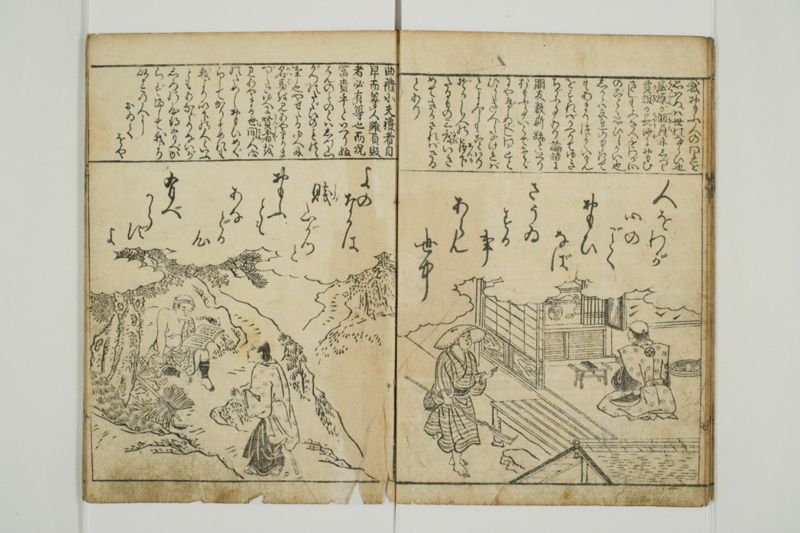
翻刻
【右丁】
【上段】
我おもふ人のわれを
思はぬは世のならひ也
屈原(くつげん)が汨羅(べきら)にしづみ
賈誼(かぎ)か長沙(ちやうしや)におもむ
きしもみな人をわが心
のことく思ひしかい也
しからば友達の中にて
もあまりつよくいけん
をすればかへりてゆき
ちがふ事あり論語に
朋友数斯疏といへり
おもふ事いはでたゞ
にややらぬべしわれと
ひとしき人しなければ
とよみしもことはり
ぞかし人の臣下(しんか)
たるもの三 度(たび)いさ
めてきかさればさる
とあり
【下段】
人をわが
心の
ごとく
おもひ
なば
さうゐ
する
事
あらん
世中
【左丁】
【上段】
曲礼に夫礼者自
卑而尊_レ 人雖_二負販
者_一必有_レ尊也而況
富貴乎といへりふ
はんのものとはしづ山
がつのたぐひのものゝ
事也やせたるゆへに
名馬(めいば)を見あやまりま
づしきゆへに賢者(けんしや)を
見あやまる世間(せけん)人心
のためしおもひめぐ
らしてかりそめにも
我より以下の人といふ
ともあなどりないが
しろの心得有べか
らずまして我より
以上の人に
おゐてをや
【下段】
よの
なかは
賤(しつ)
山がつと
おもふ
とも
あな
どる
心
有べ
からず
よ
現代語訳
【右丁】
【上段】
自分が思う人が、自分のことを思ってくれないのは、世の常というものである。屈原(くつげん)が汨羅(べきら)の川に身を投げ、賈誼(かぎ)が長沙(ちょうさ)へ赴いたのも、みな他の人々が自分の心と同じように考えてくれるはずだと思っていたことの失敗である。そうであれば、友人の間でも、あまりに強く意見を言えば、かえって仲が違う(うまくいかなくなる)ことがある。『論語』に「朋友数(しばしば)すれば斯(ここ)に疏(うと)んぜらる」とある。思うことも言わずに、ただそっとやり過ごすのがよいのであろう。「自分と同じ(気持ちの)人はいない」と詠んだのも、もっともなことである。人の臣下たる者は、三度諫めて聞き入れられなければ、(主君の元を)去るべきだとある。
【下段】
人を自分の
心と
同じように
思い
ならば
相違
する
ことが
あるであろう
世の中(では)
(世の中では、他の人も自分と同じ心であろうと思えば、必ずや食い違いが生じるであろう。)
---
【左丁】
【上段】
『礼記(らいき)』の曲礼(きょくれい)に「夫れ礼は自ら卑くして人を尊ぶ。負販の者といえども、必ず尊ぶべきことあり。いわんや富貴(ふうき)においてをや」とある。「負販のもの」とは、荷物を担いで物を売り歩く賤しい山がつ(山人・賤しい者)のたぐいの者のことである。痩せているからといって名馬を見誤り、貧しいからといって賢者を見誤る——世間の人の心のありようというものをよく思い巡らして、かりそめにも自分より下の人といえども、侮り、ないがしろにするような心がけがあってはならない。まして、自分より以上の人に対しては言うまでもないことである。
【下段】
世の
中は
賤しい
山がつと
思う
とも
あな
どる
心
あるべ
からず
よ
(世の中では、たとえ賤しい山人(身分の低い者)だと思っても、侮る心を持ってはいけないよ。)
英語訳
[Right folio]
[Upper section]
It is the way of the world that the person you care for does not necessarily care for you in return. That Qu Yuan (屈原) drowned himself in the Miluo River (汨羅), and that Jia Yi (賈誼) was sent away to Changsha (長沙) — both of these misfortunes arose from the mistaken assumption that others would think and feel just as they themselves did. In the same way, even among friends, if one voices one's opinions too forcefully, it may well lead to estrangement. The *Analects* (*Lunyu*) say: "When friends remonstrate too often, they will be distanced." It is perhaps best to let things pass quietly, without voicing everything one thinks. The poem that says "there is no one who feels exactly as I do" speaks a most reasonable truth. For a retainer serving a lord, it is said that if one has remonstrated three times and still gone unheeded, one should depart.
[Lower section]
If you think
that others'
hearts
are the same
as your own,
you will surely find
that they
differ —
such is
this world.
(*In this world, if you assume that others share your own feelings and intentions, you will inevitably find that there are differences and misunderstandings.*)
---
[Left folio]
[Upper section]
In the "Quli" (*Proper Conduct*) chapter of the *Book of Rites* (*Liji*), it is written: "The essence of propriety is to humble oneself and honor others. Even toward a peddler carrying his wares on his back, there is always something worthy of respect — how much more so toward those of wealth and high rank!" The phrase "those who carry and peddle" (*fuhan no mono*) refers to the sort of lowly people who carry loads on their backs and travel about selling goods — humble folk of the mountains and byways. Just as a lean horse may be mistaken for a poor one, or a man of poverty mistaken for one lacking in wisdom, one should reflect carefully on the nature of human judgment in this world. One must never harbor an attitude of contempt or disregard toward those one considers below oneself, even in passing. And how much more does this apply to those who stand above oneself!
[Lower section]
In this world,
even one
you think
a lowly
mountain-dweller —
you must
never
hold
contempt
in your heart.
(*Even toward those you consider to be of low and humble station — people of the mountains and fields — you must never permit yourself to look down upon them with contempt.*)