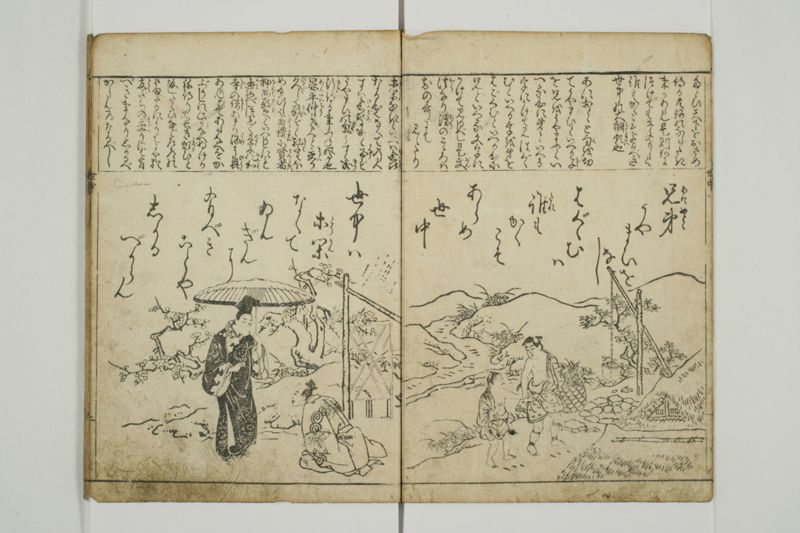
翻刻
【右丁】
【上段】
【前コマ左丁上段より】
たとひ天下をおさめ
侍る共何のなしがたき
事かあらん是則何に
つけてもたのもしく
誰もかくこそ有べき
世中の大 綱領(こうれい)也
あにおとゝと句(く)を切
てうやまひといへる字(じ)
を兄をうやまふとい
へる心に弟といへる
字にかけて見はぐゝ
むといへる字を弟を
はごくむといへる心に
兄といへる文字に
かけて見るべし是 文(ぶん)
法(ほう)なり注(ちう)のこゝろは
前の哥にて
見えたり
【下段】
兄弟(あにおとゝ)
うや
まひを
な
し
はぐゝむ
は
誰(たれ)も
かく
こそ
あらめ
世
中
【左丁】
【上段】
等閑(とうかん)なきといふは念比(ねんころ)
なる心也なへての人
すは念比(ねんごろ)に成と必(かなら)ず
うやまひの気(き)うすく成(なり)
行(ゆき)侍る事つねの事也
晏平仲(あんへいちう)よく人と交(まじは)り
久(ひさしく)して敬(けい)すと孔子(こうし)もほ
め給ひし也 曲礼(きよくれい)に賢者(けんしやは)
狎而敬之(なれてけいす)といへりしにも
通(かよ)ふべしつれ〳〵草(ぐさ)に仁和(にんわ)
寺(じ)の僧(そう)あまり酒(さけ)に興(けう)
あらんとてあしかなへをか
ぶりしに此かなへぬけか
ね侍りて長き煩(わづら)ひと
成したくひなど左道の
さまたるによりてにや猶
友(とも)だちの交(まじは)りにも有
べき事なりしかるべ
からん道なるべし
【下段】
世中は
等閑(とうかん)
なくて
ゐん
ぎん
に
有べき
ことや
しかる
べから
ん
現代語訳
【右丁】
【上段】
【前コマ左丁上段より続き】
たとえ天下を治めるとしても、何が成し難いことがあろうか。これこそが、何につけても頼もしく、誰もがこうあるべき、世の中の大きな綱領(かなめ)である。
「兄弟」の句を区切って、「うやまひ」(敬う)という字を「兄を敬う」という意味として「弟」という字にかけて読み、「はぐくむ」(育む)という字を「弟を育む」という意味として「兄」という文字にかけて読むべきである。これが文法(読み方の作法)である。注の意味は、前の歌によって明らかである。
【下段】
兄弟よ、
敬いを
なし、
育むのは、
誰も
かく
こそ
あらめ、
世の
中よ。
---
【左丁】
【上段】
「等閑なき」とは、念入りで丁寧な心のことである。一般の人は、親しく念入りになると、必ず敬う気持ちが薄れていくのが、常のことである。晏平仲は「よく人と交わり、久しくして敬す」と孔子も褒め称えられた。『曲礼』に「賢者は狎而敬之(慣れ親しみながらも敬う)」とあるのにも通じるべきである。『徒然草』に、仁和寺の僧があまりに酒に興じようとして、足鼎(あしかなえ)をかぶったところ、この鼎が抜けられなくなり、長い患いとなったという類いの話は、左道(よこしまな道)の妨げになることによってであろうか。なお、友人との交わりにも同じことが言えるはずで、ふさわしい道であるべきである。
【下段】
世の中は、
等閑(おろそか)
なくして、
懇ろ(ねんごろ)
に
あるべき
ことよ。
しかる
べから
ん。
英語訳
[Right folio]
[Upper section]
[Continued from the upper section of the left folio of the previous frame]
Even if one were to govern the entire realm, what could possibly be difficult to accomplish? This is precisely why, in all things, such a person is reassuring — and it is the great guiding principle of the world, which everyone ought to follow.
Regarding the verse on "elder and younger brother" (*ani ototo*): the reader should note that this is a grammatical construction. The character for "respect/reverence" (*uyamahi*) is to be read as "respecting one's elder brother," attached to the character for "younger brother" (*ototo*); and the character for "nurturing/raising" (*hagukumu*) is to be read as "nurturing one's younger brother," attached to the character for "elder brother" (*ani*). This is a matter of literary grammar (*bunpō*). The meaning of the annotation can be understood from the preceding poem.
[Lower section]
Between elder and younger —
showing
reverence,
and nurturing —
everyone
ought
to be
just so,
in this
world.
---
[Left folio]
[Upper section]
"Without negligence" (*tōkan naki*) means a spirit of care and attentiveness. With ordinary people, when they become close and familiar with someone, their sense of reverence invariably tends to fade — this is a common occurrence. Yan Pingzhong (*Anpeichū*) was praised by Confucius himself with the words: "He was skilled at associating with people, and the longer the acquaintance, the more he showed respect." This also connects to what is said in the *Quli* (*Kyokurei*): "The wise person, even when familiar, maintains reverence (*nare te kei su*)." In the *Tsurezuregusa*, there is the story of a monk from Ninnaji Temple who, in his eagerness to enjoy sake to the fullest, put a three-legged cauldron (*ashikanae*) on his head, only to find that he could not remove it, and it became a prolonged affliction — such instances are perhaps a result of straying into crooked paths (*sadō*). This should hold equally true in friendships: it ought to be the proper way.
[Lower section]
In this world,
without
negligence,
being
cordial
and
sincere —
this is
how
things
ought
to be.