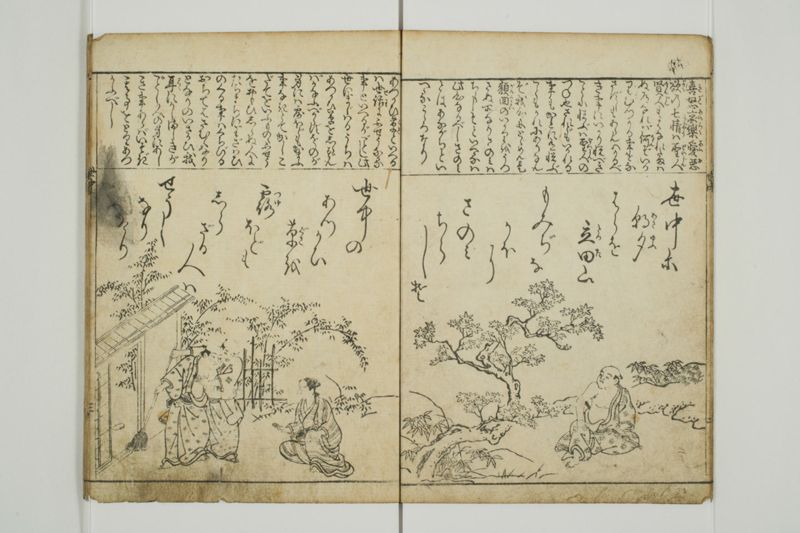
翻刻
【右丁】
【上段】
喜怒哀楽愛悪(きどあいらくあいお)
欲(よく)の七 情(じやう)は聖人(せいじん)
賢人(けんじん)もはなれたまは
ぬ道なれば何(なん)ぞいか
りむつかる事をな
さずしもあらんいかるべ
き事にいかり悦べき
ことに悦ぶは聖人(せいしん)の
つね也されどもいかれる
事もかれに有悦ぶ
こともかれにありなん
ぞ我心にとゞめん是
顔回(がんくわい)のいかりをうつ
さぬ所なりさのみは
ちらしそといへるは
此心なるべしさのみ
とはあながちとい
へるこゝろなり
【下段】
世中に
朝夕(あさゆふ)
はらを
立田(たつた)山
もみぢな
かほ
に
さのみ
ちら
しそ
【左丁】
【上段】
あつかひ草(くさ)といへる
は世話(せわ)にふせうなる
事といへるがごとし此
世にまじはるうちは
あつかひ草をしらずん
ばかなふべからずをのが
身には露ほどもかまふ
事なきとてかしこ
だてをいふものゝふせう
をおもひしらぬ人に
たちまちにわざはひ
のくる事はくちびる
おちてはさむくなり
となりのいさかひ我
耳(みゝ)にかしましきが
ごとし人の身にあし
き事あらばいそぎ
其事をとりあつ
かふべし
【下段】
世中の
あつかひ
草(ぐさ)を
露(つゆ)
ほど
も
しら
ざる
人は
せうし
なり
けり
現代語訳
【右丁】
【上段】
喜・怒・哀・楽・愛・悪・欲の七情は、聖人や賢人でさえも離れることのできないものであるから、怒ったり、むつかしい顔をすることがないとも言えない。怒るべきことに怒り、喜ぶべきことに喜ぶのは、聖人の常のことである。しかしながら、怒りの原因はあちら(相手)にあり、喜びの原因もあちらにある。どうして自分の心の中にいつまでも留めておくのであろうか。これこそが、顔回が怒りを他に移さなかったとされる境地である。「さのみちらしそ」とあるのは、この心を指しているのであろう。「さのみ」とは、「むやみに」「強引に」という意味である。
【下段】
世の中に、
朝夕(あさゆう)
腹を立てていては、
立田山(たつたやま)の
紅葉(もみじ)でもないのに、
むやみに
散らしてしまうな。
---
【左丁】
【上段】
「あつかひ草」というのは、世話が必要な、あるいは面倒な事柄のことを指すようなものである。この世に人と交わっていく以上、世間の取り扱いの難しいことを知らなければ、うまくやっていくことはできない。自分自身のことは露ほども気にかけないくせに、賢いふりをして他人の世話を焼く人が、いかに面倒な事かを知らずにいると、たちまち災いがやってくる。それは「唇が落ちれば寒くなる」というように、隣の喧嘩が自分の耳にうるさく聞こえるようなものである。人の身に悪いことがあれば、急いでその事を取り扱い(仲裁し)てあげるべきである。
【下段】
世の中の
取り扱いの難しい事を、
草(のように軽く)
露(つゆ)
ほども
知ら
ない
人は、
笑止(しょうし)
なり
けり。
英語訳
[Right folio]
[Upper section]
The seven emotions — joy, anger, sorrow, pleasure, love, hatred, and desire (*kidoairaku ai'yoku*) — are a path from which even sages and wise men cannot be separated. Therefore, it cannot be said that one will never feel anger or sullenness. To be angry at things worthy of anger, and to rejoice at things worthy of rejoicing, is the natural way of the sage. However, the cause of anger lies with that other party, and the cause of joy likewise lies with that other party. Why should one keep such things lodged in one's own heart? This is precisely the state of mind that Yan Hui (*Gangai*) exemplified when he was said never to transfer his anger onto others. The phrase "do not scatter so recklessly" (*sanomi chirashi so*) likely refers to this spirit of mind. The word *sanomi* carries the sense of "excessively" or "forcibly."
[Lower section]
In this world,
if one raises one's temper
morning and evening,
like the autumn leaves
of Mount Tatsuta —
though not even leaves —
do not scatter them
so recklessly.
---
[Left folio]
[Upper section]
The expression "atsukaisō" (*atsukahi kusa*) is akin to saying "matters that are troublesome and require careful handling." As long as one mingles with others in this world, one cannot manage without knowing how to deal with such difficult affairs. There are those who pay not even a drop of attention to their own affairs, yet put on airs of wisdom while meddling in the business of others — such people, who do not understand how troublesome this can be, will find that misfortune comes upon them suddenly. It is like the saying "when the lips are gone, one feels the cold," or like a neighbor's quarrel becoming a noise in one's own ears. If something bad befalls another person, one should swiftly step in and take care of that matter.
[Lower section]
One who knows
not even a dewdrop's worth
of the world's
difficult affairs —
treating them
as lightly as grass —
is truly
a laughingstock
indeed.