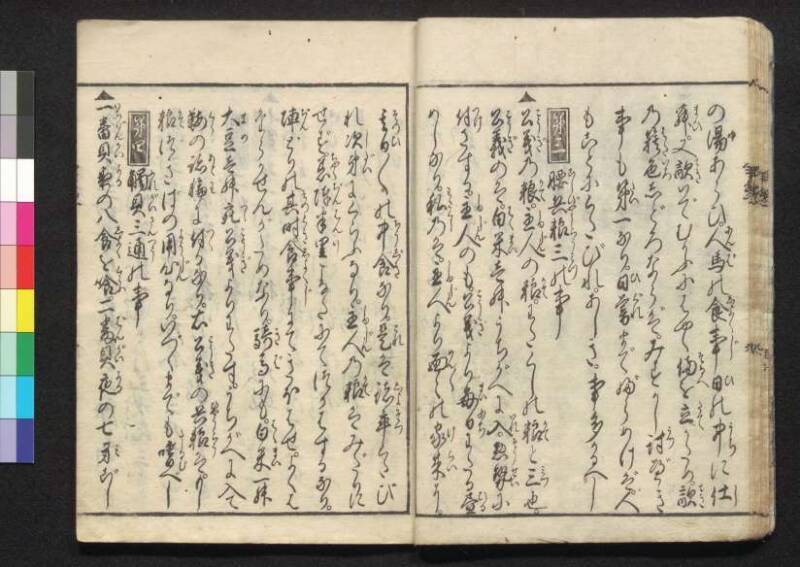
翻刻
【右丁】
の湯(ゆ)あらひ。人馬(にんば)の食事(しよくじ)日(ひ)の中(うち)に仕(し)
舞(まひ)。又 敵(てき)いでむかふにはやく備(そなへ)を立(たて)かため。敵(てき)
の籏色(はたいろ)しどろならば。みすかし討(うつ)べき
事も第(たい)一なり。日暮(ひぐれ)までぶらめけば。人
もことにくたびれ。あしき。事多かるへし
《箱:第三》腰兵粮(こしびやうらう)三(みつ)の事
▲公義(こうぎ)の粮(かて)。主人(しゆじん)の粮(かて)。わたくしの粮(かて)と三(みつ)也。
公義(こうぎ)のは。白米(はくまい)壱升うちがへに入(いれ)。惣勢(そうせい)に
付(つけ)さする。主人(しゆじん)のも。公義(こうぎ)より毎日(まいにち)わたる昼(ひる)
めしなり。私(わたくし)のは。主人(しゆじん)より面々(めん〳〵)の家来(けらい)に。
【左丁】
其日(そのひ)〳〵の中食(ちうじき)なり。是(これ)は諸卒(しよそつ)くたび
れ次第(しだい)にくらふなり。主人(しゆじん)の粮(かて)はみだりに
せず。着陣(ちやくぢん)半里(はんり)こなたにてつかはするなり。
陣(ぢん)どりの其時(そのとき)。食事(しよくじ)にてきほはせ。よくは
たらかせんがためなり。騎馬(きば)にも。白米(はくまい)一升
大豆(まめ)壱升 宛(つゝ)公義(こうぎ)よりわたす。うちがへに入て
鞍(くら)の跡輪(あとわ)に付(つく)るなり。右 公義(こうき)の兵粮(ひやうらう)は。もし
粮(かて)つきばの用心(ようじん)なり。いづくまでも嗜(たしなむ)べし
《箱:第四》触貝(ふれがい)三通(さんつう)の事
▲一番貝(いちばんかい)夜(よる)の八 食(しよく)を喰(くらふ)。二 番貝(ばんがい)夜(よる)の七 身(み)ごし
現代語訳
【右丁】
(馬の)湯洗い、人馬の食事を日のうちに済ませること。また、敵が出て向かってくる時には、早く備えを立て固め、敵の旗色が乱れていれば、見透かして討つべきことも第一である。日暮れまでぐずぐずしていれば、人も特に疲れ、悪いことが多くなるであろう。
《第三》腰兵糧・三つのこと
▲公儀の糧・主人の糧・私の糧の三つである。
公儀のものは、白米一升を打ち飼い(袋)に入れ、総勢に持たせる。主人のものも、公儀より毎日渡される昼飯である。私のものは、主人より各々の家来に
【左丁】
その日その日の中食(昼食)である。これは諸卒が疲れに応じて食べるものである。主人の糧はみだりに(勝手に)食べず、着陣の半里手前で使わせるものである。陣取りのその時、食事で気力を奮い立たせ、よく働かせるためである。騎馬にも、白米一升・大豆一升ずつを公儀より渡す。打ち飼いに入れて鞍の後輪に付けるものである。右、公儀の兵糧は、もし(自分の)糧が尽きた場合の用心である。どこまでも心がけるべきである。
《第四》触れ貝・三通りのこと
▲一番貝(の合図):夜の八つ(午前二時頃)に食事を食べる。二番貝:夜の七つ(午前四時頃)に身支度を
英語訳
【Right Page】
…bathing (the horses) in hot water, and completing the meals of both men and horses while daylight remains. Furthermore, when the enemy advances to meet you, it is of paramount importance to quickly establish and strengthen your formations, and if the enemy's battle flags appear in disorder, to see through their weakness and strike. If one dallies until nightfall, the men will become especially exhausted, and many ill consequences will follow.
《Section Three》 On the Three Kinds of Waist Rations (Koshi-hyōrō)
▲ There are three kinds: the rations of the public authority (kōgi), the rations of one's lord (shujin), and one's personal rations (watakushi).
The public authority's rations consist of one shō of white rice placed in a feed bag (uchigai), and are carried by all troops. The lord's rations are also a daily midday meal distributed from the public authority each day. The personal rations are distributed by one's lord to each retainer
【Left Page】
as each day's midday meal. These are to be eaten by the troops as their fatigue requires. The lord's rations are not to be consumed carelessly; they are to be given out when the troops are half a ri (approximately 2 km) from reaching the encampment. This is done so that, at the very moment of taking up positions, the men are invigorated by the meal and perform their duties well. For mounted warriors as well, one shō of white rice and one shō of soybeans each are distributed by the public authority. These are placed in a feed bag and attached to the rear bow (ato-wa) of the saddle. The aforementioned public authority rations serve as a precaution against one's own provisions running out. One should be mindful of this at all times and in all places.
《Section Four》 On the Three Signals of the Conch Shell (Fure-kai)
▲ At the first conch signal: at the eighth hour of the night (approximately 2 a.m.), eat your meal. At the second conch signal: at the seventh hour of the night (approximately 4 a.m.), prepare yourself…