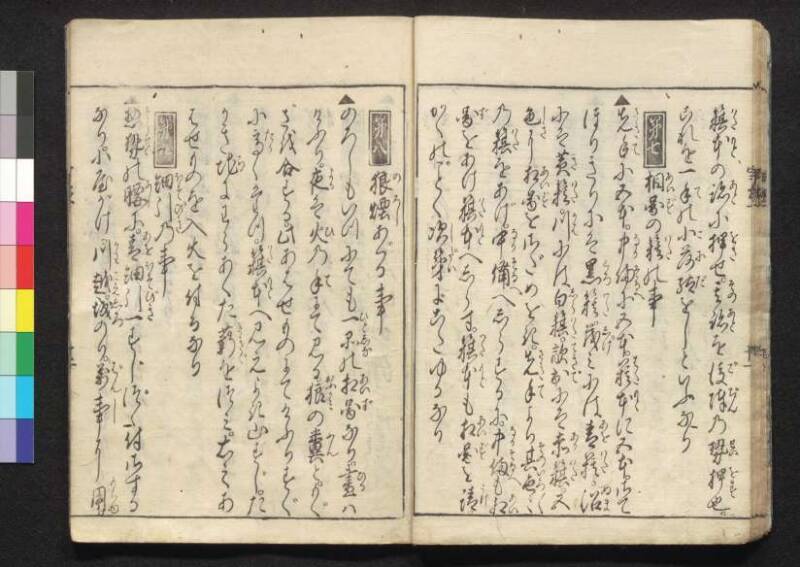
翻刻
【右丁】
籏本(はたもと)の跡(あと)に押(をさ)せ。其跡(そのあと)を後陣(ごぢん)の勢(せい)押(をす)也。
これを一 手(て)の小荷駄(こにだ)をしといふなり
《箱:第七》相図(あいず)の籏(はた)の事
▲先手(さきて)に五本。中備(なかそなへ)に五本。籏本(はたもと)に五本。さて
ほりきりには黒籏(くろはた)。茂(しげ)みには青籏(あをはた)。沼(ぬま)
には黄籏(きはた)。川(かは)には白籏(しらはた)。敵出(てきで)には赤籏(あかはた)。五
色(しき)に相図(あいず)をさだめをき。先手(さきて)より其(その)色々(いろ〳〵)
の籏(はた)をあげ。中備(なかそなへ)へしらするに。中備(なかそなへ)も相(あい)
図(ず)をあけ籏本(はたもと)へしらす。籏本(はたもと)も相図(あいず)を請(うけ)。
かくのごとく次第(しだい)にこたゆるなり
【左丁】
《箱:第八》狼煙(のろし)あぐる事
▲のろしもいつにても一品(ひとしな)の相図(あいず)なり。昼(ひる)は
けふり。夜(よる)は火(ひ)の手(て)にて見る。狼(おふかみ)の糞(ふん)と。もぐ
さを合する。此あはせものにてけふりすぐ
に高(たか)くたつ。籏本(はたもと)へ見えよき山すじ。た
かき地(ち)にわらあくた薪(たきゞ)をつみ。右之あ
はせものを入火を付るなり
《箱:第九》細引(ほそびき)の事
▲惣勢(そうせい)の腰(こし)に。青細引(あをほそびき)一すじづゝ付さする
なり。小屋がけ。川越(かわこえ)。城(しろ)のり。万事(ばんし)に用(もちゆ)。
現代語訳
【右丁】
…旗本の後ろに押し進めさせ、その後ろを後陣の勢いが押し進める。これを一手の小荷駄押しと言う。
《第七》合図の旗のこと
▲先手に五本、中備に五本、旗本に五本。さて、堀切りには黒旗、茂みには青旗、沼には黄旗、川には白旗、敵が出た時には赤旗と、五色で合図を定めておき、先手よりその色々の旗を上げて中備へ知らせ、中備も合図を上げて旗本へ知らせる。旗本も合図を受け、このように順々に応えるのである。
【左丁】
《第八》狼煙を上げること
▲狼煙もいつでも一つの合図として有効である。昼は煙で、夜は火の手によって見る。狼の糞ともぐさ(艾)を合わせる。この混合物によって煙がすぐに高く立ち上る。旗本へよく見える山の尾根や高い地に、藁・あくた(塵芥)・薪を積み上げ、右の混合物を入れて火を付けるのである。
《第九》細引きのこと
▲全軍の者の腰に、青い細引き(細縄)を一筋ずつ付けさせるものである。小屋がけ(野営の仮小屋建設)、川越え、城乗り(城への攻め登り)、万事に用いる。
英語訳
【Right Page】
…is to be advanced behind the bannermen (hatamoto), and after them the rear guard (gojin) advances. This is called the "single-force supply train advance" (itte no konida-oshi).
《Section Seven》 On Signal Flags
▲ Five flags for the vanguard, five for the central formation (nakasonae), and five for the bannermen (hatamoto). Furthermore: a black flag for moats and trenches (horikiri); a blue flag for thickets; a yellow flag for marshes; a white flag for rivers; and a red flag for when the enemy appears. Signal codes are thus established using five colors. The vanguard raises flags of the appropriate color to inform the central formation; the central formation in turn raises its signals to inform the bannermen. The bannermen receive the signals, and in this manner each responds in succession down the line.
【Left Page】
《Section Eight》 On Lighting Signal Fires (Noroshi)
▲ Signal fires are at all times a primary means of communication. During the day they are seen by their smoke; at night, by their flames. Wolf dung and moxa (mogusa) are combined together. With this mixture, smoke rises high and straight immediately. On a mountain ridge or elevated ground with a clear line of sight to the bannermen's position, straw, refuse, and firewood are piled up, the aforementioned mixture is placed within, and fire is applied.
《Section Nine》 On Thin Ropes (Hosobiki)
▲ Every soldier in the entire army is to have one length of blue thin rope (ao-hosobiki) fastened at the waist. It is to be used for constructing temporary shelters, crossing rivers, scaling castle walls, and all manner of purposes.