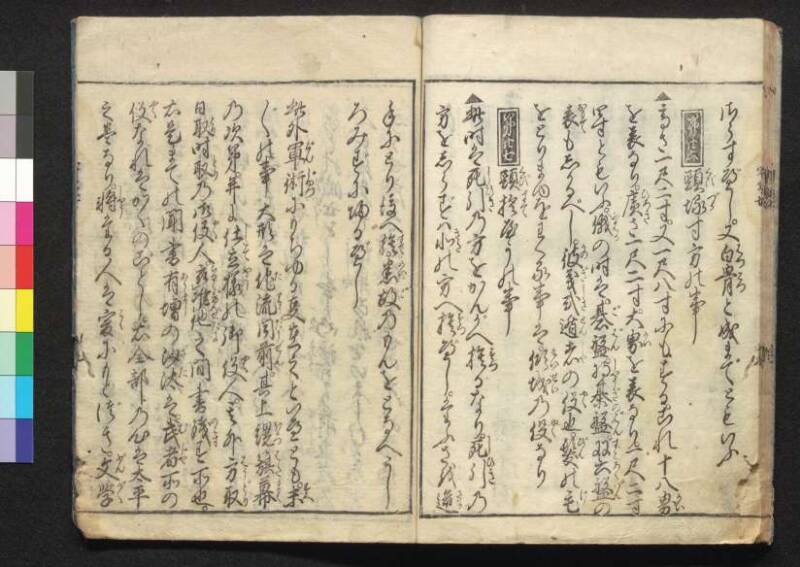
翻刻
【右丁】
さらすべし。又 白骨(はつこつ)と成までともいふ
第廿六#1頸塚(くびづか)寸方の事
▲高さ一尺二寸。又一尺八寸にもする。これ十八 界(かい)
を表なり。広(ひろき)さ一尺二寸。大 界(かい)を表なり。一尺二寸
四寸ともいふ。俄(にはか)の時は。碁盤(ごばん)。将棊盤(しやうぎのばん)。双六盤(すごろくばん)の
表(おもて)もしかるべし。彼(かの)義式(ぎしき)遁者(とんしや)の役(やく)也。髪(びん)#2の毛(け)
をとりまゆをわくる事は。傾城(けいせい)の役(やく)なり
第廿七#1頸捨(くびすて)やうの事
▲此時は死引(しひき)の方をかんがへ捨(すつ)るなり。死引(しひき)の
方をしらずは北(きた)の方へ捨(すつ)べし。たふさを逆(さか)
【左丁】
手にとり後へ捨(すて)。迷故(めいご)のもんをとなへうし
ろみずに帰るべし
此外/軍術(ぐんじゆつ)にもちゆる事在之といへとも。末(すへ)
〴〵の事大形は他流(たりう)同前(だうぜん)。其上/縨(ほろ)籏(はた)幕(まく)
の次第。幷に仕立様(したてやう)の御/役(やく)人。其外/方取(はうどり)
日/取(とり)時/取(とり)の御/役(やく)人。被(らるゝ)_レ准(じゆんぜ)_レ他(たに)之間書/残(のこす)す所也。
右是まての聞書/有増(あらまし)の沙汰(さた)は。武者(むしや)所の
役(やく)なれはかくのごとし。右全部の心は太平
之巻なり。将(しやう)たる人は爰(こゝ)にもとづき。文学(ぶんがく)
現代語訳
【右丁】
さらすべし。また白骨になるまで、ともいう。
第二十六条 首塚の寸法について
▲高さは一尺二寸、または一尺八寸にもする。これは十八界を表す。幅は一尺二寸。大界を表す。一尺二寸、四寸ともいう。急な場合は、碁盤・将棋盤・双六盤の表面を用いるのもよい。その儀式は遁者(とんしゃ)の役目である。髪の毛を取り、眉を分けることは、傾城(けいせい)の役目である。
第二十七条 首の捨て方について
▲この時は、死引きの方角を考えて捨てるのである。死引きの方角がわからない場合は、北の方へ捨てるべし。たふさを逆
【左丁】
手に取り、後ろへ捨て、迷故(めいご)の文を唱え、後ろを見ずに帰るべし。
この他にも軍術に用いることがあるといえども、末々のことは大方他流と同様である。その上、母衣・旗・幕の次第、ならびに仕立て方の御役人、その他、方取り・日取り・時取りの御役人については、他に準じているため、書き残すところである。
右のこれまでの聞書きの概略の沙汰は、武者所の役目であるからかくのごとくである。右全部の心は太平の巻である。将たる人はここに基づき、文学(学問)
英語訳
**[Right folio]**
...it should be exposed [to the elements]. It is also said [to leave it] until it becomes bare bones.
**Article 26: Dimensions of the Head Mound (kubizuka)**
▲The height should be one shaku two sun, or alternatively one shaku eight sun. This represents the Eighteen Realms (jūhakkai). The width is one shaku two sun, representing the Great Realm (daikai). Some also say one shaku two sun or four sun. In an emergency, the surface of a go board, shogi board, or sugoroku board may also serve the purpose. That ceremonial role belongs to the "tonsha" (the person in charge of fugitive/escape matters). Taking the hair and parting the eyebrows is the role of the "keisei" (a woman of pleasure, here used in a ritual context).
**Article 27: How to Dispose of a Severed Head**
▲At this time, one should consider the direction of "shihiki" (the inauspicious death direction) and dispose of it accordingly. If the direction of shihiki is not known, one should dispose of it toward the north. Taking the tafusa in the reverse...
**[Left folio]**
...hand, cast it behind, recite the "meigo" (sutra/text for the wandering dead), and return without looking back.
There are other matters used in military arts, but most of the finer details are the same as in other schools. Furthermore, regarding the order of horo (cape), banners, and curtains, as well as the officials in charge of their preparation, and the officials in charge of directional selection, date selection, and time selection — these are left unwritten here, as they follow the same practices as others.
The above summary of what has been heard thus far pertains to the duties of the mushadokoro (the office of warriors/military attendants), and is thus recorded as such. The spirit of the entire foregoing text is that of the "Scroll of Great Peace." Those who would be commanders should base themselves upon this and through literary learning (scholarship)...