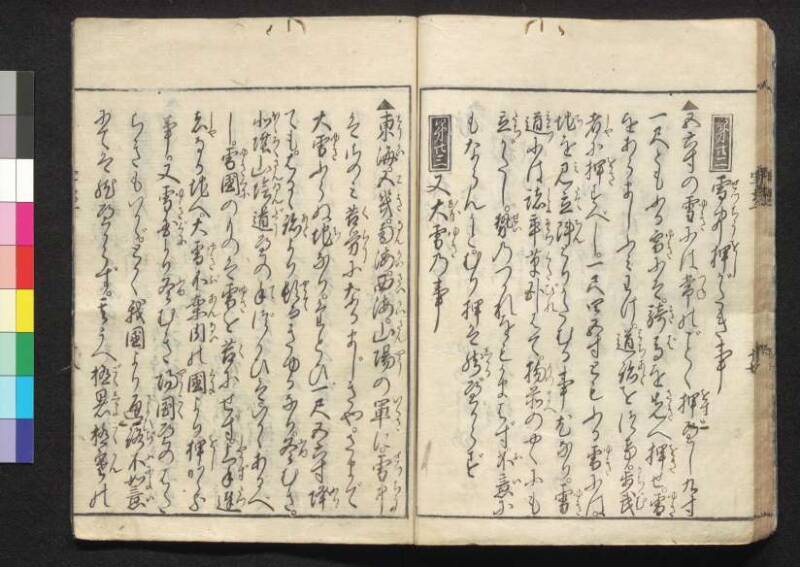
翻刻
【右丁】
《箱:第廿二》雪中(せつちう)押(をし)がたき事
▲五六寸の雪(ゆき)には常(つね)のごとく押(をす)べし九寸
一尺ともふる雪(ゆき)には。騎馬(きば)を先(さき)へ押(をさ)せ。雪(ゆき)
をあらましふみわけ。道跡(みちあと)をつけ。歩武(かちむ)
者(しや)に押(をさ)すべし。一尺四五寸ともふる雪(ゆき)には。
地(ち)を見立(みたて)陣(ちん)とりかたむる事尤なり。雪(ゆき)
道(みち)には諸卒(しよそつ)草臥(くたびれ)はて。物前(ものまへ)のやくにも
立(たち)がたし。勢(せい)のつかれをもかまはず。不意(ふい)に
もならんかと。むり押は然(しかる)べからず
《箱:第廿三》又 大雪(おほゆき)の事
【左丁】
▲東海(とうかい)。五畿(こき)。南海(なんかい)。西海(さいかい)。山陽(さんやう)の軍(いくさ)に。雪中(せつちう)
はさのみ苦労(くらう)になるまじきや。さまで
大 雪(ゆき)ふらぬ地(ち)なり。たとひ一尺五六寸 降(ふり)
ても。はるゝ跡(あと)より頓而(やかて)きゆるなり。冬(ふゆ)むき。
北陸(ほくろく)山陰道(さんゐんだう)への手(て)づかひは。いかゝあるべ
し。雪国(ゆきくに)のものは雪(ゆき)を苦(く)にせず。上手(しやうず)達(たつ)
者(しや)なる地へ。大 雪(ゆき)不案内(ぶあんない)の国(くに)より押(をし)かゝる
事。又 雪国(ゆきぐに)より冬(ふゆ)むき陽国(やうこく)へのはた
らきもいかゞ。とかく我国より通路(かよひぢ)不如意(ふによい)
にては然へからず。其うへ極暑(ごくしよ)極寒(ごくかん)の
現代語訳
【右丁】
《第二十二》雪中での行軍が困難な場合のこと
▲五、六寸(約15〜18cm)の雪であれば、平常通りに行軍すべきである。九寸から一尺(約27〜30cm)ほど降り積もった雪の場合には、騎馬を先に進ませて雪をざっと踏み分け、道筋をつけてから、歩兵を進ませるべきである。一尺四、五寸(約42〜45cm)ほど降り積もった雪の場合には、地形を見定めて陣を構え固めることがもっともである。雪道では諸卒が疲れ果てて、いざという時の戦いの役にも立ちがたい。兵の疲労も構わず、不意(奇襲)のこともあろうかと、無理に押し進めることはよくない。
《第二十三》また、大雪のこと
【左丁】
▲東海道・五畿内・南海道・西海道・山陽道での戦いでは、雪中の行軍はそれほど苦労にはなるまい。それほど大雪が降らない地域だからである。たとえ一尺五、六寸(約45〜48cm)降っても、晴れた後には程なく消えてしまう。冬の季節に、北陸道や山陰道への用兵はいかがなものであろうか。雪国の者は雪を苦にせず、(雪上行軍の)上手な達者な土地へ、雪に不案内な国から攻め掛かることは(非常に不利である)。また、雪国から冬に向かって陽(暖かい)国へ攻め出ることもいかがなものか。とかく、自国からの通路(兵站・往来の道筋)が思うようにならないのでは、よくない。そのうえ、極暑・極寒の(時季の出陣については…)
英語訳
【Right Page】
《Section Twenty-Two》 On the Difficulty of Advancing Through Snow
▲ In snow of five to six sun (approximately 15–18 cm), one should advance as in normal conditions. When the snow has accumulated to nine sun or one shaku (approximately 27–30 cm), the cavalry should be sent ahead to roughly trample through and break a path in the snow, after which the infantry should be made to advance along the trail thus created. When the snow has accumulated to one shaku four or five sun (approximately 42–45 cm), it is most advisable to assess the terrain and establish a firm encampment. On snowy roads, the troops will be utterly exhausted and will be scarcely capable of fighting effectively when the moment comes. Regardless of how urgent the situation may seem—even fearing the possibility of a surprise attack—it is not appropriate to force the army to advance recklessly.
《Section Twenty-Three》 Also, On Heavy Snow
【Left Page】
▲ In campaigns along the Tōkaidō, the Gokinai (Five Home Provinces), the Nankaidō, the Saikaidō, and the Sanyōdō, marching through snow should not present particularly great hardship, as these are regions where heavy snowfall is rare. Even if one shaku five or six sun (approximately 45–48 cm) of snow falls, it will soon melt once the weather clears. What should one think about deploying troops toward the Hokuriku region or the San'in region during the winter season? The people of snow country do not suffer from snow and are well-practiced and skilled in it—to attack such experienced lands from a country unfamiliar with heavy snow would be most disadvantageous. Likewise, what should one think about a snow-country force launching an offensive toward a warmer region during the winter months? In any case, it will not do if the routes of communication and supply from one's own territory are not functioning adequately. Furthermore, regarding campaigns during extreme heat or extreme cold—(continues on the next page)