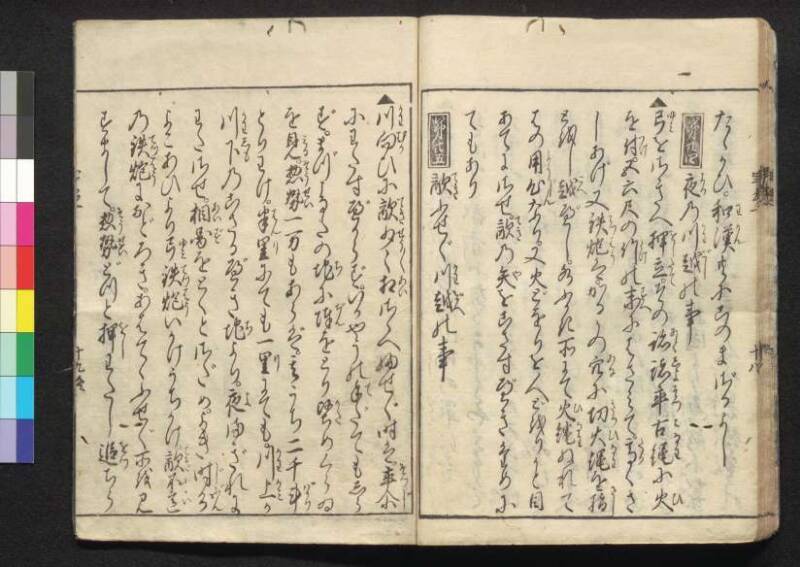
翻刻
【右丁】
たゝかひ。和漢(わかん)共にこのまざるよし
《箱:第廿四》夜(よる)の川越(かわごし)の事
▲弓(ゆみ)をさきへ押立(をしたて)。その跡(あと)諸卒(しよそつ)古縄(こなわ)に火(ひ)
を付(つけ)。五六尺の竹(たけ)の末(すへ)にはさみて。高(たか)くさ
しあげ又 鉄炮(てつはう)は。かるかの穴(あな)に切火縄(きりひなわ)を指(さし)
とをし越(こへ)べし。水ふかき所にて火縄(ひなわ)ぬれて
はの用心(ようじん)なり。又火どをりを人どをりかと目
あてにさせ。敵(てき)の矢(や)をこさすべきために
てもあり
《箱:第廿五》敵(てき)ふせぐ川越(かわごへ)の事
【左丁】
▲川向(かわむか)ひに敵(てき)少々(せう〳〵)相(あい)さゝへふせぐ時は。卒爾(そつじ)
にわたすべからず。いかやうの手(て)だてもしら
ず。まづこなたの地(ち)に陣(ぢん)をとり堅(かた)めくらゐ
を見(みる)。惣勢(そうせい)一万もあらば。其うち二千 計(ばかり)
とりわけ。半里(はんり)にても一 里(り)にても。川上(かわかみ)か
川下(かわしも)のこさるべき地(ち)より。夜(よ)まぎれに
わたさせ。相図(あいず)をとくとさだめ。よき時分(じぶん)
よこあひより弓(ゆみ)鉄炮(てつはう)いかけうちかけ。敵(てき)不意(ふい)
の鉄炮(てつはう)におどろき。あはてゝふせぐ所を見
すまして。惣勢(そうせい)どつと押(をし)わたし追(をつ)ちら
現代語訳
【右丁】
(前ページより続き)極暑・極寒の時の戦いは、日本・中国ともに好まないという。
《第二十四》夜間の川越えのこと
▲弓兵を先頭に押し立てて渡らせ、その後に続く諸卒は、古縄に火をつけ、五、六尺(約150〜180cm)の竹の先端に挟んで高く差し上げながら渡るべきである。また鉄砲は、火縄銃の火薬口(火穴)に切り火縄を差し通したまま越えるべきである。これは、水深の深い場所で火縄が濡れることを防ぐための用心である。また、火の明かりを人の通行であるかのように敵に目標とさせ、敵の矢をそちらへ向けさせるためでもある。
《第二十五》敵を防ぎながら行う川越えのこと
【左丁】
▲川の向こう岸に敵が少数とはいえ陣を構えて防いでいる時は、軽率にわたってはならない。まずはいかなる手段がよいかを考え、こちら側の地に陣を構えて堅め、敵の形勢を見定める。総勢が一万あれば、そのうち二千ほどを選び分けて、半里(約2km)でも一里(約4km)でも、川上か川下の渡れる地点から、夜に紛れて渡らせ、合図をよく定めておき、よい頃合いに横合いから弓・鉄砲を激しく打ちかけ、敵が不意の砲撃に驚いて慌てて防ごうとする隙を見計らって、総勢でどっと押し渡り追い散らす。
英語訳
【Right Page】
(Continued from previous page) Battles fought in extreme heat or extreme cold are said to be undesirable in both Japanese and Chinese military tradition.
《Section Twenty-Four》 On Crossing Rivers at Night
▲ The archers should be sent forward at the head of the crossing. The troops following behind should light old rope as torches, clamp them into the tips of bamboo poles five or six shaku (approximately 150–180 cm) in length, and hold them aloft as they cross. As for the arquebusiers, they should pass through the river with a cut slow-match inserted into the touch-hole of the firearm. This is a precaution to prevent the slow-match from being extinguished by water in deep sections of the river. Furthermore, this arrangement also serves to make the enemy direct their arrows toward the lights, mistaking them for the actual location of the crossing troops.
《Section Twenty-Five》 On Crossing a River Against Enemy Resistance
【Left Page】
▲ When the enemy has stationed even a small defensive force on the far bank of the river, one must not attempt to cross rashly. Without first determining what strategy to employ, one should begin by establishing and securing an encampment on one's own side of the river, and carefully observe the enemy's position. If the total force numbers ten thousand, one should detach approximately two thousand of them and have them cross under cover of night from a suitable point either half a ri (approximately 2 km) or one ri (approximately 4 km) upstream or downstream. Having established clear signals in advance, at the right moment these troops should unleash a fierce barrage of arrows and arquebus fire from the flank. Then, watching for the moment when the enemy is thrown into confusion by this unexpected attack and rushes to defend against it, the main force should surge across the river all at once and scatter the enemy.