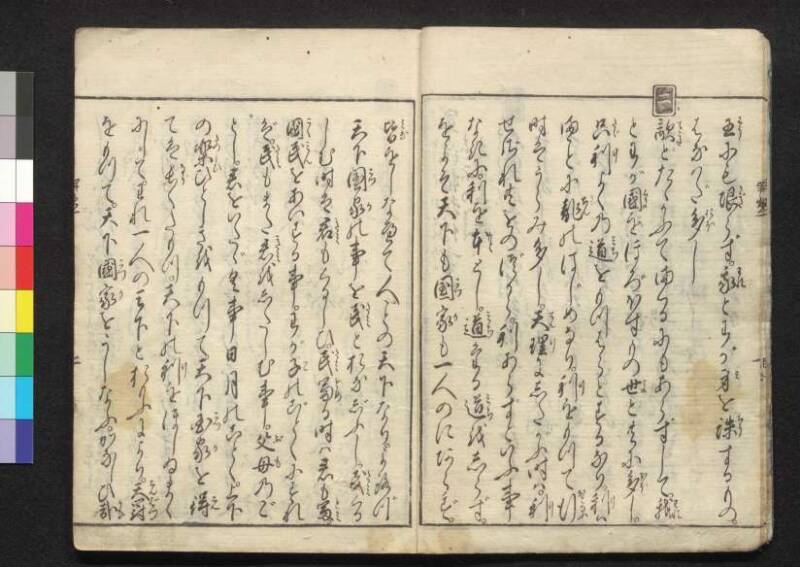
翻刻
【右丁】
王(わう)にも限(かぎ)らず。我(われ)とわが身(み)を誅(ちう)するもの。
はなはだ多(おお)し
《箱:二》敵(てき)とたゝかふてまくるにもあらずして。我(われ)
とわが国(くに)をほろ#2ぼすもの世(よ)と共に多(おお)し。
只(たゞ)利(り)よくの道(みち)をもつはらとするなり。利(り)は
まことに乱(らん)のはじめなり。利(り)をもつて行(おこなふ)
時はうらみ多し。天理(てんり)にしたがふ時は。利(り)
せざれ共をのづから。利あらずといふ事
なきに。利を本(もと)とし。道(みち)たる道(みち)をしらず。
をよそ天下も国家(こつか)も一人のにあらず。
【左丁】
皆(みな)をしなへて人ごとの天下なり。よろづ
天下 国家(こつか)の事を民(たみ)とおなじふし。民(たみ)くる
しむ時は君(きみ)もくるしひ。民(たみ) 富(とめ)る時は君も富(とみ)。
国民(こくみん)をあいする事。わが子(こ)のごとくにすれ
ば。民(たみ)もまた君(きみ)をしたしむ事。父母(ぶも)のご
とし。君をいたゞく事日月のことく。上下
の楽(たのしひ)ひとしきをもつて。天下 国家(こつか)を得(え)
ては長(なが)くたもつ。天下の利(り)をほしゐまゝ
にして。われ一人の天下とおもふにより。天罰(てんばつ)
をもつて。天下 国家(こつか)をうしなふ。かなしひ哉(かな)
現代語訳
【右丁】
(桀王・紂王に限らず、)自ら我が身を滅ぼす者は、世に非常に多い。
二、敵と戦って負けるわけでもないのに、自ら我が国を滅ぼす者は、世にともに多い。ただ、利益・私欲の道を専らとするからである。利は、まことに乱の始まりである。利によって物事を行う時は怨みが多い。天の理(ことわり)に従う時は、利を求めずとも自然と、利がないということはないのに——利を根本とし、(人として歩むべき)真の道を知らないのである。およそ天下も国家も、一人のものではない。
【左丁】
すべての人、一人ひとりの天下である。万事、天下・国家のことを民と共にし、民が苦しむ時は君も苦しみ、民が富む時は君も富む。国民を愛することをわが子のようにすれば、民もまた君を親しむことは父母のようである。君をいただくことは日月のようであり、上下の楽しみが等しいことをもって、天下・国家を得ては長く保つ。(しかし)天下の利を欲しいままにして、自分一人の天下と思うことにより、天罰をもって天下・国家を失う。悲しいことよ。
英語訳
【Right Page】
(Not limited to King Jie and King Zhou,) those who bring ruin upon themselves are exceedingly numerous throughout the world.
Two: Those who destroy their own country, not through defeat in battle against an enemy, but through their own hand, are likewise numerous throughout the ages. This is solely because they make the pursuit of profit and personal desire their primary concern. Profit is truly the beginning of disorder. When one acts on the basis of profit, resentment multiplies. When one follows the principles of Heaven, even without seeking profit, there will naturally never be a lack of it — and yet, (such rulers) make profit their foundation and do not know the true Way (that a person ought to walk). In general, neither the realm nor the state belongs to any single person.
【Left Page】
The realm belongs equally to all people, to every last person. In all matters concerning the realm and the state, (the ruler) should share the same lot as the people: when the people suffer, the ruler too suffers; when the people prosper, the ruler too prospers. If one loves the people of the nation as one's own children, then the people in turn will hold affection for the ruler as they would for a father and mother. To receive a ruler above oneself is like having the sun and moon overhead. When the joys of those above and those below are equal, one obtains the realm and the state and preserves them for a long time. But when one indulges in monopolizing the benefits of the realm and thinks of it as one's own private possession alone, Heaven's punishment will follow, and the realm and state will be lost. How lamentable!