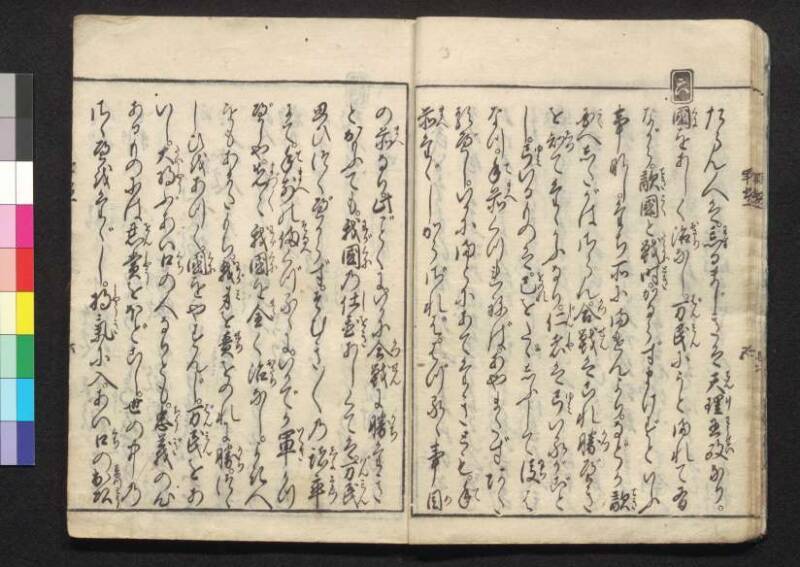
翻刻
【右丁】
たらん人は。忘(わす)るまじきは天理(てんり)王政(わうせい)なり。
《箱:六》国(くに)をあしく治(おさめ)なし。万民(ばんみん)にうとまれて有
ながら。敵国(てきこく)と戦時(たゝかふとき)。かならずまけずといふ
事なし。たち所にまけんより。などか敵(てき)
国(こく)へしたがはさらん。合戦(かつせん)はこれ勝(かつ)べき
を知(しつ)てたゝかふなり。仁者(じんしや)は弓(ゆみ)いるがごと
し。弓(ゆみ)いるものは。己(をのれ)をたゞしふして後(のち)は
なつ。手前(てまへ)くつれねば。あやまたずあた
るべし。いかにまとにあてたきとも。手(て)
前(まへ)たゞしからざれば。はづるゝ事 目(め)
【左丁】
の前(まへ)なり。此ごとくに。いかに合戦(かつせん)に勝(かち)たき
とおもふても。我国(わがくに)の仕置(しをき)あしくては。万民(ばんみん)
思ひつくべからず。そむき〳〵の諸卒(しよそつ)
にて。手前(てまへ)の備(そなへ)くづるゝに。いかでか軍(いくさ)かつ
べしや。先々(まづ〳〵)我国(わがくに)を全(また)く治(おさめ)なし。よき人
をもあまたもち。我身(わがみ)を責(せめ)をのれに勝(かち)。つゝ
しひをあつく。国(くに)をやすんじ。万民(ばんみん)をあ
いし。大将(たいしやう)ぶあい口(くち)の人なりとも。忠義(ちうぎ)の心
あるものには恩賞(をんしやう)をほどこし。世の中の
さゝへをたゞし。将(しやう)気(き)に入。あい口(くち)の出頭(しゆつとう)
現代語訳
【右丁】
……将たる者が忘れてはならないのは、天理(自然の道理)と王政(仁にもとづく政治)である。
《箱:六》国をおろそかに治め、万民に疎まれていながら、敵国と戦う時に必ず負けないとは言い切れない。すぐさま負けるくらいならば、なぜ敵国に従わないのか。合戦とは、勝てると知ってから戦うものである。仁者(仁徳ある者)は弓を射るようなものである。弓を射る者は、まず己の姿勢を正してから矢を放つ。手元が乱れなければ、必ず的に当たるはずだ。いかに的に当てたくとも、手元が正しくなければ、外れることは目に
【左丁】
見えている。このように、いかに合戦に勝ちたいと思っても、自国の仕置き(政治・統治)が悪くては、万民が心服することはない。(兵たちが)次々と背いていく諸卒では、手元の備えが崩れてしまい、どうして戦に勝てようか。まずは自国をしっかりと治め、よき人材を多く持ち、我が身を律し己に打ち克ち、慎みを厚くし、国を安定させ、万民を愛し、たとえ大将の覚えめでたい気に入りの人物であっても、忠義の心ある者には恩賞を施し、世の中の綱紀を正し、将の気に入り・覚えめでたい者の出世(頭角を現すこと)……
英語訳
【Right Page】
…What a commander must never forget is tenri (the principle of Heaven, natural order) and ōsei (benevolent kingship, righteous governance).
《Box: Six》 To govern one's country poorly, to be despised by the ten thousand people, and yet to claim that one will never lose when fighting against an enemy state — this cannot be guaranteed. If one is to suffer immediate defeat regardless, why not simply submit to the enemy state? Battle is something one enters only when one knows one can win. A benevolent person (jinsha) is like one who draws a bow. One who draws a bow first straightens his own posture, and only then releases the arrow. If his form does not waver, the arrow will surely find its mark without fail. No matter how desperately one wishes to strike the target, if one's form is not correct, missing the mark is plain for all
【Left Page】
to see. In exactly the same way, no matter how fervently one wishes to win in battle, if the governance of one's own country is poor, the ten thousand people will not give their hearts to the cause. With troops who repeatedly turn away in defiance, if one's own formations crumble, how can one possibly win a war? First and foremost, one must govern one's own country thoroughly and well, gather many capable people, discipline oneself and conquer one's own weaknesses, cultivate deep prudence, bring stability to the nation, love the ten thousand people, and — even toward those who are favored companions of the commander — bestow rewards and recognition upon those who possess hearts of loyalty and righteousness, correct the moral order of the realm, and (be wary of) the rise to prominence of those who are merely the commander's favorites and close companions…