翻刻
【右丁】
白紙
【左丁】
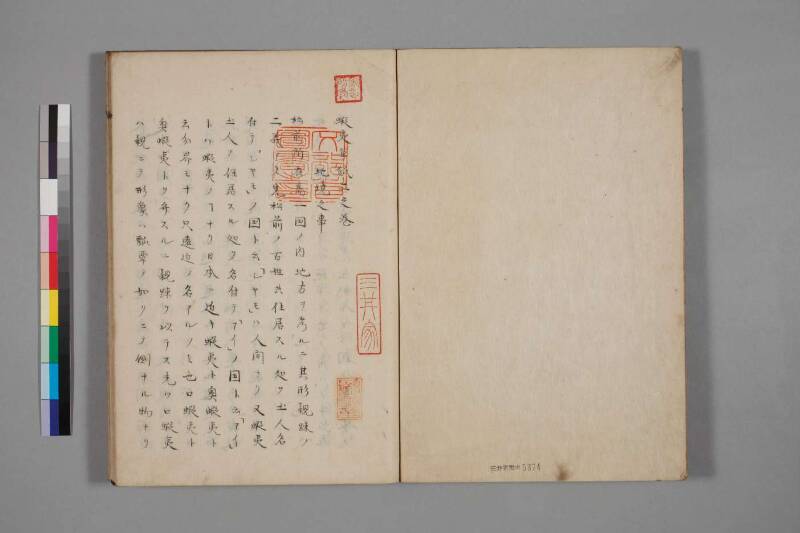
【蔵書印】上から宗辰所集 文部省図書之印 三井家 総𠧱#1舎蔵書印
蝦夷草紙二之巻
地境之事
松前所在島一国ノ内地方ヲ考ルニ其形親疎ノ
二義アリ先松前ノ百姓共住居スル処ヲ土人名
付テ「シヤモ」ノ国ト云「シヤモ」ハ人間ナリ又蝦夷
土人ノ住居スル処ヲ名付テ「アイ」ノ国ト云「アイ」
トハ蝦夷ノヿナリ日本ニ近キ蝦夷ト奥蝦夷ト
云分界モナク只遠近ノ名アルノミ也口蝦夷ト
奥蝦夷トヲ弁スルニ親疎ヲ以テス先ツ口蝦夷
ハ親ニテ形象ハ瓢覃ノ如クニテ側ナル物ナリ
現代語訳
【右丁】
白紙
【左丁】
【蔵書印】(上から)宗辰所集・文部省図書之印・三井家・総簇舎蔵書印
蝦夷草紙 第二巻
地域の境界について
松前に所在する島(北海道)一国の内、地方の区分を考えてみると、その区別には「親(近い)」と「疎(遠い)」の二つの意味がある。まず、松前の百姓たちが居住する場所を、土地の人々は「シャモ」の国と呼ぶ。「シャモ」とは人間(和人)のことである。また、蝦夷の土人(先住民)が居住する場所を「アイ」の国と呼ぶ。「アイ」とは蝦夷のことである。日本(和人地)に近い蝦夷地と奥蝦夷地との間には、はっきりとした分界線があるわけではなく、ただ遠い・近いという名称があるだけである。口蝦夷と奥蝦夷を区別するには、「親(近い)」と「疎(遠い)」をもって判断する。まず、口蝦夷は「親(近い)」であり、その形は瓢箪のようで、(本州に)傍らに寄り添うような形のものである。
英語訳
【Right Folio】
Blank page
【Left Folio】
【Library Seals】(from top) Sōshin Collection; Ministry of Education Library Seal; Mitsui Family; Sōzoku-sha Library Seal
Ezo Sōshi, Volume 2
On the Boundaries of the Territories
When considering the regional divisions within the island of Matsumae (Hokkaido), there are two concepts of distinction: "close" (kin/intimate) and "distant" (remote). First, the place where the commoners (farmers) of Matsumae reside is called by the local people the land of "Shyamo." "Shyamo" means human beings (i.e., Japanese settlers, Wajin). Furthermore, the place where the indigenous Ezo people reside is called the land of "Ai." "Ai" refers to the Ezo people. There is no clear boundary between the Ezo lands close to Japan (Wajin territory) and the deeper Ezo lands; there are only names denoting nearness and distance. To distinguish between the "outer Ezo" (Kuchi-Ezo) and the "inner Ezo" (Oku-Ezo), the concepts of "close" and "distant" are used. The outer Ezo (Kuchi-Ezo) is "close," and its shape resembles a gourd, situated alongside (the Japanese mainland) in appearance.