翻刻
【右丁】
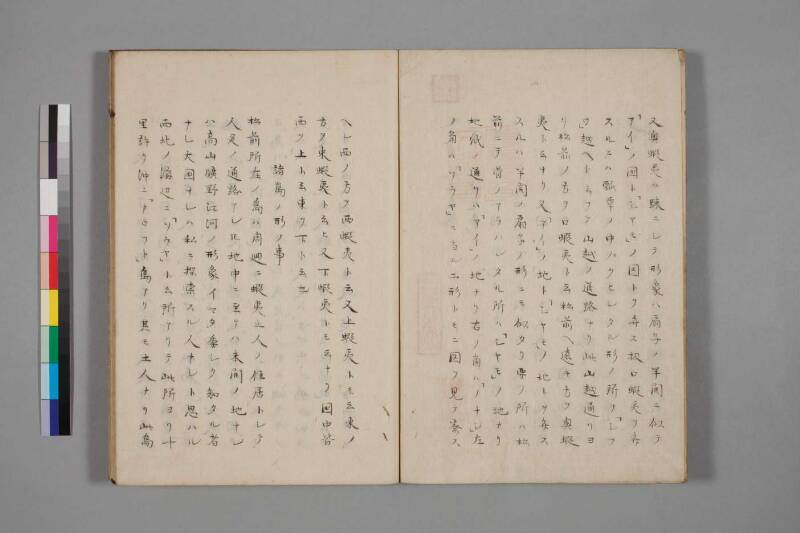
又奥蝦夷ハ疎ニシテ形象ハ扇子ノ半開ニ似テ
「アイ」ノ国ト「シヤモ」ノ国トヲ弁ス扨口蝦夷ヲ弁
スルニハ瓢覃ノ中ハクヒレタル形ノ所ヲ「シフ
ワ」越ヘト云フテ山越ノ通路ナリ此山越通リヨ
リ松前ノ方ヲ口蝦夷ト云松前ヘ遠キ方ヲ奥蝦
夷ト云ナリ又「アイ」ノ地ト「シヤモ」ノ地トヲ弁ス
スルハ半開ノ扇子ノ形ニモ似タリ要ノ所ハ松
前ニテ骨ノアラハシタル所ハ「シヤモ」ノ地ナリ
地紙ノ通リハ「アイ」ノ地ナリ右ノ角ハ「ノナシ」左
ノ角ハ「ソウヤ」ニ当ル二形トモニ図ヲ見テ察ス
【左丁】
ヘシ西ノ方ヲ西蝦夷ト云又上蝦夷トモ云東ノ
方ヲ東蝦夷ト云ヒ又下蝦夷トモ云ナリ国中皆
西ヲ上ト云東ヲ下ト云也
諸島ノ形ノ事
松前所在ノ島ハ周廻ニ蝦夷土人ノ住居トシテ
人足ノ通路アレ𪜈地中ニ至テハ未開ノ地ナレ
ハ高山曠野江河ノ形象イマタ委シク知タル者
ナシ大国ナレハ私ニ探索スル人ナシト思ハル
西北ノ海辺ニ「ソウヤ」ト云所アリテ此所ヨリ十
里許リ沖ニ「カロフト」島アリ其モ土人ナリ此島
現代語訳
【右丁】
また奥蝦夷は(日本と)疎遠であり、その形は扇子の半開きに似ている。「アイ」の国と「シャモ」の国を区別する方法を述べよう。まず口蝦夷を区別するには、瓢箪のくびれた部分を「シフワ越え」と言い、これは山越えの通路である。この山越えの通路より松前の方向を口蝦夷と言い、松前から遠い方を奥蝦夷と言う。また「アイ」の地と「シャモ」の地を区別するには、半開きの扇子の形にも似ている。要(かなめ)の部分が松前であり、骨の露わになっている部分が「シャモ」の地である。地紙(扇面の紙の部分)に当たるところが「アイ」の地である。右の角(端)は「ノナシ」、左の角は「ソウヤ」に当たる。この二つの形(瓢箪と扇子)はともに図を見て理解されたい。
【左丁】
西の方を西蝦夷と言い、また上蝦夷とも言う。東の方を東蝦夷と言い、また下蝦夷とも言う。国中すべて西を上と言い、東を下と言う。
諸島の形について
松前に所在する島(北海道)は、周囲には蝦夷の土地の人々の住居があり人の通路もあるが、内陸に至っては未開の地であるため、高山・広野・河川の様子はいまだ詳しく知っている者がいない。大きな国であるから、個人で探索する人もいないと思われる。西北の海辺に「ソウヤ」という所があり、その沖合十里ほどのところに「カラフト」島がある。そこもまた土地の人々(アイヌ)が住んでいる。この島は
英語訳
【Right Folio】
Oku-Ezo (the deeper Ezo lands) is the more remote region, and its shape resembles a half-opened fan. Let us now explain how to distinguish between "Ai" country and "Shamo" country. To distinguish Kuchi-Ezo, the narrowed, pinched part of the gourd shape is called the "Shifuwa Pass," which is a mountain crossing route. The area on the Matsumae side of this mountain pass is called Kuchi-Ezo, and the area farther from Matsumae is called Oku-Ezo. Furthermore, to distinguish "Ai" land from "Shamo" land, this too resembles the shape of a half-opened fan. The pivot (kaname) of the fan represents Matsumae; the exposed ribs of the fan represent "Shamo" land; and the paper surface of the fan (the spread portion) represents "Ai" land. The right corner (tip) corresponds to "Nonashi," and the left corner corresponds to "Sōya." Both of these shapes (the gourd and the fan) should be understood by referring to the illustrations.
【Left Folio】
The western side is called Nishi-Ezo (Western Ezo), and is also referred to as Kami-Ezo (Upper Ezo). The eastern side is called Higashi-Ezo (Eastern Ezo), and is also referred to as Shimo-Ezo (Lower Ezo). Throughout this land, west is universally referred to as "upper" and east as "lower."
On the Shape of the Various Islands
The island of Matsumae (Hokkaido) has Ezo indigenous settlements and pathways along its perimeter, but as one ventures into the interior, the land remains undeveloped, and no one yet has detailed knowledge of its high mountains, vast plains, and rivers. Being such a large land, it is thought that there are no individuals who explore it privately. On the northwestern shore there is a place called "Sōya," and approximately ten ri offshore from there lies the island of "Karafuto." That island too is inhabited by indigenous people (Ainu). This island —