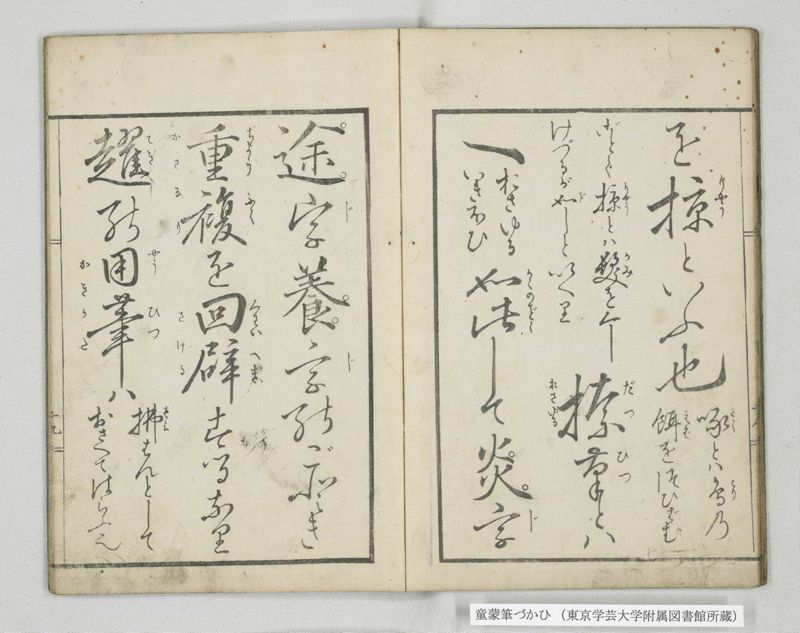
翻刻
【右丁】
を掠(りやう)といふ也 《割書:啄(たく)とは鳥(とり)の|餌(えさ)をつひばむ》
《割書:ごとく掠(りやう)とは髪(かみ)をくし|けづるが如(ごと)しといへり》捺(だつ
)筆(ひつ)とは
《割書:おさゆる|いきほひ》 如此(かくのごとく)して炎()字(じ)
【左丁】
途()字(じ)養()字(じ)のごとき
重複(ちようふく)を回辟(くわいへき)するなり
趯(てき)の用筆(やうひつ)は《割書:拂(はら)はんとして|おさへてはらふなり》
現代語訳
【右丁】
(前ページより続き)を「掠(りょう)」という。
〔割書:「啄(たく)」とは鳥が餌をつついばむようなもの、「掠(りょう)」とは髪をくしでけずるようなものだと言われている。〕
「捺筆(だっぴつ)」とは、
〔割書:押さえるような勢いで〕このようにして「炎」という字の
【左丁】
「途」という字、「養」という字のような
重複(筆画が重なること)を避けるためのものである。
「趯(てき)」の用筆(筆の使い方)は、〔割書:払おうとしながら、押さえてから払うのである。〕
英語訳
[Right page]
(Continued from previous page) ...is called "ryō" (掠, skimming stroke).
[Marginal note: "Taku" (啄, pecking stroke) is like a bird pecking at food; "ryō" (掠, skimming stroke) is said to be like combing one's hair with a comb.]
"Datsu-hitsu" (捺筆, pressing stroke) refers to:
[Marginal note: with a pressing force] — executed in this manner, as in the character "炎" (flame),
[Left page]
and characters such as "途" (path) and "養" (nurture),
it serves to avoid overlapping (repetition of strokes).
The brush technique for "teki" (趯, the hooking flick stroke) is as follows: [Marginal note: Just when one is about to sweep the brush away, one first presses down and then sweeps.]