翻刻
【右頁】
◯雪(ゆき)霰(あられ)の叓
水氣(すゐき)空中(くうちう)に騰(のぼ)りて寒(さむ)さの為(ため)に凝(こ)りて已(すで)に
雨(あめ)に化(くわ)せんとする時(とき)其(その)寒氣(かんき)別(べつ)して厳(きび)しけ
れば雨(あめ)とならずして雪(ゆき)となる其(その)雪(ゆき)の形(かたち)も
東風(ひがしかせ)と東北風(ひがしきたかぜ)の時(とき)は別(べつ)して美麗(びれい)なるは此(この)
時(とき)空中(くうちう)越歴(ゑれき)を発(はつ)すること最(さ)も多(おほ)き故(ゆへ)也(なり)雪(ゆき)も
唯(たゞ)見(み)ては白(しろ)く綿(わた)のやうなれ共(ども)よき目鏡(めがね)に
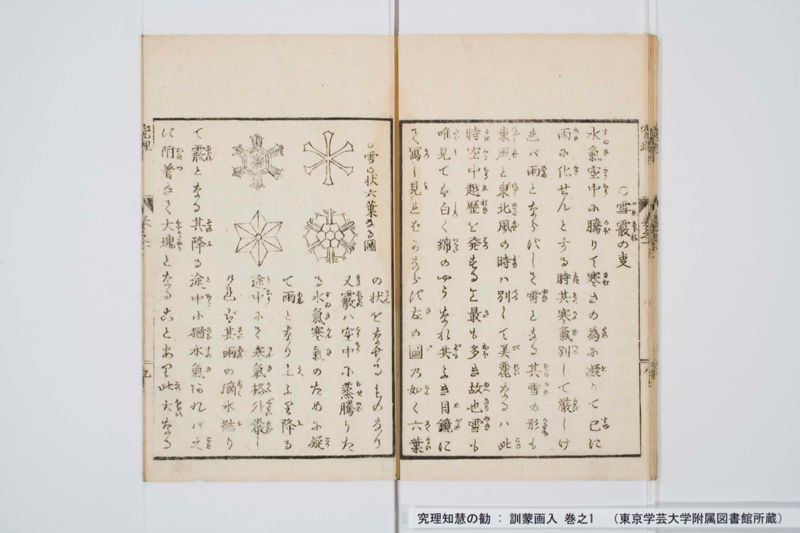
て寫(うつ)し見(み)ればかならず左(さ)の圖(づ)の如(こと)く六葉(ろくまい)
【左頁】
【上段 雪の圖の説明 四圖あり】
◯雪の状六葉なる圖
【下段 以下の文は前頁の続き】
の状(かたち)をなせるものなり
又(また)霰(あられ)は空中(くうちう)に蒸騰(むせのぼ)りた
る水氣(すゐき)寒氣(かんき)のために凝(こり)
て雨(あめ)となり上(うへ)より降(ふ)る
途中(とちう)にて寒氣(かんき)格外(かくぐわい)厳(きび)し
ければ其(その)雨(あめ)の滴(しづく)氷【(こ)脱ヵ】結(ほ)り
て霰(あられ)となる其(その)降(ふ)る途中(とちう)に猶(なほ)水氣(すゐき)あれば之(これ)
に附着(ひきつ)きて大塊(おほかたまり)となることあり此(この)大(おほひ)なる
現代語訳
【右頁】
○雪と霰について
水気が空中に上昇して寒さのために凝り、すでに雨になろうとする時、その寒気が特に厳しければ雨とならずに雪となる。その雪の形も東風と東北風の時は特に美しいのは、この時空中に電気を発することが最も多いためである。雪もただ見ては白く綿のようであるが、よい拡大鏡で写し見れば必ず下の図のように六枚
【左頁】
【上段 雪の図の説明 四図あり】
○雪の状態が六枚である図
【下段 以下の文は前頁の続き】
の形をなしたものである。
また霰は空中に蒸発上昇した水気が寒気のために凝って雨となり、上より降る途中で寒気が格外に厳しければ、その雨の滴が氷結して霰となる。その降る途中になお水気があればこれに付着して大きな塊となることがある。この大きな
英語訳
【Right page】
○ On Snow and Hail
When water vapor rises into the air and condenses due to cold, and is about to become rain, if the cold air is particularly severe, it does not become rain but becomes snow. The shape of the snow is especially beautiful during easterly and northeasterly winds because at these times the air generates the most electricity. Snow appears white and cotton-like when simply observed, but when examined through a good magnifying glass, it invariably takes the shape of six petals as shown in the diagram below.
【Left page】
【Upper section: Explanation of snow diagrams with four illustrations】
○ Diagram showing snow in six-petal form
【Lower section: Continuation of text from previous page】
such is its form.
Also, hail occurs when water vapor that has evaporated and risen into the air condenses due to cold air to become rain, but if during its descent from above the cold air is exceptionally severe, those raindrops freeze and become hail. If there is still water vapor during the descent, it can attach to the hail and form large masses. These large