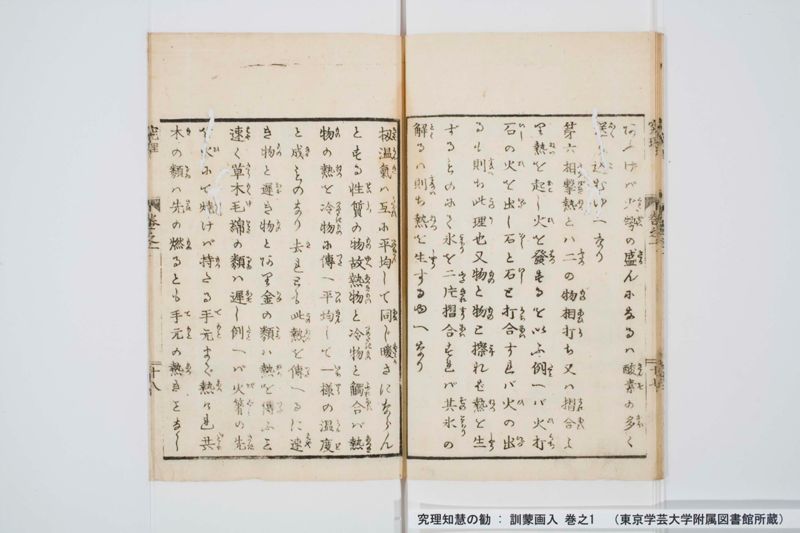
翻刻
【右頁】
あふげば火㔟(くわせい)の盛(さか)んになるは酸素(さんそ)の多(おほ)く
送(おく)り込(こ)むゆへなり
第六 相撃熱(さうげきねつ)とは二(ふたつ)の物(もの)相打(あひう)ち又は摺合(すれあひ)た
り熱(ねつ)を起(おこ)し火(ひ)を發(はつ)するをいふ例(たと)へば火打(ひうち)
石(いし)の火(ひ)を出(いだ)し石(いし)と石(いし)と打合(うちあい)すれば火(ひ)の出(いづ)
るも則(すなは)ち此(この)理(り)也又 物(もの)と物(もの)と擦(こす)れば熱(ねつ)を生(しやう)
ずるものにて氷(こほり)を二片(ふたきれ)摺合(すりあは)すれば其氷(そのこほり)の
解(とく)るは則(すなは)ち熱(ねつ)を生(しやう)するゆへなり
【左頁】
扨(さて)温氣(うんき)は互(たがひ)に平均(へいきん)して同(おな)じ暖(あたゝか)さにならん
とする性質(せいしつ)の物(もの)故(ゆへ)熱物(あつきもの)と冷物(つめたきもの)と觸合(ふれあは)ば熱(あつき)
物(もの)の熱(ねつ)を冷物(つめたきもの)に傳(つた)へ平均(へいきん)して一様(いちやう)の温度(うんど)
と成(なる)ものなり去(さ)れとも此(この)熱(ねつ)を傳(つた)へるに速(はや)
き物(もの)と遲(おそ)き物(もの)とあり金(かね)の類(るゐ)は熱(ねつ)を傳(つた)ふこと
速(はや)く草木(さうもく)毛(け)綿(わた)の類(るゐ)は遲(おそ)し例(たと)へば火箸(ひばし)の先(さき)
を火(ひ)にて焼(や)けば持(もつ)たる手元(てもと)まで熱(あつ)けれ共(ども)
木(き)の類(るゐ)は先(さき)の燃(もゆ)るとも手元(てもと)の熱(あつ)きことなし
現代語訳
【右頁】
あおげば火勢が盛んになるのは酸素を多く送り込むためである。
第六 摩擦熱とは二つの物が相打ったり擦れ合ったりして熱を起こし火を発することをいう。例えば火打石が火を出したり、石と石とを打ち合わせれば火が出るのもまさにこの理屈である。また物と物とを擦れば熱を生じるものであって、氷を二片擦り合わせればその氷が溶けるのはまさに熱を生じるためである。
【左頁】
さて温気は互いに平均して同じ暖かさになろうとする性質のものであるため、熱い物と冷たい物とが触れ合えば熱い物の熱を冷たい物に伝えて平均し、一様の温度となるものである。しかしながらこの熱を伝えるのに速い物と遅い物とがある。金属の類は熱を伝えることが速く、草木・毛・綿の類は遅い。例えば火箸の先を火で焼けば持っている手元まで熱くなるが、木の類は先が燃えても手元が熱くなることはない。
英語訳
【Right page】
When you fan the fire, the flames become vigorous because more oxygen is being supplied.
Sixth: Friction heat refers to when two objects strike against each other or rub together, generating heat and producing fire. For example, flint producing sparks, or when stones are struck together and fire emerges - this follows exactly this principle. Also, when objects rub against each other, they generate heat, and when two pieces of ice are rubbed together, the ice melts precisely because heat is generated.
【Left page】
Now, heat has the property of equalizing mutually to achieve the same temperature, so when a hot object and a cold object come into contact, the heat from the hot object is transmitted to the cold object, equalizing to create a uniform temperature. However, there are materials that conduct this heat quickly and others that conduct it slowly. Metals conduct heat rapidly, while plants, fur, and cotton conduct it slowly. For example, when the tip of fire tongs is heated in a fire, even the handle you're holding becomes hot, but with wood, even when the tip is burning, the handle does not become hot.