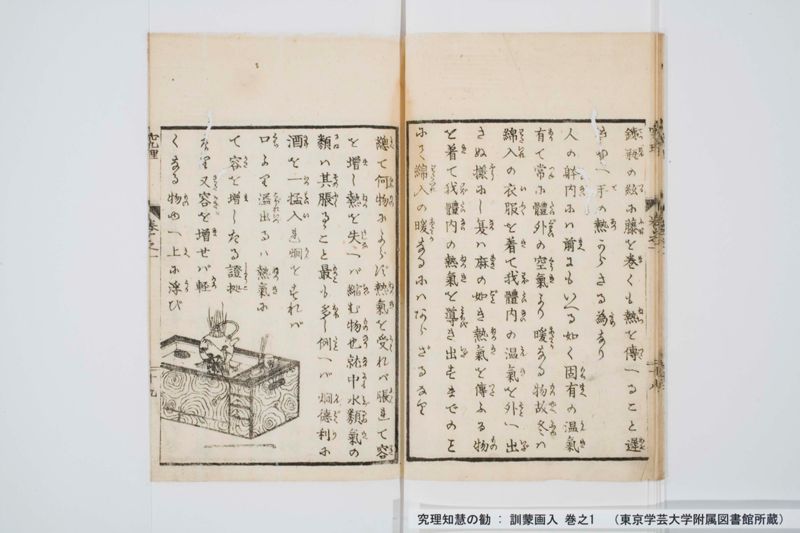
翻刻
【右頁】
銕瓶(てつびん)の絃(つる)に藤(ふぢ)を巻(ま)くも熱(ねつ)を傳(つた)へること遅(おそ)
きゆへ手(て)の熱(あつ)からさる為(ため)なり
人の躰内(た?いない)には前(まへ)にもいへる如く固有(もちまへ)の温氣(うんき)
有(あり)て常(つね)に體外(たいぐわい)の空氣(くうき)より暖(あたゝか)なる物(もの)故(ゆへ)冬(ふゆ)は
綿入(わたいれ)の衣服(いふく)を着(き)て我(わが)體内(たいない)の温氣(うんき)を外(そと)へ出(いだ)
さぬ様(やう)にし夏(なつ)は麻(あさ)の如(ごと)き熱氣(ねつき)を傳(つた)ふる物(もの)
を着(き)て我(わが)體内(たいない)の熱氣(ねつき)を導(みちび)き出(いだ)すまでのこと
にて綿入(わたいれ)の暖(あたゝか)なるにはあらざるなり
【左頁】
總(すべ)て何物(なにもの)によらず熱氣(ねつき)を受(うく)れば脹(ふく)れて容(かさ)
を増(ま)し熱(ねつ)を失(うしな)へば縮(ちゞ)む物(もの)也(なり)就中(なかにも)水類(みずるゐ)氣(き)の
類(るゐ)は其(その)脹(ふく)るゝこと最(もつと)も多(おほ)し例(たと)へば燗徳利(かんどくり)に
酒(さけ)を一㮎(いつはい)入(い)れ燗(かん)をすれば
口(くち)より溢出(こぼれいづ)るは熱氣(ねつき)に
て容(かさ)を増(ま)したる證拠(しようこ)
なり又(また)容(かさ)を増(ま)せば軽(かろ)
くなる物(もの)ゆへ上(うえ)に浮(うか)び
現代語訳
【右頁】
鉄瓶の持ち手に藤を巻くのも、熱を伝えることが遅いため、手が熱くならないようにするためである。
人の体内には前にも言った通り固有の体温があって、常に体外の空気より暖かいものであるから、冬は綿入りの衣服を着て我々の体内の温気を外へ出さないようにし、夏は麻のような熱気を伝えやすい物を着て我々の体内の熱気を導き出すまでのことであって、綿入りの衣服自体が暖かいわけではないのである。
【左頁】
すべて何物によらず熱気を受ければ膨らんで体積を増し、熱を失えば縮むものである。中でも水類や気体の類はその膨らむことが最も多い。例えば燗徳利に酒を一杯入れて燗をすれば口より溢れ出るのは、熱気によって体積を増した証拠である。また体積を増せば軽くなるものであるから上に浮かび
英語訳
【Right page】
The reason why rattan is wrapped around the handle of iron kettles is also because it conducts heat slowly, preventing the hands from becoming hot.
As mentioned before, the human body has its own inherent body temperature and is always warmer than the outside air. Therefore, in winter we wear cotton-padded clothing to prevent our body's warmth from escaping outside, and in summer we wear materials like hemp that conduct heat well to allow our body's heat to be drawn out. This does not mean that the cotton-padded clothing itself is warm.
【Left page】
In general, regardless of what material it is, when it receives heat it expands and increases in volume, and when it loses heat it contracts. Among these, water and gases expand the most. For example, when you fill a sake warming bottle with sake and heat it, the sake overflows from the mouth because the heat has increased its volume, which is evidence of this principle. Also, when volume increases, things become lighter, so they float upward