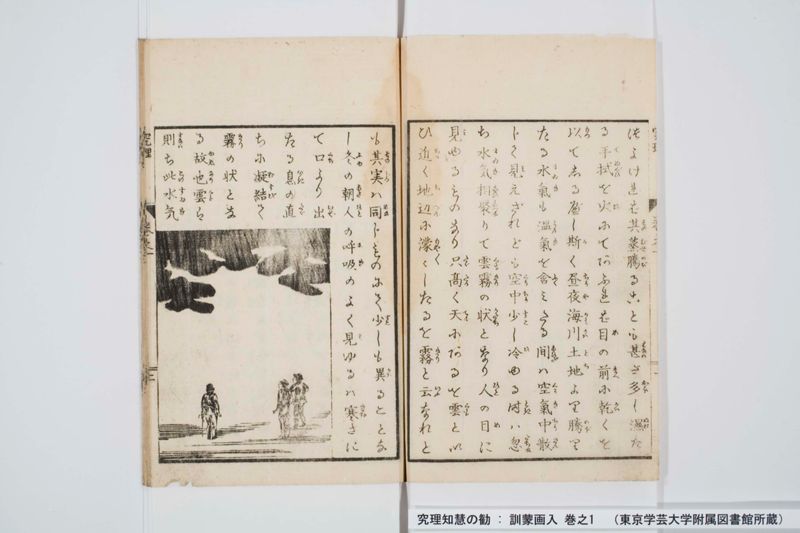
翻刻
【右頁】
つよければ其(その)蒸(むせ)騰(のぼ)ることも甚(はなは)だ多(おほ)し湿(ぬれ)た
る手拭(てぬぐひ)を火(ひ)にてあふれば目(め)の前(まへ)に乾(かわ)くを
以(もつ)てしるべし斯(か)く昼夜(ちうや)海川(うみかは)土地(とち)より騰(のぼ)り
たる水氣(すゐき)も温氣(たんき)を含(ふく)みたる間(あひだ)は空氣中(くうきちう)散(さん)
じて見(み)えざれども空中(くうちう)少(すこ)し冷(ひ)ゆる時(とき)は忽(たちま)
ち水気(すゐき)相聚(あひあつま)りて雲霧(くもきり)の状(かたち)となり人(ひと)の目(め)に
見(み)ゆるものなり只(ただ)高(たか)く天(てん)にあるを雲(くも)とい
ひ近(ちか)く地辺(ちへん)に濛々(もや〳〵)したるを霧(きり)と云(いふ)なれと
も其実(そのじつ)は同(おな)じものにて少(すこ)しも異(かは)ることな
し冬(ふゆ)の朝(あさ)人(ひと)の呼吸(ゑき)のよく見(み)ゆるは寒(さむ)さに
て口(くち)より出(いで)
たる息(いき)の直(たゞ)
ちに凝結(むすび)て
霧(きり)の状とな
る故(ゆゑ)也(なり)雲(くも)は
即(すなは)ち此(この)水気(すゐき)
現代語訳
【右頁】
強ければその蒸発することも非常に多い。濡れた
手拭いを火にかざせば目の前で乾くことで
分かるだろう。このように昼夜、海や川、土地から上った
水蒸気も温気を含んでいる間は空気中に散
らばって見えないが、空中が少し冷える時には、たちまち
水蒸気が集まって雲や霧の形となり、人の目に
見えるものである。ただ高く天にあるものを雲とい
い、近く地面の辺りにもやもやしているものを霧というけれ
ども、その実態は同じものであって少しも違うことはな
い。冬の朝、人の呼吸がよく見えるのは寒さによ
って口から出た
息がすぐに
凝結して
霧の状態とな
るためである。雲は
すなわちこの水蒸気が
英語訳
【Right page】
When it is strong, the amount of evaporation is also very great. You can understand this by observing how a wet hand towel dries right before your eyes when held over a fire. In this way, water vapor that rises day and night from seas, rivers, and land remains invisible, scattered in the air while it contains warm air, but when the air becomes slightly cooler, the water vapor immediately gathers together to form clouds and mist that become visible to human eyes. We simply call what appears high in the sky "clouds" and what hovers hazily near the ground "mist," but in reality they are the same thing with no difference whatsoever. The reason human breath is clearly visible on winter mornings is that the breath expelled from the mouth immediately condenses due to the cold and takes the form of mist. Clouds are precisely this water vapor that has