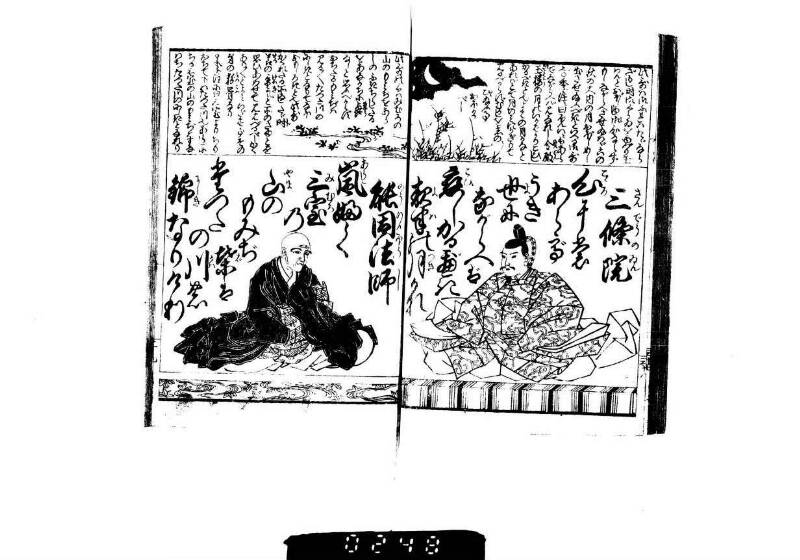
翻刻
【右頁中】
三條院(さんでうのゐん)
心(こゝろ)にも
あらで
うき
世(よ)に
ながらへば
恋(こひ)しかるべき
夜半(よは)の月(つき)かな
【右頁上】
此哥は御ふれいたゞなら
ざりし時御くらゐをゆづり玉
はんとおぼしめし御(み)【別刷はルビなし】心ならず
もしながらへさせ給はゞこの
秋の大内【=内裏】の月おぼしめし
出させ給ふべきといへる御哥
也〇季注に曰ほんいにもあら
でながらへば見なれし金殿(きんでん)
玉楼(ぎよくろう)の月のいかばかりこひし
かるべきと也よはの月かなと
あればとて月のみにかぎりて
みるべからずむかしをしの
び給ふ事
おほかる
べし
【左頁中】
能因法師(のういんほうし)
嵐(あらし)ふく
三室(みむろ)の
山(やま)の
もみぢ
葉(ば)は
たつた
の川(かは)の
錦(にしき)なりけり
【左頁上】
此哥の心はみむろの
山のもみぢをあら
しのふきちらしたる
をあなかちに興(きやう)
なしと思ふべからず
おちたるもみぢは
見る〳〵たつた川の
にしきとなりてなほ
おもしろきと也此哥
かくれたる所なしたゞ時(じ)
節(せつ)の景気(けいき)と所のさまとを
思ひあはせて見はべるべしかく
あり〳〵とよみいだす事その
身の粉骨(ふんこつ)なり
〇季注に曰三室よりちり
おちて下はたつた川也あらしに
ちる三室の山のもみぢはすな
はちたつた川のにしきとなれり
現代語訳
【右頁中】
三条院(さんじょうのいん)
心にも
あらで
憂き
世に
長らえば
恋しかるべき
夜半の月かな
【右頁上】
この歌は、御不例(病気)がただならない時、御位を譲ろうと思し召し、御心ならずも(本意ではないが)もし長生きなさったなら、この秋の大内裏の月を思い出しなさるだろうという御歌である。○季注によれば、「本意でもなく長生きすれば、見慣れた金殿玉楼の月がどれほど恋しいことだろう」ということである。「夜半の月かな」とあるからといって月のみに限って見るべきではない。昔を偲び給うことは多いはずである。
【左頁中】
能因法師(のういんほうし)
嵐吹く
三室の
山の
紅葉
葉は
竜田
の川の
錦なりけり
【左頁上】
この歌の心は、三室の山の紅葉を嵐が吹き散らしたのを、むやみに興ざめだと思ってはならない。落ちた紅葉は見れば見るほど竜田川の錦となって、なおおもしろいということである。この歌に隠れた所はない。ただ時節の景色と場所の様子とを思い合わせて見るべきである。このようにありありと詠み出すことは、その身の努力の結果である。○季注によれば、「三室より散り落ちて下は竜田川である。嵐に散る三室の山の紅葉は、すなわち竜田川の錦となった」とある。
英語訳
【Right Page Center】
Emperor Sanjō
Not by my own will,
in this sorrowful
world
should I live longer,
how dear it would be—
the midnight moon
【Right Page Top】
This poem was composed when His Majesty was gravely ill and was considering abdicating the throne. The meaning is that if, against his own wishes, he were to live longer, he would surely long for the autumn moon of the Imperial Palace. According to the seasonal commentary, "If I live longer against my true intention, how deeply I would long for the moon over the familiar golden halls and jeweled towers." Though it says "midnight moon," one should not limit the interpretation to the moon alone. There must be many things from the past that he would fondly remember.
【Left Page Center】
Nōin Hōshi
The autumn leaves
of Mount Mimuro
blown by the storm
have become
the brocade
of Tatsuta River
【Left Page Top】
The heart of this poem is that one should not thoughtlessly consider it disappointing when the storm scatters the autumn leaves of Mount Mimuro. The more one looks at the fallen leaves, the more they become the brocade of Tatsuta River, making it even more beautiful. There is nothing hidden in this poem. One should simply contemplate it by considering both the seasonal scenery and the nature of the place together. To compose so vividly is the result of the poet's own dedicated effort. According to the seasonal commentary, "The leaves scatter and fall from Mimuro, and below flows Tatsuta River. The autumn leaves of Mount Mimuro scattered by the storm have indeed become the brocade of Tatsuta River."