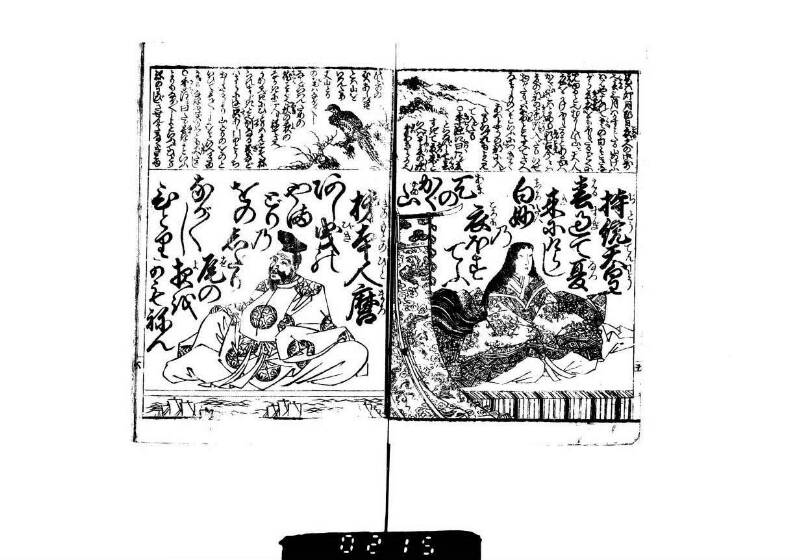
翻刻
【右頁中】
持統天皇(ぢとうてんわう)
春過(はるすぎ)て夏(なつ)
来(き)にけらし
白妙(しろたへ)
の
衣(ころも)ほす
てふ
天(あま)
の
かぐ
山(やま)
【右頁上】
是は卯月朔日 衣(ころも)かへの御哥
也 春(はる)三月はかすみたる山のけふ
ははやはれて雲(くも)の白々とさな
がら夏衣(なつぎぬ)をもほしたるごとくに
見ゆること也むかし此山に天人
衣(ころも)をかけほしたることあるゆへ
かぐ山とはよめり新古今(しんこきん)には
夏の部(ぶ)の巻頭(くわんとう)に入れたりいせ
物がたりには露(つゆ)とこたへてさ【「き」の誤り? 印刷のせいか別刷で「き」を確認】へ
なましものをといふにつきて
あいじやうの部(ぶ)に入れ
たりいづれもよく見
て入れたり
〇 季注(きちう)に曰(いはく)たゞ夏
といはずして春(はる)
すぎて夏来(なつき)と
いへば首夏(しゆか)の次(し)
第(だい)あきらか也
【左頁中】
柿本(かきのもとの)人麿(ひとまろ)
あし曳(びき)の
やま
どりの
をのしだり
尾(を)の
なが〳〵
し夜(よ)を
ひとりかもねん
【左頁上】
此哥の
心はあしびき
とは山を
いはんため
又山とり
の尾(を)はなが〴〵し
などいはんための
枕(まくら)ことば也 秋(あき)の夜(よ)の
なかきに二人りねてさへ
う【憂】かるべきにひとりはえこそね
られまじきと也 別(べつ)なる義(ぎ)など
はさらになし只(たゞ)あし引のとうち
出したるにより山どりのをのと
いひて長〳〵しよをといへるさま
かぎりなきふぜいもつとも丈(たけ)たかし
〇 季注(きちう)に曰たゞ長(なが)きよといふ
よりもなが〳〵しよといふにてひとり
ねのわびしさせんかたなくきこゆ
現代語訳
【右頁中】
持統天皇
春過ぎて夏
来にけらし
白妙の
衣干すてふ
天の香具山
【右頁上】
これは卯月朔日の衣替えの御歌である。春の三月はかすんでいた山が、今日は早々と晴れて雲が白々と、さながら夏衣を干したかのように見えることである。昔この山に天人が衣をかけて干したことがあるゆえ、香具山と詠まれている。新古今和歌集には夏の部の巻頭に入れられている。伊勢物語には「露とこたえてさえ(さき)がなましものを」ということに関連して恋愛の部に入れられている。いずれもよく見て分類されている。
季吟の注に曰く、ただ「夏」と言わずして「春過ぎて夏来」と言えば初夏の順序が明らかである。
【左頁中】
柿本人麻呂
あしひきの
山鳥の
尾のしだり尾の
ながながし夜を
ひとりかも寝む
【左頁上】
この歌の心は、「あしひき」とは山を言うための、また「山鳥の尾はながながし」などと言うための枕詞である。秋の夜の長いのに二人で寝てさえ憂かるべきなのに、一人では到底寝られないだろうということである。特別な意味などは全くなく、ただ「あし引の」と詠み出したことにより「山鳥の尾の」と言って「ながながし夜を」と言った様子は、限りない風情で最も優れている。
季吟の注に曰く、ただ「長き夜」と言うよりも「ながながし夜」と言うことで、一人寝の侘しさがせんかたなく聞こえる。
英語訳
【Right Page Middle】
Empress Jitō
Spring has passed
And summer seems to have come—
They say that on Mount Kagu
Of heaven
White robes
Are hung to dry
【Right Page Top】
This is a poem about changing clothes on the first day of the fourth month. The mountain that was hazy during the three months of spring has cleared early today, and the white clouds appear as if summer robes were hung out to dry. Long ago, celestial beings hung their robes to dry on this mountain, which is why it is called Mount Kagu. In the Shin Kokin Wakashū, this poem is placed at the beginning of the summer section. In the Tales of Ise, it is included in the love section in connection with the phrase "replying only 'dew' would have been heartless." In both cases, it has been well-considered and appropriately categorized.
Kigin's commentary states that by not simply saying "summer" but rather "spring has passed and summer has come," the progression into early summer is made clear.
【Left Page Middle】
Kakinomoto no Hitomaro
On the long trailing tail
Of the mountain pheasant
Dragging through the hills—
Long, long is this night
That I must sleep alone
【Left Page Top】
The meaning of this poem is that "ashihiki" is a pillow word used to introduce "mountain," and also to set up phrases like "the mountain pheasant's tail is long and long." The idea is that even sleeping together on a long autumn night would be melancholy, so sleeping alone would be utterly unbearable. There is no special hidden meaning—it is simply that by beginning with "ashi-hiki no," the poet leads into "yamadori no o no" and then "naganagashi yo wo," creating a style of limitless elegance that is most excellent.
Kigin's commentary notes that rather than simply saying "nagaki yo" (long night), saying "naganagashi yo" makes the loneliness of sleeping alone sound infinitely more poignant.