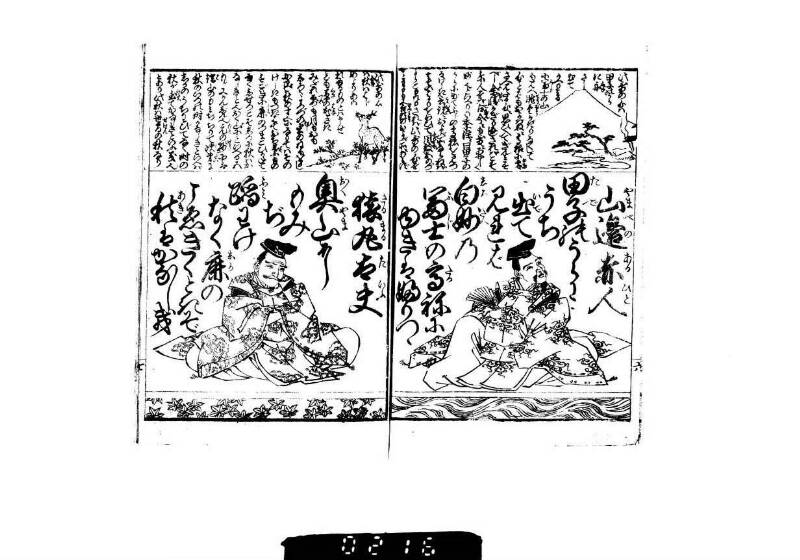
翻刻
【右頁中】
山辺赤人(やまべのあかひと)
田子(たご)のうらに
うち
出(いで)てみれば
白妙(しろたへ)の
冨士(ふじ)の高(たか)ねに
ゆきはふりつゝ
【右頁上】
此哥の心は
田子のうら
に舟(ふね)
さし
出て
かへりみる
に冨士(ふじ)の山
もはへ眺望(てうぼう)かぎりなくして
心ことばもおよばぬに高根に雪(ゆき)
さへ見たる心に思ひ入てぎんみす
べし余情(よせい)かぎりなしさればこそ
赤人をば古今(こきん)にも哥にあやしく
妙也といへり〇季注に曰田子の
うらに出てふじの高ねを見つ
るけしき言説(ごんせつ)におよぶ所ならねば
其ていばかりをいひて風致(ふうち)おのづ
からこもれりされば此哥の心を
ことわるも又 舌頭(せつとう)のおよぶ所あらず
【左頁中】
猿丸太夫(さるまるたいふ)
奥山(おくやま)に
もみぢ
踏(ふみ)わけ
なく鹿(しか)の
こゑきくときぞ
秋(あき)はかなしき
【左頁上】
此哥の心
は秋(あき)ははじ
めよりあは
れなるものとは申せ
ども草(くさ)の花(はな)さき
みだれ露(つゆ)も月もおも
しろくよろづの虫(むし)のねもをかし
かるべし秋のすへになりてはその
けしきもつきはておち葉(ば)もの
すごきに鹿(しか)のつまこひかねて
なくじせつこそじつに秋はか
なしきと也おく山にといへる五
もじ又かんじん也 元(もと)の抄(せう)には
端(は)山のもみぢちりて次第(しだい)に
秋のいつの時かなしきといへは
しかのうちわびてなく時の
秋が至(いたつ)てかなしきといふ義也
とあり此秋は世間(せけん)の秋なり
現代語訳
【右頁中】
山辺赤人
田子の浦に
うち
出でて見れば
白妙の
富士の高嶺に
雪は降りつつ
【右頁上】
この歌の心は、田子の浦に舟を漕ぎ出して振り返って見ると、富士の山も含めて眺望が限りなく広がり、心も言葉も及ばないほどである。その高い峰に雪までも見える心境に思いを込めて吟味すべきである。余韻が限りない。だからこそ赤人を古今和歌集でも「歌に不思議なほど巧みである」と言っている。季吟の注に曰く、田子の浦に出て富士の高嶺を見る景色は、言葉では表現しきれないところなので、その様子だけを述べて風趣が自然に込められている。それゆえこの歌の心を説明するのも、また言葉の及ぶところではない。
【左頁中】
猿丸太夫
奥山に
紅葉
踏み分け
鳴く鹿の
声聞く時ぞ
秋は悲しき
【左頁上】
この歌の心は、秋は初めからもの悲しいものとは言うものの、草花が咲き乱れ、露も月も美しく、あらゆる虫の音も風情があるだろう。秋の終わりになってはその景色も尽きて落ち葉も物寂しい中で、鹿が妻を恋い慕いかねて鳴く時節こそ、真に秋は悲しいということである。「奥山に」と言った五文字もまた重要である。元の注釈書には「端山の紅葉が散って次第に、秋のいつの時が悲しいかと言えば、鹿が心わびしく鳴く時の秋が最も悲しいという意味である」とある。この秋は世間一般の秋のことである。
英語訳
【Right Page Middle】
Yamabe no Akahito
When I go out
To Tago Bay
And look around,
White snow is falling
On Fuji's lofty peak
【Right Page Top】
The meaning of this poem is that when one rows a boat out into Tago Bay and looks back, the view including Mount Fuji extends limitlessly, beyond what heart or words can express. One should contemplate deeply the feeling of seeing snow even on that high peak. The lingering emotion is boundless. This is why Akahito is praised even in the Kokin Wakashū as being "mysteriously skillful in poetry." Kigin's commentary states that the scene of going out to Tago Bay and viewing Fuji's high peak is beyond what words can describe, so by merely depicting that appearance, aesthetic charm is naturally contained within. Therefore, explaining the heart of this poem is also beyond what words can reach.
【Left Page Middle】
Sarumaru Tayū
Deep in the mountains,
Treading through
The fallen maple leaves,
When I hear the cry
Of the calling deer—
Then autumn is truly sad
【Left Page Top】
The meaning of this poem is that although we say autumn is melancholy from the beginning, when the grasses and flowers bloom in profusion, when dew and moon are beautiful, and when the voices of all insects have their charm, it is at the end of autumn when that scenery has exhausted itself and the fallen leaves are desolate, and the deer cries unable to bear its longing for its mate—that is when autumn is truly sad. The five characters "oku yama ni" (deep in the mountains) are also crucial. The original commentary states: "As the maple leaves of the near mountains scatter gradually, if we ask when in autumn is most sad, it is when the deer cries in heartbreak—that autumn is most intensely sad." This autumn refers to the autumn of the secular world in general.