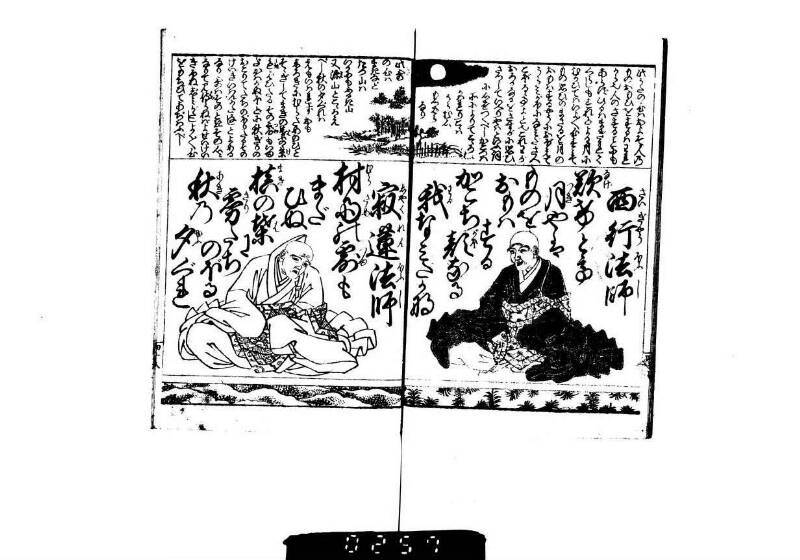
翻刻
【右頁中】
西行法師(さいぎやうほふし)
歎(なげ)けとて
月(つき)やは
ものを
おもは
する
かこち顔(がほ)なる
我(わが)なみだかな
【右頁上】
此哥の心はおよそ人の
ものおもひをするはわれ
から也人のさすることにも
あらずひるはまぎ【(別刷は「き」)】 れて
くらしもすれど【(別刷は「と」)】 よる月に
むかひてはいよ〳〵心すみて
もの思ひのまさるを月の
おもはするやうにおぼえて
うらみがほになみださへ
こぼるゝ事よと也これわが
おろかなるをさすがに思ひ
さつしていへりやはといふ詞
に心をつくべしかこつは
所によりてこゝろ
かはれりこゝは
うらむ心
もつぱら
なり
【左頁中】
寂蓮法師(ぢやくれんほふし)
村雨(むらさめ)の露(つゆ)も
まだ
ひね
槇(まき)の葉(は)
に
霧(きり)たち
のぼる
秋(あき)の夕(ゆふ)ぐれ
【左頁上】
此哥
の心は
まきなど
たつ山は
いかにもふるき山
又 深(み)山とこゝろえ
べし秋の夕ぐれには
えもいはれずおも
しろきにむらさめのひと
そゝぎしてまきの葉(は)の景(け)
色(しき)ばひたるその露(つゆ)もいま
だかはかぬほどに秋ぎりの
おこりてたちのぼりたるその
けいきいはんかたなしとよめる
なり哥はそのときその心に
なりて見 侍(はべ)らねばよせいけい
きほねじみ【(滋味?)】 がたしよく〳〵心
をもちひてあぢはうべし
現代語訳
【右頁中】
西行法師(さいぎょうほうし)
嘆けとて
月やは
ものを
思わする
かこち顔なる
わが涙かな
【右頁上】
この歌の心は、およそ人が物思いをするのは自分からのことである。人がそうさせることでもない。昼は紛れて過ごしもするけれど、夜、月に向かってはいよいよ心が澄んで物思いが募るのを、月が思わせるように思われて、恨みがましく涙さえもこぼれることよということである。これは自分の愚かなるを、さすがに思い察して言ったのである。「やは」という言葉に心を尽くすべし。「かこつ」は所によって心が変わる。ここは恨む心がもっぱらである。
【左頁中】
寂蓮法師(じゃくれんほうし)
村雨の露も
まだ
干ぬ
槙の葉に
霧立ち
のぼる
秋の夕暮れ
【左頁上】
この歌の心は、槙などが立つ山は、いかにも古い山、また深山と心得るべし。秋の夕暮れには、言いようもなく趣深いのに、村雨がひとしきり降って、槙の葉の景色が美しく映えた、その露もまだ乾かないほどに、秋霧が起こって立ち上った、その景色は言いようがないと詠んだのである。歌はその時その心になって見なければ、余情・景色の味わいは難しい。よくよく心を用いて味わうべし。
英語訳
【Right Page Center】
Priest Saigyō
Does the moon
tell me to lament
and make me
think of things?
How accusatory
are my tears!
【Right Page Top】
The heart of this poem: Generally, when people fall into melancholy thoughts, it comes from within themselves. It is not something that others make them do. During the day one can find distractions and pass the time, but at night when facing the moon, the heart becomes ever more clear and melancholy thoughts increase, and it seems as if the moon is causing these thoughts, so that one's tears spill forth in a resentful manner. This expresses his recognition of his own foolishness, yet with understanding. One should pay attention to the word "yaha" (does it?). "Kakotsу" (to blame/resent) changes meaning depending on the context. Here it expresses a heart full of resentment.
【Left Page Center】
Priest Jakuren
On the leaves of the maki tree
where the dew
from the sudden shower
has not yet
dried,
mist rises
in the autumn evening.
【Left Page Top】
The heart of this poem: Mountains where maki trees and such stand should be understood as ancient mountains, or deep mountains. Autumn evenings are indescribably beautiful, and when a sudden shower falls and the scenery of the maki leaves becomes beautifully vivid, before even that dew has dried, autumn mist arises and ascends—he composed this saying that such scenery is beyond words. Unless one places oneself in that moment and that state of mind when reading poetry, it is difficult to appreciate the lingering emotion and scenic beauty. One should apply one's heart carefully to savor it.