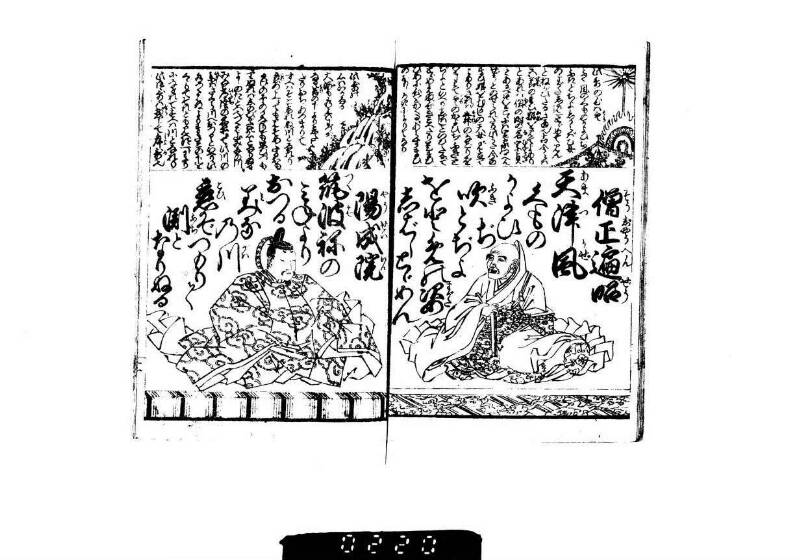
翻刻
【右頁中】
僧正遍昭(そうじやうへんぜう)
天津風(あまつかぜ)
くもの
かよひぢ
吹(ふき)とぢよ
をとめの姿(すがた)
しばしとゞめん
【右頁上】
此哥の心は空(そら)
ふく風のくものかよひぢ
ふきとちよしからば乙女
のすがたしばしとどめて見ん
とねがひたるさま也古今には
五 節(せち)のまひ姫(ひめ)を見てよめり
とあれば俗(ぞく)の時の名(な)宗貞(むねさだ)
とあるべきをこゝには定家わへん
ぜうとのせられたり此うた今の
まひ姫をむかしの天女に見立て
よめりされは舞(まひ)のなごりを
をしみて雲(くも)のかよひぢふきと
ぢよといへりしはしといひたるにて
とゞめえぬ心きこへたり是まひ
ひめに心をかくるにあらすまひ
のおもしろきによりてなり
【左頁中】
陽成院(やうせいいん)
筑波(つくば)ねの
みねより
おつる
美(み)な
の川(がは)
恋(こひ)ぞつもりて
渕(ふち)と
なりぬる
【左頁上】
此哥の
心はいかなる
大 河(か)【別刷は「が」】も水上はわづが
なる苔(こけ)の下よりした
だりおちあつまりて
すへはそこしれぬ川となれり
恋(こひ)の上にても見そめたるおも
かげのほのかなりしも思ひつも
りぬればしのびがたき心となりぬる
よしのたとへ也つくば山みなの川
みな常陸(ひたち)の名所にて此川の
東(ひがし)はさくら川へおつるといへり此
水つくばねよりまさごの下を
くゞりてそれとも見へず一トわたり
にながれてすへは川となれり
此御哥は惣(そう)【総】じて序哥(じよか)也
現代語訳
【右頁中】
僧正遍昭
天津風
雲の
通い路
吹き閉じよ
乙女の姿
しばし留めん
【右頁上】
この歌の心は、空を吹く風が雲の通い路を吹き閉じてくれたなら、乙女の姿をしばらく留めて見ようと願った様子である。古今和歌集には「五節の舞姫を見て詠んだ」とあるので、俗世の時の名は宗貞とあるべきところを、ここでは定家が遍昭として載せられた。この歌は今の舞姫を昔の天女に見立てて詠んだものである。そうであるから、舞の名残を惜しんで「雲の通い路吹き閉じよ」と言った。「しばし」と言ったことで、留めることができない心が聞こえてくる。これは舞姫に心を寄せるのではなく、舞の面白さによるものである。
【左頁中】
陽成院
筑波嶺の
峰より
落つる
みなの川
恋ぞ積もりて
淵と
なりぬる
【左頁上】
この歌の心は、どのような大河も水源はわずかな苔の下より滴り落ち、集まって、ついには底知れぬ川となるものである。恋についても、見初めた面影がほのかであったものも、思いが積もれば忍び難い心となってしまうという例えである。筑波山、みなの川は、皆常陸の名所で、この川の東は桜川へ落ちるという。この水は筑波嶺より真砂の下を潜って、それとも見えず一渡りに流れて、ついには川となった。この御歌は総じて序歌である。
英語訳
【Right page center】
Monk Henjō
Heavenly wind,
blow shut
the cloud pathways—
I would keep
the maiden's form
here for a while.
【Right page upper】
The heart of this poem is that if the wind blowing through the sky would close off the pathways through the clouds, he wishes to keep the maiden's figure there for a while to gaze upon. In the Kokin Wakashū, it says this was composed "upon seeing the Gosechi dance maidens." Since it was from his secular days, his name should be Munesada, but here Teika has listed it under Henjō. This poem likens the present dance maiden to the celestial maidens of old. Therefore, lamenting the end of the dance, he says "blow shut the cloud pathways." By saying "for a while," one can hear his heart knowing he cannot truly detain her. This is not about romantic feelings for the dance maiden, but rather about the beauty of the dance itself.
【Left page center】
Emperor Yōzei
From the peak
of Mount Tsukuba
falls
the Mina River—
love has accumulated
and become
a deep pool.
【Left page upper】
The heart of this poem is that no matter how great a river, its source begins as mere drops falling from beneath moss, gathering together until it eventually becomes an unfathomable river. Regarding love too, even though the glimpsed image of one's beloved was initially faint, when thoughts accumulate, it becomes an unbearable longing—this is the metaphor. Mount Tsukuba and the Mina River are both famous places in Hitachi Province, and this river is said to flow eastward into the Sakura River. This water flows from Mount Tsukuba, running beneath the sand invisibly, flowing in one course until it eventually becomes a river. This imperial poem is entirely a jo-ka (introductory poem).