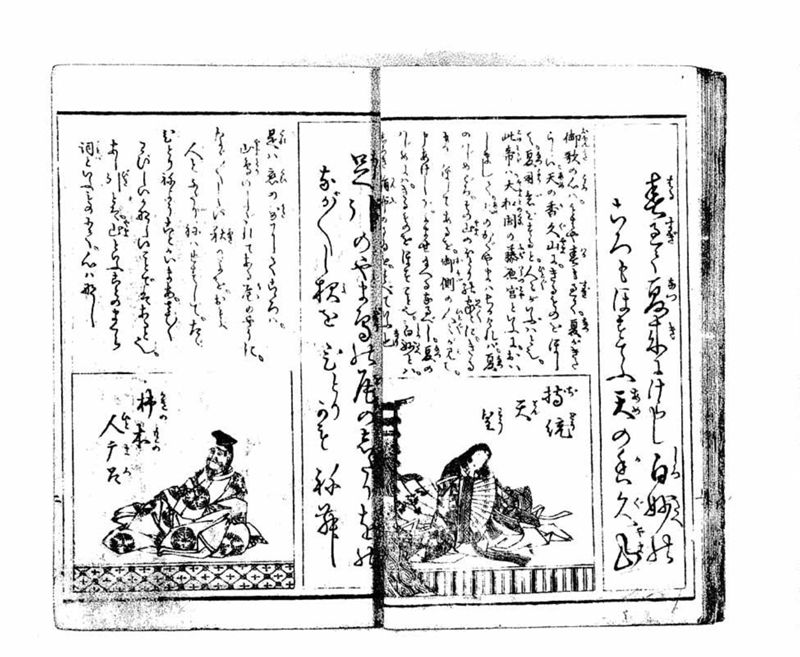
翻刻
【右丁】
春過ぎて夏来にけらし白妙の
ころもほふてふ天の香具山
御歌の心はもはや春も過て夏がきた
らしい天の香具山にきものをほし 持統
て夏用意をすると人々がいふ也 天
此帝は大和国の藤原宮といふにおは 皇
しまして天のかぐやまはちかければ夏
のはじめごろその山のほとりの家々にきる
ものほしてあるを御側の人々が
申しあげしがよませ給へるなるべし夏の
はじめにはきるものをほすこと也白妙とは
しろき絹布のるゐをすべていふ也
【左丁】
足引のやま鳥の尾のしたりをの
なが〳〵し夜をひとりかもねむ
是は恋の哥にてこゝろは
山鳥のしだれてある尾のやうに
なが〳〵しい秋のよをおもふ
人とふたりねはせすしてたゞ
ひとりねようことかいまあさて〳〵
わびしいかなしいことではあると也 柿本
あし引とは山といふことのまくら 人摩呂
詞といふものにて心はなし
現代語訳
【右丁】
春過ぎて夏来にけらし白妙の
ころもほすてふ天の香具山
この歌の意味は、もはや春も過ぎて夏が来たらしい、天の香具山に衣を干して夏の準備をすると人々が言っているということである。この帝は大和国の藤原宮にいらっしゃって、天の香具山は近いので、夏の始めの頃、その山のほとりの家々に着物を干してあるのを、お側の人々が申し上げたのをお詠みになったのであろう。夏の始めには着物を干すことである。白妙とは白い絹布の類をすべて言うのである。
持統天皇
【左丁】
足引の山鳥の尾のしだり尾の
長々し夜をひとりかも寝む
これは恋の歌で、心は山鳥の垂れ下がっている尾のように長々しい秋の夜を、思う人と二人で寝ることはできずに、ただ一人で寝ることだろうか、まことにつらく悲しいことであるということである。「足引」とは「山」という言葉の枕詞というもので、特別な意味はない。
柿本人麻呂
英語訳
【Right page】
"Spring has passed / And summer seems to have come / White hemp robes / Are being hung to dry, they say / On heavenly Mount Kagu"
The meaning of this poem is that spring has already passed and summer seems to have arrived, as people say they are hanging out clothes to dry on Mount Kagu in preparation for summer. This empress resided at Fujiwara Palace in Yamato Province, and since Mount Kagu was nearby, at the beginning of summer when clothes were being hung out to dry at houses around that mountain, her attendants must have reported this to her, which inspired her to compose this poem. It is customary to air out clothes at the beginning of summer. "Shirotae" refers to all kinds of white silk fabrics.
Empress Jitō
【Left page】
"Foot-dragging / mountain pheasant's / drooping tail— / Like that long, long night / Must I sleep alone?"
This is a love poem, and its meaning is: Like the drooping tail of a mountain pheasant, through this long, long autumn night, unable to sleep together with the one I love, must I sleep alone? How truly painful and sad this is. "Ashibiki" is what is called a makurakotoba (pillow word) for "mountain" and has no particular meaning.
Kakinomoto no Hitomaro