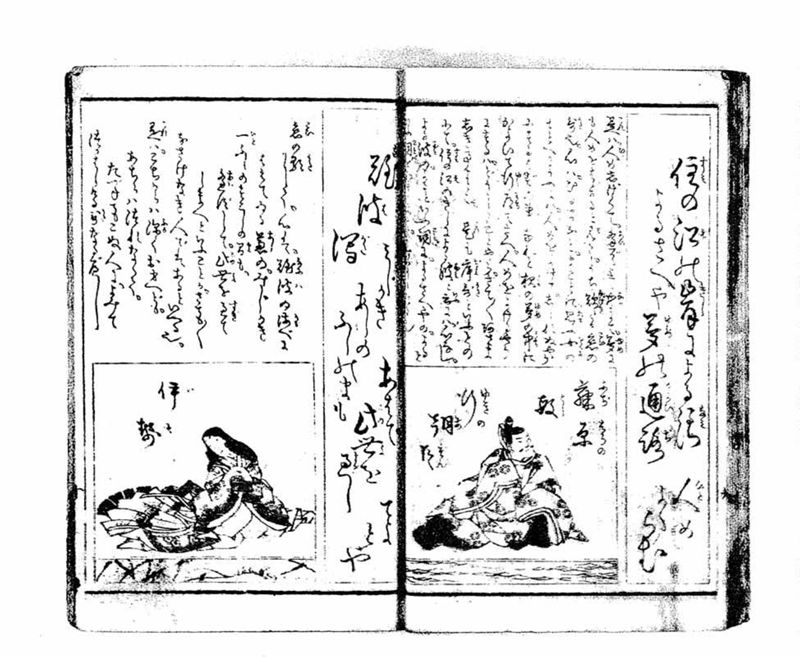
翻刻
【右丁】
住の江の岸による波 人め
よるさへや夢の通路 よく
らむ
是は人めしげくて■■■■■■夢に
も人めをはゞかると見てうち歎きたる恋の 藤原
哥也心はひ■■■■まことに思ふ女の 敏
もとへ■■■ふよは人めをさけて■■ぬやう
かよひて行道てさへ人目めをさけて
にするはどうしたことやらさて〳〵あさま
しき事■■■也 是も序詞といふもの 行
にて住の江のきしによる波と云は心なし 朝
よる波のよるといふ詞によるさへやのよる 臣
といふ詞をおきて■■■■■■■■■
【左丁】
難 みじかき あはで てよ
波 あしの 此世を と
潟 ふしのまも 過し や
恋の哥
にて心■■難波の海べに
はえてゐる葦のみぢかき
一ふしのすこしの夜も
逢ずして此世を過て
しまへといふことかさても〳〵
なさけなき人ではあるといへる也 伊
是はこちうらは深くおもへども 勢
あちらはつれなくて
たづねてもこぬ人によみて
つかはしける哥なるべし
現代語訳
【右丁】
住の江の岸による波よるさへや
夢の通ひ路人目よくらむ
これは人目が多くて昼間は通えないので、夢に
も人目を憚ると見て嘆いた恋の
歌である。歌の意味は、本当に思う女の
もとへ通う夜は人目を避けて通うように
している。通って行く道でさえ人目を避けて
いるのに、どうして夢の中でも人目を避けて
いるのだろうか。まことに情けない事である。これも序詞というもの
で、「住の江の岸による波」というのは意味がなく、
「よる波」の「よる」という言葉によって「よるさへや」の「よる」
という言葉を導き出している。
藤原敏行朝臣
【左丁】
難波潟みじかき蘆のふしの間も
逢はでこの世を過ぐしてよとや
恋の歌
で、歌の意味は難波の海辺に
生えている蘆の短い
一節の少しの間も
逢わずにこの世を過ごして
しまえということか。それにしても
情けない人であると言ったのである。
これはこちらは深く思っているけれど
あちらはつれなくて
訪ねても来ない人に詠んで
送った歌であろう。
伊勢
英語訳
【Right Page】
"At Suminoe's shore / The waves that come at night— / Even in dreams / Does the path of love / Avoid watchful eyes?"
This is a love poem lamenting that even in dreams one must be wary of people's eyes, since during the day one cannot visit because there are too many watching eyes. The meaning of the poem is: "When visiting the woman I truly love at night, I avoid people's eyes. Even on the path I take, I avoid people's eyes. So why must I avoid people's eyes even in my dreams? This is truly a pitiful thing." This is also what is called a jo-kotoba (introductory phrase), where "the waves that come to Suminoe's shore" has no meaning in itself, but the word "yoru" (come/night) in "yoru nami" (waves that come) leads to the word "yoru" (night) in "yoru sae ya" (even at night).
Fujiwara no Toshiyuki, Court Noble
【Left Page】
"In Naniwa Bay / The short joints of reeds— / Must I spend this life / Without meeting you / Even for such brief moments?"
This is a love poem,
and the meaning is: "Must I spend
this world without meeting you
even for a brief moment,
short as a joint of the reeds
growing by Naniwa's seashore?"
What a heartless person you are, the poet says.
This was probably a poem composed and
sent to someone who was cold and distant
though the poet felt deep love,
and who would not come even when sought.
Ise