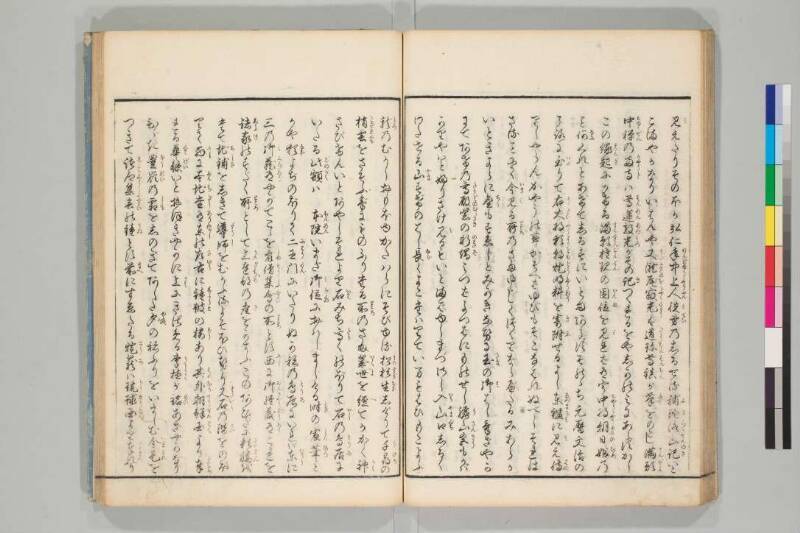
翻刻
【右丁】
見(み)えたりそのほか弘仁 年中(ねんぢゆう)上人(しやうにん)徒㐧(とてい)のしるせる補陀洛山記(ふだらくせんのき)いと
こまやかなりいはんや又(また)瀧尾(たきのを)寂光(じやくくわう)は道珎(だうちん)尊鎮(そんちん)が筆(ふで)をのこし満願(まんぐわん)
中禅(ちゆうぜん)の両寺(りやうじ)は尊蓮(そんれん)敦光(あつみつ)がその記(き)つくれるをやしかのみにあらずかし
この縁起(えんぎ)にかける満願權現(かんぐわんごんげん)の因位(いんゐ)を見(み)れば有宇 中将(ちゆうじやう)朝日姫(あさひひめ)の
こと何(なに)くれとあげてしるすにいとまあらずそのゝち元歷文治の
ころに至(いた)りて右大将(うだいしやう)頼朝(よりとも)燈明料(とうみやうれう)を寄附(きふ)せるよし東鑑(あづまかゞみ)に見(み)え侍(はべ)
りしやらんかやうの事かぞへばゆびもそこなはれぬべしそれは
さることにて今(いま)見(み)る所(ところ)のさまゆゝしくつくりならべたるみあらか
いときよらに塵(ちり)もすゑじとみがきなせる玉(たま)の御(み)はしけざやか
にてあけの高殿(たかどの)紫(むらさき)の軒端(のきば)みつばよつばにものせし驪山宮(りさんきう)もかば
かりやはとふりさけ見(み)るもいとまばゆしまづさし入(いる)山口(やまぐち)しろく
わたせる山(やま)すげのはし長(なが)くよこたはりていまもはひもこよふ
【左丁】
龍(たつ)のむかしおもほゆかたはらにそびゆる松(まつ)杉(すぎ)生(おひ)しげりて千尋(ちひろ)の
梢(こずゑ)雲(くも)をさそふげにものふりたる所(ところ)のさま幾世(いくよ)を經(へ)てかかく神(かみ)
さびけんいとあやしそれより石(いは)みち高(たか)くのぼりて《振り仮名:石の鳥居|いし とりゐ 》に
いたる此額(このがく)は 本院(ほんゐん)いまだ御位(みくらゐ)におはしましける时(とき)の宸筆(しんひつ)と
かや猶(なほ)よぢのぼりて二王門(にわうもん)にいたりぬかねの鳥居(とりゐ)にいれば東(ひがし)に
三の御蔵(みくら)有(あり)やがてこゝを衆僧(しゆそう)集會(しうくわい)の所(ところ)とす西(にし)に御經蔵(おんきやうざう)有(あり)これを
諸家(しよけ)のすだく所(ところ)として上達部(かんだちめ)の座(ざ)をかまふこのあひだに彩旙(さいはん)を
たて地鋪(ちしき)をしきて導師(だうし)をむかふるよそほひせり又(また)《振り仮名:石の階|いし かい》をのぼ
りて西(にし)に本地堂(ほんちだう)有(あり)東(ひがし)の左右(さいう)に鍾皷(しようこ)の楼(ろう)あり其外(そのほか)朝鮮国(てうせんこく)より奉(たてまつ)
れる蕐鯨(くわげい)いとおほきやかに上(かみ)にきざめる李植(りしよく)が銘(めい)あざやかなり
ひゞき豊嶺(ほうれい)の霜(しも)をしのぎてあした夕(ゆふべ)のねふりをいましむ今(いま)是(これ)を
つきて諸卿(しよきやう)集会(しふくわい)の鐘(かね)とす前(まへ)にすゑたる燈籠(とうろ)は琉球国(りうきうこく)より奉(たてまつ)れり
現代語訳
【右丁】
見られる。そのほか弘仁年間に上人の弟子たちが記した『補陀洛山記』は
とても詳細である。いわんや滝尾寂光寺は道珍・尊鎮が筆を残し、満願寺・
中禅寺の両寺は尊蓮・敦光がその記録を作ったのである。それだけではない。
この縁起に関わる満願権現の因位を見ると、有宇中将・朝日姫の
ことなど様々なことが挙げて記されており、詳述する暇がない。その後、元暦・文治の
頃に至って、右大将頼朝が燈明料を寄附したことが『吾妻鏡』に見える
のである。このような事を数え上げれば指も足りなくなるだろう。それは
さておき、今見る所の様子は、荘厳に造り並べられた御廟が
とても清らかに塵も据えじと磨きなされた玉の御階が美しく
朱塗りの高殿、紫の軒端を三つ葉四つ葉に飾った驪山宮も
これほどであろうかと振り仰いで見るのもまばゆい。まず差し入る山口に白く
渡された山菅の橋が長く横たわっており、今も這い回る
【左丁】
龍の昔が思われる。傍らに聳える松杉が生い茂って、千尋の
梢が雲を誘うような、古風な所の様子は、幾世を経てこのように神々
しくなったのだろうか、とても不思議である。それより石道を高く登って石の鳥居に
至る。この額は本院(後水尾院)がまだ御位におられた時の宸筆と
いう。なお攀じ登って仁王門に至った。金の鳥居に入ると東に
三の御蔵があり、やがてここを衆僧集会の所とする。西に御経蔵があり、これを
諸家の控える所として上達部の座を設ける。この間に彩旛を
立て地敷を敷いて導師を迎える装いをしている。また石の階を登
って西に本地堂があり、東の左右に鐘鼓の楼がある。その外、朝鮮国より奉
られた華鯨がとても大きく、上に刻まれた李植の銘が鮮やかである。
響きは豊嶺の霜を凌いで、朝夕の眠りを戒める。今これを
撞いて諸卿集会の鐘とする。前に据えられた燈籠は琉球国より奉られた。
英語訳
【Right Page】
can be seen. Furthermore, the "Record of Mount Fudaraku" written by the saint's disciples during the Kōnin era is
very detailed. Moreover, Takio Jakkō-ji temple has writings left by Dōchin and Sonchin, and the two temples of Manganji and
Chūzenji have records created by Sonren and Atsumitsu. It is not only that.
Looking at the karmic position of Mangan Gongen related to this founding legend, various matters concerning Middle Captain Ariū and Princess Asahi
are enumerated and recorded, leaving no time for detailed description. Later, around the Genryaku and Bunji eras,
it appears in the Azuma Kagami that Right General Yoritomo
donated funds for altar lamps. If we were to count such matters, even our fingers would not suffice. That
aside, the present appearance shows shrines magnificently constructed in rows,
so pure that not even dust would settle, with polished jewel-like sacred stairs gleaming
beautifully, vermillion high halls with purple eaves decorated in trefoil and quatrefoil patterns - even Lishan Palace would
hardly compare to this dazzling sight when one looks up. First, at the mountain entrance, a white
bridge of mountain sedge stretches long across, and even now the crawling
【Left Page】
dragons of old come to mind. Pine and cedar trees tower alongside, growing thick, with thousand-fathom
treetops seeming to invite clouds - this ancient place's appearance makes one wonder how many ages
it took to become so divine and mysterious. From there, climbing high on the stone path to reach the stone torii.
This plaque bears the imperial calligraphy from when the Main-in (Emperor Go-Mizunoo) was still on the
throne. Climbing further up to reach the Niō gate. Entering the gold torii, to the east
are the three sacred storehouses, which serve as the assembly place for the monks. To the west is the sutra repository, which
serves as the waiting place for various houses where seats for the court nobles are arranged. Between these, colored banners are
raised and floor mats spread to prepare for welcoming the head priest. Climbing more stone steps,
to the west is the Honji-dō hall, and to the east on both sides are bell and drum towers. Beyond that, a whale-shaped bell offering
from Korea is very large, with Li Zhi's inscription carved above appearing vivid.
Its sound surpasses the frost of abundant peaks, warning against morning and evening slumber. Now striking this
serves as the bell for the assembly of court officials. The lantern placed in front was offered by the Ryukyu Kingdom.