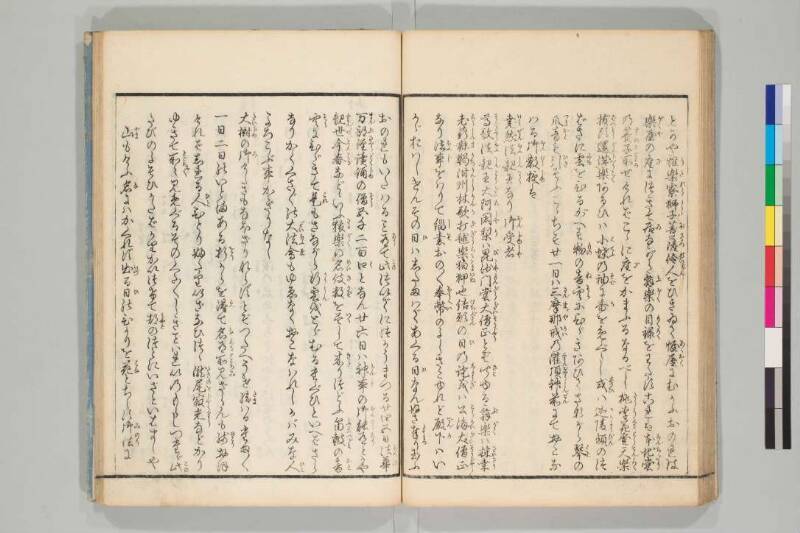
翻刻
【右丁】
とかや雅樂寮(うたれう)獅子(しゝ)菩薩(ぼさつ)伶人(れいじん)をひきゐて幄屋(あくおく)にむかふおのれは
樂屋(がくや)の座(ざ)につきて居(ゐ)ながら舞樂(ぶがく)の目録(もくろく)をわたすこれは本地堂(ほんちだう)
の簀子(すのこ)所(ところ)せければこゝに座(ざ)をかまふるなるべし桃李花(たうりくわ)登天樂(とうてんらく)
拔頭(ばつとう)還城樂(げんじやうらく)あるひは小蝶(こてふ)の袖(そで)に香(か)をめぐらし或(あるひ)は迦陵頻(かりようびん)のつ
ばさに雲(くも)をひるがへす物(もの)の音(ね)空(そら)にひゞきあひてさながら琴(こと)の
爪音(つまおと)も引(ひき)そふこゝちす廿一日は 三摩耶戒(さんまやかい)の灌頂(くわんぢやう)神前(しんぜん)にておこな
はる御敎授(おんけうじゆ)は【平出】
尭然法親王(けうぜんほふしんわう)なり御受者(おんじゆしや)【平出】
尊敬法親王(そんきやうほふしんわう)大阿闍梨(だいあじやり)は毘沙門堂大僧正(びしやもんだうだいそうじやう)とぞ聞(きこ)ゆる舞樂(ぶがく)は採桒(さいさう)
老(らう)薪靺鞨(しんまかち)泔州(かんしう)林歌(りんか)打毬樂(だぎうらく)狛狎(こまいぬ)也 結願(けちぐわん)の日(ひ)の證義(しようぎ)は公海大僧正(こうかいだいそうじやう)
なり法事(ほふじ)をはりて緇素(しそ)おの〳〵奉幣(ほうへい)のよしきこゆれど殿下(でんか)はい
かゞおはしけんその日(ひ)はしたまはであくる日(ひ)なんぬさ奉(たてまつ)り玉ふ
【左丁】
おのれもいたはること有(あり)て此(この)ついでにつかうまつる廿四五日 法蕐(ほつけ)
万部經(まんぶきやう)讀誦(どくじゆ)の僧(そう)五千二百口( く)となん廿六日は神事(じんじ)の御能(おんのう)有(あり)とかや
觀世(くわんぜ)金春(こんはる)などゝいふ猿樂(さるがく)の名伎(めいき)数(かず)を尽(つく)して來(きた)りつどふ笛(ふえ)皷(つゞみ)の音(おと)
空(そら)にひゞきて是(これ)もさながら行雲(かううん)をとゞむるたぐひといへばさら
なりかくくさ〴〵の大法會(だいほふゑ)もゆゑなくおこなはれしかばみな人(ひと)
よろこぶ事かぎりなし【平出】
《振り仮名:大𣗳|たいじゆ》の御(み)けしきもなほざりならずとぞつたへうけ給(たま)はるたま〳〵
一日二日のいとまある折(をり)からを得(え)て名有所(なあるところ)見(み)ざらんも残(のこり)おほ
ければしれる人(ひと)ひとりふたりいざなひつゝ瀧尾(たきのを)寂光(じやくくわう)などかり
ゆきて《振り仮名:所〻|ところ〴〵》みめぐるそのくさ〳〵しきことはれいのもらしつたゞ此(この)
たびのよそひかたばかりかいつけて都(みやこ)のつとにいざといはましや
山(やま)もけふ名(な)にはかくれず出(いづ)る日(ひ)のひかりを花(はな)とちらす御法(にのり)に
現代語訳
【右丁】
とかいう。雅楽寮の獅子菩薩の伶人を引き連れて幄屋に向かう。私は楽屋の座について座りながら舞楽の目録を渡す。これは本地堂の簀子が手狭なので、ここに座を設けるのであろう。桃李花、登天楽、抜頭、還城楽、あるいは小蝶の袖に香を巡らし、あるいは迦陵頻のつばさに雲をひるがえす。楽の音が空に響き合って、そのまま琴の爪音も引き添うような心地がする。
二十一日は三摩耶戒の灌頂が神前で行われる。御教授は堯然法親王である。御受者は尊敬法親王。大阿闍梨は毘沙門堂大僧正と聞いている。舞楽は採桑、老、薪靺鞨、泔州、林歌、打毬楽、狛犬である。結願の日の証義は公海大僧正である。法事が終わって僧俗それぞれが奉幣したと聞くが、殿下はいかがでいらしたか、その日はなさらないで翌日に幣を奉られた。
【左丁】
私も病気のことがあって、この機会にお仕えする。二十四、五日は法華万部経を読誦する僧が五千二百口という。二十六日は神事の御能があるとかいう。観世、金春などという猿楽の名人が数を尽くして来て集まる。笛鼓の音が空に響いて、これもそのまま行雲をとどめる類といえばその通りである。
このようにさまざまな大法会も無事に行われたので、皆人の喜びは限りない。大樹のご機嫌もおざなりでないと伝え承った。たまたま一日二日の暇のある時を得て、名のある所を見ないのも心残りが多いので、知っている人一人二人を誘って滝尾、寂光などを仮に行って、所々を見て回る。その詳細な事柄は例のごとく省略し、ただこの度の装いの一端ばかり書きつけて都の土産にしようと思う。
山も今日名には隠れず 出る日の光を花と散らす御法に
英語訳
【Right Page】
So it is said. Leading the musicians of the Bureau of Court Music who perform as lion bodhisattvas, they proceed to the curtained pavilion. I take my seat in the musicians' area and while seated there, hand over the catalog of court dances. This is because the bamboo flooring of the Honji-dō is cramped, so seats must be arranged here. The performances include Tōrika, Tōtenraku, Battō, Genjōraku—some with butterflies' sleeves wafting incense, others with karyōbin's wings turning clouds. The sounds of the music resonate in the sky, creating a feeling as if the plucking sounds of the koto join in harmony.
On the 21st, the initiation ceremony of the Samaya precepts is performed before the deities. The instructor is Prince Gyōzen Hōshin'ō. The recipient is Prince Sonkei Hōshin'ō. The Great Ācārya is said to be the Great Priest of Bishamon-dō. The court dances are Saisō, Rō, Shin Makachi, Kanshū, Rinka, Dakyūraku, and Komainu. The testimony for the final prayer day is given by Great Priest Kōkai. After the religious ceremonies ended, both clergy and laity are said to have made offerings, but as for His Excellency's condition, he did not do so that day but offered sacred streamers the following day.
【Left Page】
I too had some illness and served on this occasion. On the 24th and 25th, it is said that 5,200 monks recited the Lotus Sutra in its complete form of ten thousand volumes. On the 26th, there was said to be a sacred Nō performance. Master performers of sarugaku such as Kanze and Konparu gathered in great numbers. The sounds of flutes and drums resonated in the sky, and this too could be said to be like stopping the flowing clouds.
Thus various great religious assemblies were conducted without incident, and people's joy knew no bounds. It is reported that the Great Tree's (Shogun's) mood was also not perfunctory. Taking advantage of having a day or two of free time, and thinking it would be regrettable not to see the famous places, I invited one or two acquaintances and temporarily visited places like Takino'o and Jakkō, touring various locations. I omit the detailed particulars as usual, and write down only the outline of this occasion's ceremonies as a souvenir for the capital.
Even the mountain today cannot hide behind its name— in the sacred teaching that scatters the light of the rising sun like flowers.