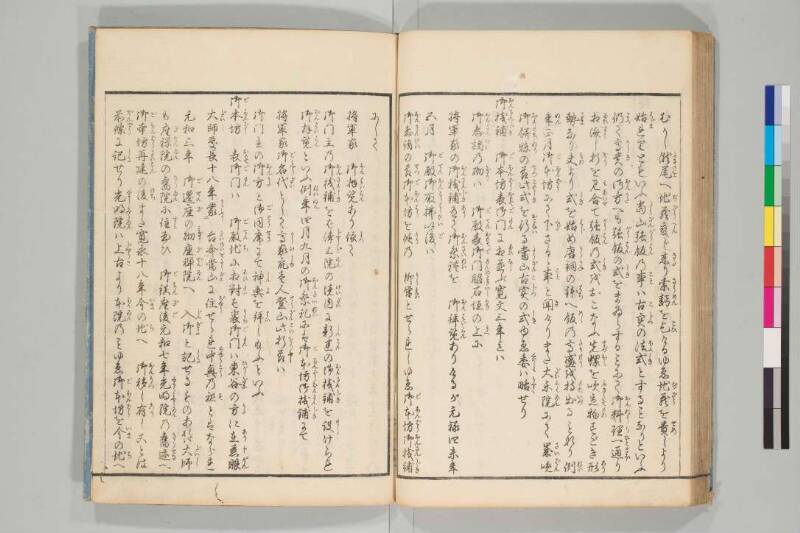
翻刻
【右丁】
むかし瀧尾(たきのを)へ地蔵(ぢざう)変(へん)じ来(きた)り索麪(さうめん)を乞(こひ)けるゆゑ地蔵(ぢざう)を責(せめ)しより
始(はじま)れりともいふ當山(たうざん)強飯(がうはん)の事(こと)は古実(こじつ)の法式(ほふしき)とすることなりといふ
仍(よつ)て高貴(かうき)の御方(おんかた)へも強飯(がうはん)の式(しき)をまゐらすることにて御料理(おんれうり)一通(ひととほ)り
相済(あひすみ)し折(おり)を見合(みあはせ)て強飯(がうはん)の式(しき)をおこなふ先(まづ)螺(ほら)を吹立(ふきたて)物(もの)すごき形(あり)
勢(さま)なり夫(それ)より式(しき)を始(はじ)め唐銅(からかね)の鉢(はち)へ飯(めし)の高盛(たかもり)を持出(もちいづ)ることなり例(れい)
年(ねん)正月 御本坊(ごほんばう)にて下(くだ)さるゝ事(こと)と聞(き)けりまた大楽院(だいらくゐん)にて歳晩(さいばん)
御餅練(おんもちねり)の節(せつ)此式(このしき)を行(おこなは)る當山(たうざん)古実(こじつ)の式(しき)ゆゑ委(くはしく)は略(りやく)せり
御棧鋪(おんさんじき) 御本坊(ごほんばう)表御門(おもてごもん)に相並(あひなら)ぶ寛文三年迄は
御参詣(おんさんけい)の砌(みぎり)は 御殿(ごてん)表御門(おもてごもんの)脇(わき)石垣(いしかき)の上(うへ)に
将軍家の御棧鋪(おんさんじき)有(あり)て御祭禮(おんさいれい)を 御拜覧(おんはいらん)ありけるが元禄四未年
五月 御殿(ごてん)御取拂(おんとりはらひ)以後(いご)は
御参詣(おんさんけい)の節(せつ)御本坊(ごほんはう)を假(かり)の 柳営(りうえい)とせられしゆゑ御本坊(ごほんばう)御棧鋪(おんさんじき)
【左丁】
にして
将軍家 御拜覧(おんはいらん)あり依(よつ)て【平出】
御門主の御棧鋪(おんさんしき)をば浄土院(じやうどゐん)の境内(けいだい)に新建(しんこん)の御棧鋪(おんさんじき)を設(まう)けられ
御拜覧(おんはいらん)といふ例年(れいねん)四月九月の御祭礼(おんさいれい)には御本坊(ごほんばう)御棧鋪(おんさんじき)にて【平出】
将軍家 御名代(ごみやうだい)として高家衆(かうけしゆ)壱人 登山(とうざん)此(この)折節(をりふし)は【平出】
御門主の御方(おんかた)と御同席(ごどうせき)にて神輿(しんよ)を拜(はい)し給ふといふ
御本坊(ごほんばう) 表御門(おもてごもん)は 御殿地(ごてんち)に相對(あひたい)す裏御門(うらごもん)は東谷(ひがしだに)の方(かた)に在(あり)慈眼(じげん)
大師(だいし)慶長十八年 蒙(かうふり)_二 台命(たいめいを)_一當山(たうざん)に住(ぢゆう)せられ中興(ちゆうこう)の祖(そ)とはなられ
元和三年 御遷座(ごせんざ)の砌(みぎり)座禅院(ざぜんゐん)へ 入御(じふぎよ)と記(しる)せるものあれば大師(だいし)
も座禅院(ざぜんゐん)の《振り仮名:𦾔院|きうゐん》に住(すみ)玉ひ 御鎮座(ごちんざ)後(ご)元和七年 光明院(くわうみやうゐん)の《振り仮名:舊迹|きうせき》へ
御本坊(ごほんばう)再建(さいこん)の後(のち)また寛永十八年 今(いま)の地(ち)へ 御移(おんうつ)し有(あり)しことは
前條(ぜんでう)に記(しる)せり光明院(くわうみやうゐん)は上古(じやうこ)より本院(ほんゐん)のことゆゑ御本坊(ごほんばう)を今(いま)の地(ち)へ
現代語訳
【右丁】
昔、滝尾へ地蔵が変身して来て素麺を乞うたので、地蔵を責めたことより
始まったとも言う。当山の強飯のことは古来の法式とすることであるという。
そのため高貴な方へも強飯の式を差し上げることになっており、お料理一通り
済んだ頃合いを見計らって強飯の式を行う。まず法螺を吹き立てて、物凄い形
勢である。それより式を始め、唐銅の鉢へ飯を高く盛って持ち出すことである。例年
正月に御本坊にて下されることと聞いている。また大楽院にて歳末の
お餅練りの節にこの式を行う。当山古来の式なので詳しくは省略した。
御桟敷 御本坊表御門に相並ぶ。寛文三年までは
御参詣の際は御殿表御門の脇の石垣の上に
将軍家の御桟敷があって御祭礼を御拝覧されていたが、元禄四年未年
五月に御殿御取り払い以後は、
御参詣の節は御本坊を仮の柳営とされたので、御本坊の御桟敷
【左丁】
にして
将軍家が御拝覧あり。よって
御門主の御桟敷は浄土院の境内に新建の御桟敷を設けられ、
御拝覧という。例年四月九月の御祭礼には御本坊御桟敷にて
将軍家の御名代として高家衆一人が登山。この折節は
御門主の方と御同席にて神輿を拝し給うという。
御本坊 表御門は御殿地に相対す。裏御門は東谷の方にあり。慈眼
大師は慶長十八年に台命を蒙り、当山に住され、中興の祖となられ、
元和三年の御遷座の際、座禅院へ入御と記されたものがあれば、大師
も座禅院の旧院に住まい、御鎮座後、元和七年に光明院の旧跡へ
御本坊再建の後、また寛永十八年に今の地へお移しがあったことは
前条に記した。光明院は上古より本院のことなので、御本坊を今の地へ
英語訳
【Right Page】
Long ago, Jizō came in disguise to Takino-o and begged for sōmen noodles, so the practice began with "tormenting" Jizō.
It is said that the gōhan ceremony of our mountain is an ancient ritual practice.
Therefore, the gōhan ceremony is also performed for noble persons, and after the regular meal service is completed, the timing is observed and the gōhan ceremony is conducted. First, conch shells are blown, creating an eerie and impressive atmosphere. Then the ceremony begins, with rice piled high in bronze bowls and brought out. It is heard that this is bestowed annually at the main temple in the New Year. Also, this ceremony is performed at Dairakuin during the year-end mochi preparation. Since this is an ancient ceremony of our mountain, details are omitted.
Imperial Viewing Stand: Adjacent to the front gate of the main temple. Until Kanbun 3 (1663),
during imperial visits, there was a viewing stand for the Shogun family on the stone wall beside the front gate of the palace, from which they viewed the festivals. However, after the palace was demolished in Genroku 4 (1691), the year of the sheep, in the fifth month,
during visits, the main temple was used as a temporary military headquarters, so the main temple's viewing stand
【Left Page】
[served as the place] where
the Shogun family viewed [the ceremonies]. Therefore,
a new viewing stand was built within the grounds of Jōdoin for the head priest's viewing stand.
This is called imperial viewing. At the annual festivals in the fourth and ninth months, from the main temple's viewing stand,
one member of the Kōke (court nobility) climbs the mountain as the Shogun's representative. On these occasions,
it is said that [the representative] sits together with the head priest and pays respects to the portable shrine.
Main Temple: The front gate faces the palace grounds. The rear gate is located toward the eastern valley. Jigen
Daishi received imperial command in Keichō 18 (1613) and resided at this mountain, becoming the founder of the restoration.
During the enshrinement ceremony in Genna 3 (1617), there are records stating "imperial entry into Zazenin," so the Daishi
also lived in the former buildings of Zazenin. After the enshrinement, in Genna 7 (1621), [he moved] to the former site of Kōmyōin.
After the main temple was rebuilt, and again in Kan'ei 18 (1641), it was moved to the present location, as
recorded in the previous section. Since Kōmyōin has been the main temple since ancient times, [when] the main temple [was moved] to the present location