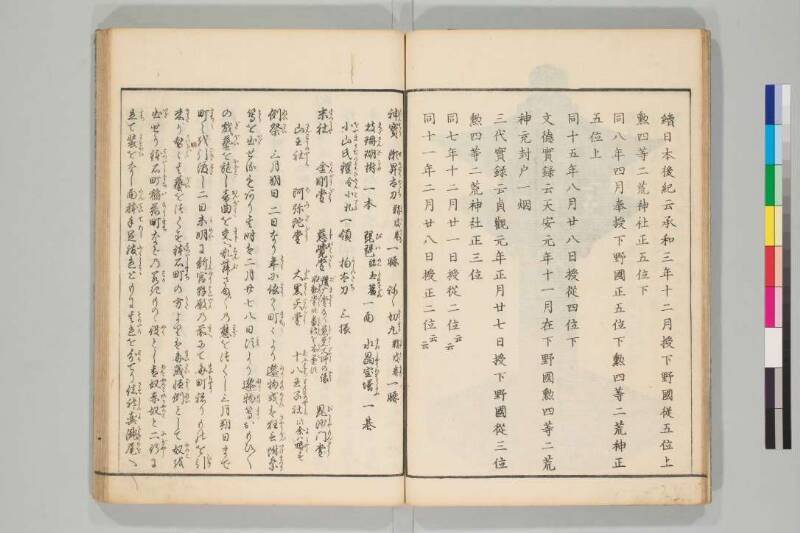
翻刻
【右丁】
續日本後紀云承和三年十二月授下野國従五位上
勲四等二荒神社正五位下
同八年四月奉授下野國正五位下勲四等二荒神正
五位上
同十五年八月廿八日授從四位下
文德實錄云天安元年十一月在下野國勲四等二荒
神充封戸一烟
三代實錄云貞觀元年正月廿七日授下野國從三位
勲四等二荒神社正三位
同七年十二月廿一日授從二位《割書:云| 云》
同十一年二月廿八日授正二位《割書:云| 云》
【左丁】
神寶(じんはう) 瀬昇太刀(せのぼりのたち)《割書:鞘皮巻(さやかはまき)》一腰 ねゝ切丸(きりまる)《割書:鞘皮巻(さやかはまき)》一腰
枝珊瑚樹(えださんごじゆ)一本 琵琶(びは)《割書:銘玉簾(めいたますだれ)》一面 水晶宝塔(すゐしやうのはうたふ)一基
小山氏鎧(をやまうぢのよろひ)《割書:金小札(きんこざね)》一領 柏太刀(かしはたち) 三振
末社(まつしや) 金剛堂(こんがうだう) 慈覺堂(じがくだう)《割書:護广堂(ごまだう)なり慈覚大師(じがくだいし)の像(ざう)|不動堂(ふどうだう)卅 番神(ばんじん)を安置(あんち)す》 毘沙門堂(びしやもんだう)
山王社(さんわうのやしろ) 阿弥陀堂(あみだだう) 大黒天堂(だいこくてんだう) 十八王子社(じふはちわうじのやしろ)《割書:此 余(よ)は略(りやく)す》
例祭(れいさい) 三月朔日二日なり年(とし)に依(より)て町(まち)〻(〳〵)より邌物(ねりもの)或(あるひ)は狂言(きやうげん)附祭(つけまつり)
等(とう)を出(いだ)せるもあり其时は二月廿七八日 頃(ころ)より邌物(ねりもの)等(とう)おもひ〳〵
の戯藝(ぎげい)を施(ほどこ)し音曲(おんぎよく)を交(まじ)へ乱舞(らんぶ)さま〴〵の態(わざ)をつくし三月朔日まで
町(まち)〻(〳〵)を引渡(ひきわた)し二日 未明(みめい)に新宮(しんぐう)拜殿(はいでん)の前(まへ)にて毎町(まいちやう)ねりものを引(ひき)
来(きた)り替(かはる)〻(〴〵)其 藝(げい)をつくす鉢石町(はついしまち)の方(かた)よりは毎歳(まいさい)恒例(ごうれい)として奴(やつこ)を
出(いだ)せり鉢石町(はついしまち)稲荷町(いなりまち)などの若(わか)きものゝ役(やく)とし青奴(あをやつこ)赤奴(あかやつこ)と二行(にぎやう)に
立(たち)て装(よそほひ)をなし面躰(めんてい)手足(てあし)服色(ふくしよく)ともに其色(そのいろ)を分(わか)てり偖(さて)神輿(しんよ)瀧尾(たきのを)へ
現代語訳
【右丁】
続日本後紀によれば、承和三年十二月、下野国従五位上勲四等二荒神社に正五位下を授けた。
同八年四月、下野国正五位下勲四等二荒神に正五位上を奉授した。
同十五年八月二十八日、従四位下を授けた。
文徳実録によれば、天安元年十一月、下野国勲四等二荒神に封戸一煙を充てた。
三代実録によれば、貞観元年正月二十七日、下野国従三位勲四等二荒神社に正三位を授けた。
同七年十二月二十一日、従二位を授けた。
同十一年二月二十八日、正二位を授けた。
【左丁】
神宝 瀬昇太刀(鞘皮巻)一腰、ねね切丸(鞘皮巻)一腰
枝珊瑚樹一本、琵琶(銘玉簾)一面、水晶宝塔一基
小山氏鎧(金小札)一領、柏太刀三振
末社 金剛堂、慈覚堂(護摩堂である。慈覚大師の像を安置する)、不動堂(三十番神を安置する)、毘沙門堂
山王社、阿弥陀堂、大黒天堂、十八王子社(この他は省略する)
例祭 三月朔日・二日である。年によって町々より練り物、或いは狂言・付け祭りなどを出すこともある。その時は二月二十七八日頃より練り物などを思い思いの戯芸を施し、音曲を交えて乱舞し、様々な技をつくして三月朔日まで町々を引き渡し、二日未明に新宮拝殿の前にて毎町練り物を引き来たり、代わる代わるその芸をつくす。鉢石町の方よりは毎歳恒例として奴を出している。鉢石町・稲荷町などの若い者の役とし、青奴・赤奴と二行に立って装いをなし、面体・手足・服色ともにその色を分けている。さて神輿は滝尾へ
英語訳
【Right Page】
According to the Shoku Nihon Kōki (Later Chronicle of Japan Continued), in the twelfth month of Jōwa 3 (836), the rank of Shōgoi-ge (Junior Fifth Rank, Lower Grade) was granted to Futaara Shrine of Shimotsuke Province, which held Jūgoi-jō (Senior Fifth Rank, Upper Grade) and Fourth Class Merit.
In the fourth month of the same eighth year, Shōgoi-jō (Junior Fifth Rank, Upper Grade) was respectfully granted to Futaara Shrine of Shimotsuke Province, which held Shōgoi-ge (Junior Fifth Rank, Lower Grade) and Fourth Class Merit.
In the eighth month, twenty-eighth day of the same fifteenth year, Jūshi-ge (Junior Fourth Rank, Lower Grade) was granted.
According to the Montoku Jitsuroku, in the eleventh month of Ten'an 1 (857), one household of tribute was allocated to Futaara Shrine of Shimotsuke Province with Fourth Class Merit.
According to the Sandai Jitsuroku, on the twenty-seventh day of the first month of Jōgan 1 (859), Shōsanmi (Senior Third Rank) was granted to Futaara Shrine of Shimotsuke Province, which held Jūsanmi (Junior Third Rank) and Fourth Class Merit.
On the twenty-first day of the twelfth month of the same seventh year, Jūnii (Junior Second Rank) was granted.
On the twenty-eighth day of the second month of the same eleventh year, Shōnii (Senior Second Rank) was granted.
【Left Page】
Sacred Treasures: One Senobori sword (leather-wrapped scabbard), one Nene Kirimaru sword (leather-wrapped scabbard)
One branch of coral tree, one biwa lute (inscribed "Tamasudare"), one crystal pagoda
One suit of armor of the Oyama clan (gold kozane scales), three Kashiwa swords
Subsidiary Shrines: Kongō Hall, Jigaku Hall (this is the Goma Hall, enshrining a statue of Jigaku Daishi), Fudō Hall (enshrining the Thirty Guardian Deities), Bishamon Hall
Sannō Shrine, Amida Hall, Daikokuten Hall, Eighteen Prince Shrines (others are omitted)
Regular Festival: Takes place on the first and second days of the third month. Depending on the year, various neighborhoods may present parade floats, kyōgen performances, or auxiliary festivals. During such times, from around the twenty-seventh or twenty-eighth day of the second month, parade floats and various theatrical performances are conducted with music and dancing, displaying all manner of skills as they are passed from neighborhood to neighborhood until the first day of the third month. At dawn on the second day, each neighborhood brings their parade floats to the front of Shingu worship hall, taking turns to display their arts. From Hatsuishi-machi, as an annual custom, servant performers (yakko) are presented. Young men from Hatsuishi-machi and Inari-machi take on this role, standing in two lines as blue and red yakko, with their faces, hands, feet, and clothing colors differentiated accordingly. Then the portable shrine proceeds to Takino...