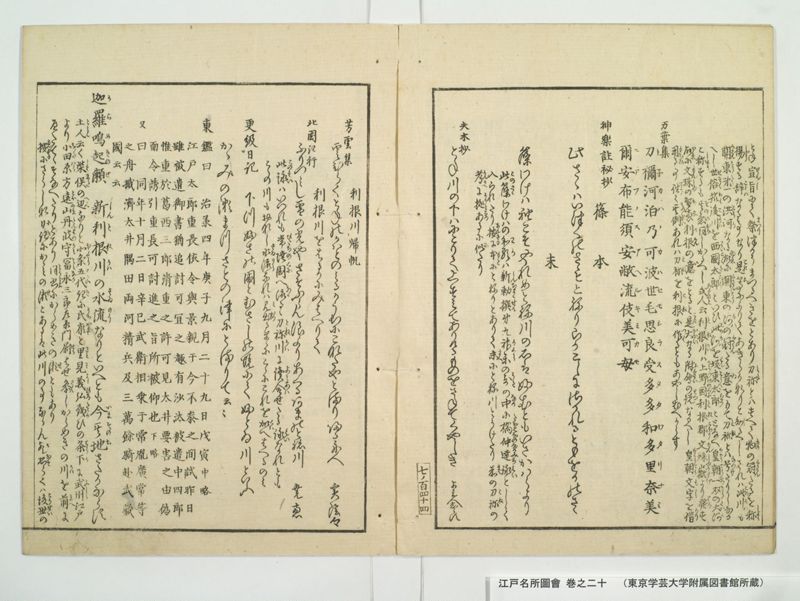
翻刻
とね宣旨(せんし)にて祭(まつり)つかうまつるへきをとあり刀祢(とね)はすへて物(もの)の冠(くわん)たるを称(しよう)
揚(しやう)する辞(ことは)なる事なり是等(これら)によりてあきらかなりと知(し)るへしされは此川(このかは)も
関東(くわんとう)第(たい)一の洪河(こうか)なる故(ゆゑ)に関東(くわんとう)の河(かは)の冠(くわん)たる意(ゐを)もて刀祢(とね)とは号(なつけ)たりしなる
へし世俗(せそく)筑後川(ちくこかは)を西国(さいこく)太郎(たらう)といひ此河(このかは)を坂東(はんとう)太郎(たらう)ととなへ皇朝(くわうてう)一双(いつさう)の大河(たいか)
を称(しよう)するも其意(そのい)同(おな)しかるへし或人(あるひと)云 利根川(とねかは)は上野国(かうつけのくに)利根郡(とねこほり)文珠嶽(もんしゆたけ)より発(はつ)す
故(ゆゑ)に文珠(もんしゆ)の智恵(ちゑ)利根(りこん)の意(い)をとると是(これ)大(おほい)なる附会(ふくわい)の説(せつ)なるへし皇朝(くわうてう)文字(もし)を借(かり)
用(もちひ)る事 往(わう)々 其例(そのれい)あれは刀祢(とね)を利根(とね)に作(つく)るともあやしむへからす
万葉集
刀(ト)禰(ね)河(カ)泊(ハ)乃(ノ)可(カ)波(ハ)世(セ)毛(モ)思(シ)良(ラ)受(ス)多多(タタ)和多里奈(ワタリナ)美(ミ)
爾安布能須安埤敝伎美可母(ニアフノスアヘルキミカモ)
神楽註秘抄
篠 本
此さゝはいつくのさゝととねりらかこしにさかれるともをかのさゝ
未
篠わけは袖こそやれめとね川の石はふむともいさかはらより
此篠(このさゝ)わけはの和歌(わか)は新勅撰(しんちよくせん)第九 神楽(かくら)の歌(うた)の中(なか)に橘仲達(たちはなのなかみち)詠(えい)として【正しくは橘仲遠(たちばなのなかとお)】
入られたり按(あんする)に本(もと)にとねりとありて末(すへ)にとね川とうけたり前(まへ)の刀祢(とね)の
考(かんかへ)に拠(よりところ)あるに似(に)たり
夫木抄
とね川の下はにこりて上すみてありけるものをさねてくやしき よみ人しらす
利根川帰帆
芳雲集
雲ひらくとねのかはとのみるかうちにこなたやとまり帰る舟人 実陰卿
北国
ふりつみし雪の光やさそふらん浪よりあくるあまのとね川 尭恵
此(この)詠(えい)はいつれも常陸国(ひたちのくに)へ
流(なか)るゝ刀祢川(とねかは)に読合(よみあは)せたる詠(えい)なれとも
こゝの川もおなし水流(すゐりう)なれは見出(みいつ)るまゝにこゝにこれを加(くわ)へはへ?るのみ
更級日記 下つふさの国とむさしの境にてふとゐ川といふ
かゝみの瀬まつさとの津にとまりて云々
東鑑曰 治承四年庚子九月二十九日戊寅《割書:中略| 》
江戸太郎重長依令与景親干今不参之間試昨日
雖被遣御書猶追討可宜之趣有沙汰被遣中四郎
惟重於葛西三郎清重之許可見大井要害之由僞
而令誘引重長可討進之旨所被仰也《割書:下略|》
又曰 同年十月二日辛巳武衛相乗于常胤広常等
之舟檝済太井隅田両河精兵及三万余騎赴武蔵
国《割書:云云|》
迦羅鳴起瀬(からめきのせ) 新利根川(しんとねかは)の水流(すゐりう)なりといへとも今(いま)其地(そのち)さたかならす
土人(としん)云く柴俣(しままた)の辺(へん)なりと北条(ほうてう)五代記(こたいき)に氏康(うちやす)と里見(さとみ)義弘(よしひろ)戦(たゝか)ひの条下(てうか)に武州(ふしう)江戸
より小田原(をたはら)方 遠山丹波守(とほやまたんはのかみ)富永(とみなか)三郎左衛門 尉(せう)はせ参(さん)しからめきの川(かは)を前(まへ)に
へたてゝそなへたりとあり同書(とうしよ)にからめきの瀬(せ)ともあり
按(あんする)にさらしな 日記(にき)にかゝみの瀬(せ)とあるは此川の事ならん歟(か)恐(おそ)らくは後世(こうせい)の
現代語訳
刀禰の宣旨によって祭りを執り行うべきであるとある。刀禰とはすべて物事の頂点に立つものを称賛する言葉である。これらによって明らかであると知るべきである。そうであれば、この川も関東第一の大河である故に、関東の川の頂点であるという意味で刀禰と名付けたのであろう。世俗では筑後川を西国太郎といい、この川を坂東太郎と唱え、皇朝一双の大河を称するのも、その意味は同じであろう。ある人が言うには、利根川は上野国利根郡文殊嶽より発する故に、文殊の智慧と利根(聡明)の意味を取るという。これは大いなる付会の説であろう。皇朝では文字を借用することが往々にしてその例があるので、刀禰を利根に作るとも怪しむべきではない。
万葉集
刀禰河泊乃可波世毛思良受多多和多里奈美爾安布能須安埤敝伎美可母
神楽註秘抄
篠本
この篠はどこの篠と、刀禰りらが腰に離れるとも、岡の篠
末
篠分けは袖こそ破れめ、刀禰川の石は踏むとも、いざ川原より
この「篠分けは」の和歌は新勅撰第九、神楽の歌の中に橘仲達の詠として【正しくは橘仲遠】入れられている。按ずるに、本に「とねり」とあって、末に「とね川」と受けている。前の刀禰の考察に拠り所があるようである。
夫木抄
利根川の下は濁りて上澄みて、ありけるものを、さねて悔しき 詠み人知らず
利根川帰帆
芳雲集
雲開く利根の河との見る間に、こなたや泊まり帰る舟人 実陰卿
北国
降り積もし雪の光や誘うらん、波より明くる天の利根川 尭恵
この詠はいずれも常陸国へ流れる利根川に詠み合わせた詠であるが、ここの川も同じ水流なので、見つけるままにここにこれを加える。
更級日記 下総の国と武蔵の境にて太井川という
鏡の瀬、松里の津に泊まって云々
東鑑に曰く 治承四年庚子九月二十九日戊寅【中略】
江戸太郎重長が景親の命に従わず、今に参らない間、昨日御書を遣わされたといえども、なお追討すべきである旨の沙汰があり、中四郎惟重を遣わし、葛西三郎清重の許に、大井の要害を見るという偽りで重長を誘い出し、討ち進めるべき旨を仰せられた【下略】
また曰く 同年十月二日辛巳、武衛(源頼朝)は常胤・広常等の舟に相乗り、太井・隅田両河を渡り、精兵三万余騎をもって武蔵国に赴いた【云々】
迦羅鳴起瀬(からめきの瀬) 新利根川の水流であるというが、今その場所は定かでない。土人が言うには柴俣の辺りであるという。北条五代記に氏康と里見義弘の戦いの条下に、武州江戸より小田原方へ、遠山丹波守・富永三郎左衛門尉が馳せ参じ、からめき川を前に隔てて陣を敷いたとある。同書にからめきの瀬ともある。
按ずるに、更級日記に「鏡の瀬」とあるのは、この川のことであろうか。恐らくは後世の
英語訳
It states that festivals should be conducted according to the "tone" imperial decree. "Tone" is a word that praises those who stand at the pinnacle of all things. From these examples, this should be understood as clear. If so, since this river is also the greatest river in the Kantō region, it was probably named "tone" with the meaning of being the pinnacle of Kantō rivers. Commonly, the Chikugo River is called "Saikoku Tarō" and this river is called "Bandō Tarō," and calling them the imperial court's pair of great rivers probably has the same meaning. Someone says that because the Tone River originates from Mount Monjudake in Tone District of Kōzuke Province, it takes the meaning of Monju's wisdom and "tone" (cleverness). This would be a greatly contrived theory. Since the imperial court often has examples of borrowing characters, it should not be considered strange to write "tone" as "tone" (利根).
Man'yōshū
To-ne-ga-ha no ka-ha-se mo shi-ra-zu ta-ta wa-ta-ri na-mi ni a-fu no su a-he-ru ki-mi ka-mo
Kagura Chū Hishō
Shino-moto
These bamboo grasses - from where do these bamboo grasses come, even if the toneri's waist becomes separated, the bamboo grasses of the hill
Sue
In parting the bamboo grasses, sleeves may tear, but even treading on the stones of Tone River, come from the riverbank
This waka "Shino wake wa" is included in the Shinchokusen, ninth volume, among the kagura songs as composed by Tachibana no Nakatachi [correctly Tachibana no Nakatō]. Upon examination, in the beginning it says "toneri" and at the end it connects with "Tone River." This seems to have basis in the previous consideration of "tone."
Fubokushō
The lower part of Tone River is muddy, the upper part clear - such as it was, how regrettable indeed Anonymous
Tone River Returning Sails
Hōunshū
Clouds part over Tone River - in that moment of viewing, here the boat people moor and return Jitsuinkyō
Hokkoku
Does the light of accumulated snow invite? Dawn breaks over the heavenly Tone River through the waves Gyōe
These poems were all composed about the Tone River flowing to Hitachi Province, but since the river here is the same water flow, I add them here as I encounter them.
Sarashina Diary: At the border between Shimōsa Province and Musashi, it is called Futoi River
At Kagami-no-se, moored at Matsusato harbor, etc.
The Azuma Kagami states: Jishō 4, year of the metal rat, 9th month, 29th day, day of the earth tiger [abbreviated]
Because Edo Tarō Shigenaga has not obeyed Kagechika's orders and has not come even now, although an imperial letter was sent yesterday, there was discussion that he should still be pursued and attacked, so Naka Shirō Koreshige was sent to Kasai Saburō Kiyoshige's place, pretending to inspect the Ōi fortification to lure out Shigenaga and attack him [abbreviated below]
Also states: Same year, 10th month, 2nd day, day of the metal snake, the military guard (Minamoto no Yoritomo) boarded boats with Tsunemochi, Hiromasa and others, crossed both the Ōi and Sumida rivers, and headed to Musashi Province with elite troops of over 30,000 horsemen [etc.]
Karameki-no-se: Although it is said to be the water flow of the New Tone River, its location is not certain today. Local people say it is in the vicinity of Shimamata. In the Hōjō Godaiki, in the section about the battle between Ujiyasu and Satomi Yoshihiro, it states that from Edo in Bushū toward Odawara, Tōyama Tanba-no-kami and Tominaga Saburō Zaemon-no-jō rushed to participate and set up formation with Karameki River in front as a barrier. The same book also calls it Karameki-no-se.
Upon examination, the "Kagami-no-se" mentioned in the Sarashina Diary might refer to this river. Probably in later times...