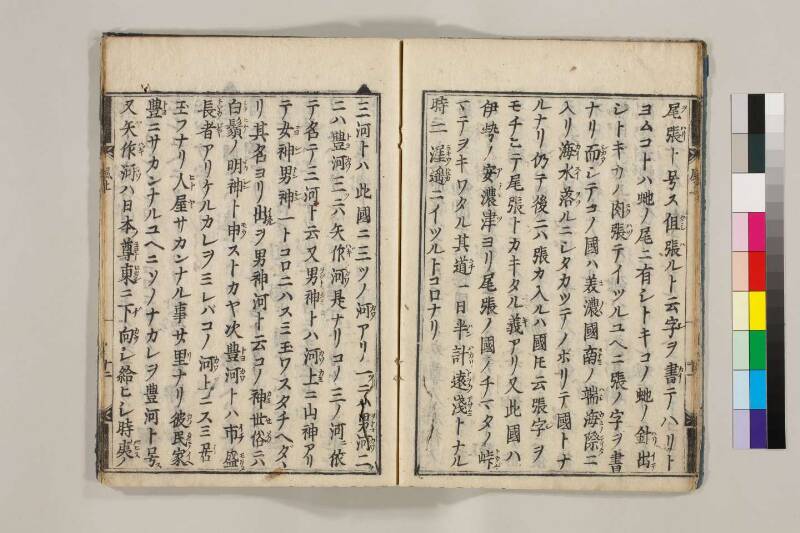
翻刻
【コマ16】
【右丁】
尾張(ヲハリ)ト号ス但(タヽシ)張(ハ)ルト云 字(シ)ヲ書(カイ)テハリト
ヨムコトハ虵ノ尾ニ有シトキコノ虵ノ針(ハリ)出(イテ)
シトキカノ肉(ニク)張(ハツ)テイツルユヘニ張ノ字ヲ書
ナリ而(シカウ)シテコノ國ハ美濃國(ミノヽ ) 南(ミナミ)ノ端(ハシ)海際(ウミノアイタ)ニ
入リ海水(カイスイ)落(ヲツ)ルニシタカツテノボリテ國トナ
ルナリ仍テ後ニハ張カ入ルハ國𪜈云張 字(シ)ヲ
モチヒテ尾張トカキタル義(キ)アリ又此國ハ
伊㔟ノ安濃津(アノヽツ)ヨリ尾張ノ國ノチマタノ峠(トウゲ)
マテヲキワタル其道( ミチ)一日半計( ハンハカリ)遠淺(トヲクアサミ)トナル
時ニ涯(ミキワ)遥(ハルカ)ニイツルトコロナリ
【左丁】
三河トハ 此國ニ三ッノ河(カワ)アリ一ッニハ男河(ヲトコカワ)二ッ
ニハ豊河(トヨカワ)三ッニハ矢作河( ハギカワ)是ナリコノ三ノ河 ̄ニ依
テ名テ三河ト云又 男神(ヲツトカミ)トハ河上(カワカミ)ニ山神アリ
テ女神男神(ニヨシンナンシン)一トコロニハスミ玉ワスタチヘダヽ
リ其名ヨリ出(イスル)ヲ男神河ト云コノ神(カミ)世俗(セソク)ニハ
《振り仮名:白鬚ノ明神|シラヒケ メウシン》ト申(モウ)ストカヤ次 豊河(トヨカワ)トハ市盛(イチモリノ)
長者(チヤウジヤ)アリケルカレヲミレバコノ《振り仮名:河上|カワ□□》ニスミ居(イ)
玉フナリ人屋(ヒトヤ)サカンナル事 廿里( リ)ナリ彼(カノ)民家(タミノイヘ)
豊(トヨ)ニサカンナルユヘニソノナガレヲ豊河ト号 ̄ス
又 矢作河(ヤハギカワ)ハ《振り仮名:日本 ̄ノ尊| ミコト》東(ヒカシ)ニ下向(ゲカウ)シ給ヒシ時《振り仮名:夷|□ヒス》ノ
現代語訳
### 尾張国(おわりのくに)について(承前)
……その場所を「尾張(をはり)」と号する。ただし、「張る」という字を書いて「ハリ」と読むことについては、(かの剣が)蛇の尾にあったとき、この蛇の針(とげ)が出て、そのとき、かの肉が張り出して出てきたゆえに、「張」の字を書くのである。
そして、この国(尾張)は美濃国の南の端、海際(うみのきわ)に入り込み、海水が落ちる(潮が引く)のに従って上ってきて国となったものである。それゆえ、後には「張が入る」は国でもあると言われ、「張」の字を用いて「尾張」と書く意義がある。
また、この国は伊勢の安濃津(あののつ)より尾張の国の「ちまたの峠」まで、沖を渡って行くと、その道のり一日半ほどの距離で、遠く浅瀬となる時に、水際が遥かに広がって現れる土地である。
---
### 三河国(みかわのくに)について
三河とは——この国に三つの川がある。一つには男川(おとこがわ)、二つには豊川(とよかわ)、三つには矢作川(やはぎかわ)、これである。この三つの川によって名付けて「三河」という。
また、「男川(をとこかわ)」とは——川上に山神があって、女神と男神が一か所には住まわれず、立ち隔たっており、その名より出るを「男神川(をとこかみかわ)」という。この神は、世俗には「白鬚の明神(しらひけのみょうじん)」と申すとのことである。
次に「豊川(とよかわ)」とは——市盛(いちもり)の長者がいたが、これを見れば、この川上に住み居られるのである。人家が盛んなること二十里である。彼の民家が豊かに盛んであるゆえに、その流れを「豊川」と号する。
また「矢作川(やはぎかわ)」は——日本武尊(やまとたけるのみこと)が東(あずま)へ下向(げこう)なさった時、夷(えびす)の……
(本頁はここで終わる)
英語訳
### On the Province of Owari (尾張国) — continued
...that place came to be called "Owari" (尾張). However, regarding the writing of the character 張 (hari, meaning "to stretch/extend") and reading it as "hari": when [the sword] was in the tail of the serpent, the serpent's stinger (hari/needle) emerged, and at that time the flesh swelled and protruded outward (hatta/張った), which is why the character 張 is written.
Furthermore, this province (Owari) extends into the southern edge of Mino Province, reaching into the sea, and as the seawater recedes (with the tide), it rises up to form the land of the province. For this reason, it is later said that "hari [the sea] enters" is also a meaning of the province's name, and there is a significance to writing it as "Owari" (尾張) using the character 張.
Moreover, this province is the land that stretches from Ano-no-tsu (安濃津) in Ise Province to the "Chimata-no-Tōge" pass of Owari Province, crossing offshore — a journey of about a day and a half — where the water becomes shallower at a great distance from shore, and the waterline appears to extend far and wide.
---
### On the Province of Mikawa (三河国)
As for Mikawa — there are three rivers in this province. The first is the Otoko-gawa (男川, "Male River"), the second is the Toyo-gawa (豊川, "Abundant River"), and the third is the Yahagi-gawa (矢作川, "Arrow-Making River"). The province is named "Mikawa" (三河, "Three Rivers") after these three rivers.
Regarding the "Otoko-gawa" (Male River) — there is a mountain deity at the headwaters of this river, and the female deity and male deity do not dwell in the same place; they stand apart and are separated from each other. The river takes its name from this [male deity], and is called the "Otoko-kami-gawa" (Male Deity River). This deity is known in popular tradition as "Shirahige-no-Myōjin" (the Bright Deity of the White Beard), so it is said.
Next, regarding the "Toyo-gawa" (Abundant River) — there was a wealthy man called the Elder (chōja) of Ichimori, and if one looks at where he resided, it was at the upper reaches of this river. The houses of the people extended for twenty ri (approximately 80 km). Because the people's homes were prosperous and abundant (toyo ni sakan), the river flowing past them was named the "Toyo-gawa."
As for the "Yahagi-gawa" (Arrow-Making River) — when Yamato Takeru-no-Mikoto was travelling down to the East, at the time of [his encounter with] the barbarians (Ebisu)...
(The page ends here.)