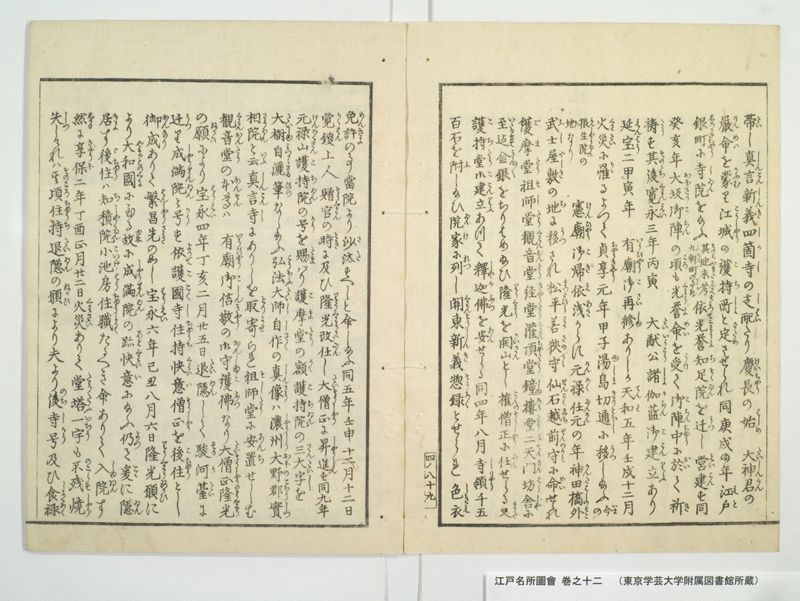
翻刻
【右丁】
帯(たい)し真言新義(しんこんしんき)四箇寺(しかし)の支配(しはい)たり慶長(けいちやう)の始(はしめ) 大神君(たいしんくん)の
嚴命(けんめい)を蒙(かふむ)り江城(こうしやう)の護持所(こちしよ)と定(さため)させられ同庚戌の年 江戸(えと)
銀町(しろかねちやう)に寺院(しゐん)を給ふ《割書:其地(そのち)未考(いまたかんかへす)|九軒町(くけん )の事(こと)欤(か)》依(よつて)光誉(くわうよ)知足院(ちそくゐん)を迁(うつ)し営建(えいこん)す同
癸亥年 大坂(おほさか)御陣(こちん)の頃(ころ)も光誉(くわうよ)命(めい)を受(うけ)て御陣中(こちんちゆう)に於(おい)て祈(き)
祷(たう)す其後(そのゝち)寛永(くわんえい)三年丙寅 大猷公(たいいうこう)諸伽藍(しよからん)御建立(ここんりふ)あり
延宝(えんはう)二甲寅年 有廟(いうひやう)御再修(こさいしゆ)ありしか天和(てんわ)五年壬戌十二月
火災(くわさい)に罹(かゝ)るよつて貞享(ちやうきやう)元年甲子 湯島切通(ゆしまきりとほし)に移(うつ)し給ふ《割書:今(いま)|の》
《割書:根性院(こんしやうゐん)の|地(ち)なり》 憲廟(けんひやう)御帰依(こきえ)浅(あさ)からす元禄(けんろく)任元(にんけん)の年 神田橋(かんたはしの)外(そと)
武士屋敷(ふしやしき)の地(ち)に移(うつ)され松平若狭守(まつたいらわかさのかみ)仙石越前守(せんこくゑちせんのかみ)に命(めい)せられ
護摩堂(ごまたう)祖師堂(そしたう)観音堂(くわんおんたう)経堂(きやうたう)灌頂堂(くわんちやうたう)鐘樓堂(しゆろうたう)二天門(にてんもん)坊舎(はうしや)に
至迠(いたるまて)金銀(きん〳〵)をちりはめ給ひ隆光(りうくわう)を開山(かいさん)とし権僧正(こんのそうしやう)に任(にん)せらる又(また)
護持堂(こちたう)御建立(ここんりふ)あつて釋迦佛(しやかふつ)を安(あん)せらる同四年八月 寺領(しりやう)千五
百石を附(ふ)し給ひ院家(ゐんけ)に列(れつ)し関東(くわんとう)新義(しんき)惣録(そうろく)とせられ色衣(しきえ)
【左丁】
免許(めんきよ)の事當院より沙汰(さた)すへしと命し給ふ同五年壬申十二月十二日
覚鍐上人(かくはん ) 贈官(そうくわん)の時(とき)に及ひ隆光(りうくわう)改任(かいにん)し大僧正(たいそうしやう)に昇進(しやうしん)す同九年
元禄山(けんろくさん)護持院(こちゐん)の号(かう)を賜(たま)はり護摩堂(こまたう)の額(かく)護持院(こちゐん)の三大字(さんたいし)を
大樹(たいしゆ)自(みつから)灑筆(さゐひつ)なし給ふ弘法大師(こうほふたいし)自作(しさく)の真像(しんさう)は濃州(しやうしう)大野郡(おほのこほり)實(しつ)
相院(さうゐん)と云(いふ)真言寺(しんこんし)にありしを取寄(とりよせ)られ祖師堂(そしたう)に安置(あんち)せしむ
観音堂(くわんおんたう)の本尊(ほんそん)は 有廟(いうひやう)御信敬(こしんきやう)の御守護佛(おんしゆこふつ)なり大僧正(たいそうしやう)隆光(りうくわう)
の願(ねかひ)により宝永(はうえい)四年丁亥二月廿五日 退隠(たいゐん)して駿河臺(するかたい)に
迁(うつ)り成満院(しやうまんゐん)と号(かう)す依(よつて)護國寺(ここくし)住持(ちゆうし)快意僧正(くわいいそうしやう)を後住(こちゆう)とし
御成(おんなり)ありて繁昌(はんしやう)先(さき)の如し宝永(はうえい)六年己丑八月六日 隆光(りうくわう)願(ねかひ)に
より大和國(やまとのくに)に至る故(ゆゑ)に成満院(しやうまんゐん)の跡(あと)快意(くわいい)に給ふ仍(よつ)て爰(こゝ)に隠(ゐん)
居(きよ)す後住(こちゆう)は智積院(ちしやくゐん)小池房(こいけはう)住職(ちゆうしよく)たるへき命ありて入院(しゆゐん)す
然(しかる)に享保(きやうほ)二年丁酉正月廿二日 火災(くわさい)ありて堂塔(たうたふ)一宇(いちう)も不残(のこらす)焼(しやう)
失(しつ)しけれは其頃(そのころ)住持(ちゆうし)退隠(たいゐん)の願(ねかひ)により夫より後(のち)寺号(しかう)及ひ食禄(しよくろく)
現代語訳
【右丁】
(知足院・宥俊は)真言新義四箇寺の支配を兼帯し、慶長の始め、大神君(徳川家康)の厳命を蒙り、江城(江戸城)の護持所と定められた。同じ庚戌の年、江戸・銀町に寺院を賜った。《その地はいまだ考えていないが、九軒町のことであろうか。》これにより光誉は知足院を移して堂宇を建設した。同じく癸亥の年、大坂御陣(大坂の陣)の頃も、光誉は命を受けて御陣中において祈祷を行った。その後、寛永三年丙寅(1626年)、大猷公(徳川家光)により諸伽藍が建立された。延宝二年甲寅(1674年)、有廟(徳川秀忠)の廟の再修があったが、天和五年壬戌(1682年)十二月、火災に遭った。よって貞享元年甲子(1684年)、湯島切通しに移し給うた。《今の根性院の地である。》憲廟(徳川綱吉)の御帰依が浅からず、元禄壬元(壬申、1692年)の年、神田橋外の武士屋敷の地に移され、松平若狭守・仙石越前守に命じられ、護摩堂・祖師堂・観音堂・経堂・灌頂堂・鐘楼堂・二天門・坊舎に至るまで、金銀をちりばめ給い、隆光を開山とし権僧正に任ぜられた。また護持堂が建立され、釈迦仏が安置された。同四年(1691年)八月、寺領千五百石を付し給い、院家に列し、関東新義惣録とされ、色衣
【左丁】
免許の事は当院より沙汰すべしと命じ給うた。同五年壬申(実際は五年)十二月十二日、覚鑁上人に贈官の時に及び、隆光は改任し大僧正に昇進した。同九年(1696年)、元禄山護持院の号を賜り、護摩堂の額「護持院」の三大字は、大樹(将軍)が自ら揮毫なさった。弘法大師自作の真像は、濃州(美濃国)大野郡・実相院という真言寺にあったものを取り寄せられ、祖師堂に安置せしめた。観音堂の本尊は、有廟(徳川秀忠)が御信敬の御守護仏である。大僧正・隆光の願いにより、宝永四年丁亥(1707年)二月二十五日、退隠して駿河台に移り、成満院と号した。よって護国寺住持・快意僧正を後住とし、御成(将軍の御来訪)があって、繁昌することは以前の如くであった。宝永六年己丑(1709年)八月六日、隆光の願いにより大和国に至ったため、成満院の跡は快意に賜り、これにより(快意は)ここに隠居した。後住は智積院・小池房の住職たるべき命があって入院した。しかるに享保二年丁酉(1717年)正月二十二日、火災があって堂塔一宇も残らず焼失したため、その頃、住持退隠の願いにより、それ以後、寺号および食禄(ふちまい)…
英語訳
【Right page】
(Chisoku-in's Yūshun) also held administrative authority over the four temples of the Shingon Shingi school, and at the beginning of the Keichō era (c. 1596–1615), by the strict order of Daijin-kun (Tokugawa Ieyasu), the temple was designated as the guardian institution (goji-sho) of Edo Castle. In the same year of Kanoe-inu (1610), a temple site was granted in Shirogane-chō, Edo. 《The exact location has not yet been determined — perhaps it refers to Kuken-chō.》 Accordingly, Kōyo relocated Chisoku-in and constructed the temple buildings. In the same year of Mizunoto-i (1623), around the time of the Siege of Osaka (Osaka no Jin), Kōyo received orders and performed prayers during the military campaign. After that, in Kan'ei 3 (1626), the year of Hinoe-tora, the Lord of Great Heroism (Taiyu-kō, i.e., Tokugawa Iemitsu) had the various temple halls constructed. In Enpō 2 (1674), the year of Kinoe-tora, the Yūbyō (Tokugawa Hidetada's mausoleum) underwent renovation, but in the twelfth month of Tenna 5 (1682), the year of Mizunoe-inu, the temple was struck by fire. Therefore, in Jōkyō 1 (1684), the year of Kinoe-ne, it was relocated to Yushima Kiritōshi. 《This is the site of the present-day Konjō-in.》 The Kenpyō (Tokugawa Tsunayoshi) held deep devotion to the temple, and in the year Mizunoe-saru (1692) of Genroku, it was relocated to a site outside Kandabashi that had been the grounds of samurai residences. Lords Matsudaira Wakasa-no-kami and Sengoku Echizen-no-kami were given orders (to oversee the construction), and the halls — including the Goma Hall, the Patriarch's Hall, the Kannon Hall, the Sutra Hall, the Initiation Hall, the Bell Tower, the Niōmon Gate, and the residential quarters — were lavishly adorned with gold and silver. Ryūkō was designated as the founding abbot and appointed to the rank of Junior Senior Ecclesiastic (Gon-Sōjō). A Goji Hall was also constructed and a Shakyamuni Buddha enshrined therein. In the eighth month of the fourth year of Genroku (1691), the temple was granted a stipend of 1,500 koku, was ranked among the in-ke (imperially affiliated temples), designated as the head administrator (sō-roku) of the Kantō Shingi school, and the authority to grant permission for the wearing of colored robes (shiki-e)
【Left page】
was decreed to be issued from this temple. On the twelfth day of the twelfth month of the fifth year (1692), at the time of the posthumous promotion of the Venerable Kakuban, Ryūkō was reassigned and advanced to the rank of Dai-Sōjō (Senior Archbishop). In the ninth year (1696), the name "Genrokuyama Goji-in" was bestowed upon the temple, and the three large characters "護持院" (Goji-in) on the plaque of the Goma Hall were personally brushed by the Taiju (the Shōgun, i.e., Tsunayoshi). The true likeness of Kōbō Daishi (Kūkai), said to have been made by the saint himself, was procured from a Shingon temple called Jissō-in in Ōno-gun, Nōshū (Mino Province), and enshrined in the Patriarch's Hall. The principal image of the Kannon Hall was the guardian Buddha held in deep veneration by the Yūbyō (Tokugawa Hidetada). At the request of Dai-Sōjō Ryūkō, on the twenty-fifth day of the second month of Hōei 4 (1707), the year of Hinoto-i, he retired and moved to Surugadai, taking the name Shōman-in. Accordingly, the chief priest of Gokoku-ji Temple, Kaii Sōjō, was appointed as his successor, and with the Shōgun's visits (gon-nari), the temple flourished as before. On the sixth day of the eighth month of Hōei 6 (1709), the year of Tsuchinoto-ushi, since Ryūkō had proceeded to Yamato Province at his own request, the Shōman-in residence was granted to Kaii, who accordingly retired there. The subsequent chief priest was ordered to be the incumbent of the Koike-bō of Chishaku-in and duly entered the temple. However, on the twenty-second day of the first month of Kyōhō 2 (1717), the year of Hinoto-tori, a fire broke out and every single hall and pagoda was burned to the ground without exception. As a result, around that time, in accordance with the chief priest's wish to retire, from that point onwards, the temple name and its stipend…