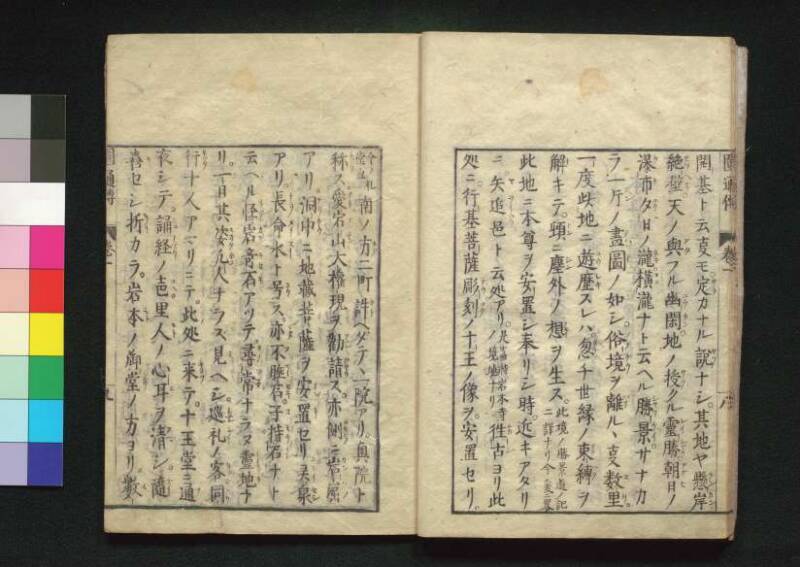
翻刻
【コマ14】
【右丁】
開基ト云㕝モ。定(サタ)カナル說(セツ)ナシ。其地ヤ《振り仮名:懸⁻岸|ケンカン》
《振り仮名:絶⁻壁|セツヘキ》。天ノ與(アタ)フル《振り仮名:幽⁻閑|ユウカン》。地ノ授(サツ)クル《振り仮名:靈⁻勝|レイシヤウ》。朝日(アサヒ)ノ
《振り仮名:瀑₋布|タキ》《振り仮名:夕₋日|ユウ 》ノ瀧(タキ)。《振り仮名:横⁻瀧|ヨコ 》ナト云ヘル《振り仮名:勝⁻景|シヤウケイ》。サナカ
ラ一片( ヘン)ノ《振り仮名:畫⁻圖|クハト》ノ如シ。《振り仮名:俗⁻境|ソクケウ》ヲ離(ハナ)ルヽ㕝《振り仮名:数⁻里|スリ》。
一⁻度此₋地ニ《振り仮名:遊⁻歴|ユウレキ》スレハ。忽(タチマ)チ世縁ノ《振り仮名:束⁻縛|ソクハク》ヲ
解(ト)キテ。頓(トン)ニ塵外(ジン )ノ想(ヲモイ)ヲ生ス。《割書:此境ノ勝景道ノ記|ニ詳ナリ今爰ニ畧》
此地ニ本尊󠄁ヲ安⁻置シ奉リシ時。近キアタリ
ニ。矢追邑(ヤヲイムラ)ト云処アリ。《割書:是當時岩本寺|ノ境地ナリ》《振り仮名:往₋古|ムカシ》ヨリ此
処ニ。行⁻基菩⁻薩《振り仮名:彫⁻刻|テウコク》ノ十⁻王ノ像ヲ。安⁻置セリ。
【左丁】
《割書:今ノ札|堂也》南ノ方(カタ)二町許( ホド)ヘダテヽ一院アリ。奧院ト
称(シヤウ)ス《振り仮名:愛⁻宕⁻山大⁻權⁻現|アタゴサン 》ヲ勸請(クハンジヤウ)ス。亦 側(カタハラ)ニ《振り仮名:岩⁻崫|カンクツ》
アリ。《振り仮名:洞⁻中|トウチウ》ニ地⁻藏菩⁻薩ヲ安置(アンチ)セリ。《振り仮名:㚑⁻泉|レイセン》
アリ。《振り仮名:長命水|チ#1ウメイスイ》ト号(コウ)ス。亦(マタ)《振り仮名:不睡⁻石|フスイセキ》。《振り仮名:子₋持₋石|コモチイシ》ナト
云ヘル。《振り仮名:怪⁻岩|クハイガン》竒石(キセキ)アツテ。《振り仮名:尋₋常|ヨノツネ》ナラヌ靈地(レイチ)ナ
リ。一⁻日 其姿( スカタ)《振り仮名:凢⁻人|ホン 》ナラズ見(ミ)ヘシ。廵礼(シユンレイ)ノ客(カク)。《振り仮名:同⁻|トウ 》
行(キヤウ)十人アマリニテ。此 ̄ノ処ニ来(キタツ)テ。十王堂ニ通(ツ)
夜シテ。誦経(シユキヤウ)ノ声(コヘ)。里人( ヒト)ノ《振り仮名:心⁻耳| ニ》ヲ清(スマ)シ。隨(ズイ)
喜(キ)セシ折(ヲリ)カラ。岩本( モト)ノ《振り仮名:御⁻堂| タウ》ノ方ヨリ。《振り仮名:數⁻|ス 》
現代語訳
【右丁】
開基が誰であるかも、定かなる説がない。その地は懸崖(けんがい)・絶壁(ぜっぺき)にして、天の与える幽閑(ゆうかん)の趣、地の授ける霊勝(れいしょう)の景。朝日の滝、夕日の滝、横滝などと呼ばれる勝景(しょうけい)は、さながら一幅の画図(えず)のようである。俗境(ぞっきょう)を離れること数里、一度この地に遊歴すれば、たちまち世の縁の束縛を解き、ただちに塵外(じんがい)の想いを生ずる。〔この地の勝景は道の記に詳らかなり、今ここに略す〕
この地に本尊を安置し奉った時、近くに矢追村(やおいむら)という処があった。〔これは当時、岩本寺の境地なり〕昔より、この処に行基菩薩彫刻の十王の像を安置していた。
【左丁】
〔今の札堂なり〕南の方、二町ほど隔てて一院あり、奥院と称する。愛宕山大権現(あたごさんだいごんげん)を勧請(かんじょう)する。また傍らに岩窟(がんくつ)あり、洞中に地蔵菩薩を安置せり。霊泉あり、長命水(ちょうめいすい)と号す。また不睡石(ふすいせき)、子持石(こもちいし)などと呼ばれる怪岩・奇石があって、尋常ならぬ霊地である。
ある日、その姿が凡人ならず見えた巡礼の客が、同行十人あまりにて、この処に来て、十王堂に通夜(つや)して、誦経(ずきょう)の声が里人の心耳を清め、随喜(ずいき)させた折から、岩本の御堂の方より、数……
英語訳
[Right page]
As for who founded the temple, there is no definitive account. The land there features sheer cliffs and precipitous rock faces; the tranquil seclusion bestowed by heaven, the spiritually sublime scenery granted by the earth. The Asahi Falls, the Yūhi Falls, the Yoko Falls, and other scenic wonders are altogether like a single painted picture scroll. Situated several *ri* removed from the mundane world, once one has made the journey to this place, one immediately shakes off the bonds of worldly attachment and at once gives rise to thoughts beyond the dust of the world. [The scenic beauty of this place is described in detail in the *Michi no Ki* (travel record); I therefore omit it here.]
At the time the principal image was enshrined here, nearby there was a place called Yaoi Village (矢追村). [This was at the time within the precincts of Iwamoto-ji temple.] Since ancient times, images of the Ten Kings of the Underworld, carved by Bodhisattva Gyōki, had been enshrined in this place.
[Left page]
[This is what is now the *fuda-dō* (tablet hall).] Approximately two *chō* to the south, separated from the main hall, there is a sub-temple called the *Oku-no-in* (Inner Sanctuary). The Great Avatar of Atago Mountain (*Atago-san Daigongen*) has been ritually invited to reside there. Beside it there is also a rocky cave (*gankutsu*), within which a statue of Jizō Bodhisattva has been enshrined. There is a sacred spring, known as the *Chōmei-sui* ("Water of Long Life"). Furthermore, there are strange rocks and curious stones known as the *Fusui-seki* ("Sleepless Stone") and the *Komochi-ishi* ("Child-bearing Stone"), making this an extraordinary sacred site.
One day, a party of pilgrims — more than ten companions travelling together — whose appearance seemed unlike that of ordinary people, came to this place and kept an all-night vigil (*tsuya*) at the Hall of the Ten Kings, chanting sutras. The sound of their recitation purified the minds and ears of the villagers, who rejoiced with deep spiritual gladness (*zuiki*). It was at that very moment that from the direction of the main hall at Iwamoto, several...