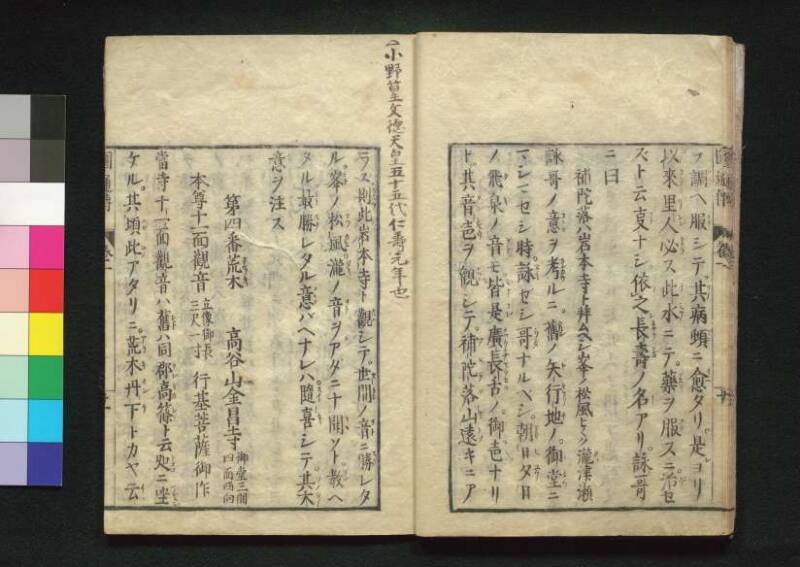
翻刻
【コマ16】
【右丁】
ヲ調(トヽノ)ヘ服(フク)シテ。其病(ソノ )頓(トン)ニ愈(イヘ)タリ。是《送り仮名:レ》ヨリ
《振り仮名:以₋來|コノカタ》。《振り仮名:里⁻人|リシン》必(カナラ)ス《振り仮名:此₋水|コノミツ》ニテ。藥(クスリ)ヲ服(フク)スニ。治(ヂ)セ
ズト云 㕝(コト)ナシ。依 ̄テ_レ之 ̄ニ《振り仮名:長⁻壽|チヤウシユ》ノ名(ナ)アリ。詠⁻哥
ニ曰
補陀落ハ岩本寺ト拜ムヘシ峯ノ松風ヒヽク瀧津瀬(タキ )
詠哥ノ意(コヽロ)ヲ考(カンカウ)ルニ。《振り仮名:𦾔|ムカシ》ノ《振り仮名:矢⁻行⁻地|ヤキヤウチ》ノ。御堂(ミタウ)ニ
マシマセシ時。詠(ヱイ)ゼシ哥(ウタ)ナルベシ。《振り仮名:朝₋日|アサヒ》《振り仮名:夕₋日|ユウ 》
ノ飛泉(タキ)ノ音(ヲト)モ。皆(ミナ)是(コレ)《振り仮名:廣⁻長⁻舌|クワウチヤウセツ》ノ。御声(ミコヘ)ナリ
ト。其《振り仮名:音⁻声|ヲンシヤウ》ヲ觀(クハン)シテ。《振り仮名:補⁻陀⁻落⁻山|フタラクセン》遠(トヲ)キニア
【左丁】
ラズ。則(スナハチ)此 ̄ノ岩₋本₋寺ト觀(クハン)シテ。《振り仮名:世⁻間|セケン》ノ音(ヲト)ニ勝(スク)レタ
ル。峯(ミネ)ノ《振り仮名:松₋風|マツカセ》。瀧(タキ)ノ音(ヲト)ヲ。アダニナ聞(キヽ)ソト。教(ヲシ)ヘ
タル。最勝(イトスク)レタル意(コヽロ)バヘナレハ。《振り仮名:隨⁻喜|スイキ》シテ。其(ソノ)《振り仮名:大⁻|タイ 》
意(イ)ヲ注ス
第四番 荒木(アラキ) 高谷山金昌寺《割書:御堂三間|四面西向》
本尊󠄁十一面觀音《割書:立像御長|三尺一寸》 行基菩薩御作
當寺十一⁻面觀⁻音ハ𦾔(モト)ハ同 郡高篠(クンタカシノ)ト云 処(トコロ)ニ㘴(マシマシ)
ケル。《振り仮名:其₋頃| コロ》此(コノ)アタリニ。《振り仮名:荒木丹⁻下|アラキタンケ》トカヤ云(イヽ)
【枠外】
△小野篁文德天皇五十五代仁壽元年也
現代語訳
【右丁】
を調えて服用したところ、その病はたちどころに癒えた。これより以来、里人は必ずこの水にて薬を服用すれば、治らないということがない。これによって「長寿」の名がある。詠歌に曰く、
補陀落は岩本寺と拝むべし 峯の松風響く瀧津瀬
詠歌の意を考えるに、昔の矢行地の御堂においでになった時に詠ぜし歌なるべし。朝日・夕日に輝く飛泉(滝)の音も、みなこれ広長舌(こうちょうぜつ)の御声なりと、その音声を観じて、補陀落山は遠きにあらず。
【左丁】
すなわちこの岩本寺と観じて、世間の音に勝れたる峯の松風・滝の音を、あだに(むなしく)聞くなかれと、教えたる、いと優れたる心ばえなれば、随喜して、その大意を注す。
第四番 荒木 高谷山金昌寺(御堂三間四面、西向き)
本尊 十一面観音(立像、御長三尺一寸) 行基菩薩御作
当寺の十一面観音は、もとは同郡高篠(たかしの)という処においでになった。その頃このあたりに、荒木丹下(あらきたんげ)とかや言う
【枠外】
△小野篁(おののたかむら)は文徳天皇(五十五代)、仁寿元年なり。
英語訳
[Right page]
...prepared as a medicinal decoction and drank it, whereupon the illness was suddenly and completely cured. From that time onward, whenever the villagers took medicine using this water, there was never a case in which they failed to recover. For this reason, the spring came to be known by the name "Long Life" (*Chōju*). The verse composed in its praise reads:
*Fudaraku is Iwamoto-ji — let us reverently behold it:*
*the pine-wind echoes over the peaks, and the cascading rapids roar.*
Reflecting on the meaning of this verse, it was likely composed when the sacred image still resided in the old hall at Yakyōchi. The sound of the waterfall, shining in the morning and evening sun, is — in its entirety — the voice of the All-Encompassing Tongue (*kōchōzetsu*) of the Buddha. Contemplating these sounds, one realizes that Mount Fudaraku (Potalaka) is not far away.
[Left page]
Indeed, one should regard this very Iwamoto-ji as Fudaraku itself, and one should not idly let pass — without due attention — the sound of the pine wind over the peaks and the roar of the waterfall, which surpass all worldly sounds. As this poem teaches with supremely profound intent, I record its great meaning here with a heart full of joyful reverence (*zuiki*).
---
**The Fourth Place: Araki — Kōkokuzan Kinshō-ji**
*(The hall measures three *ken* on each of four sides; faces west.)*
**Principal Image: Eleven-faced Kannon** *(standing figure, height: three shaku one sun)* — **Carved by the Bodhisattva Gyōki**
The Eleven-faced Kannon of this temple originally resided in a place called Takashino in the same district. Around that time, in this vicinity, there was a person known as Araki Tange...
---
[Margin note]
△ Ono no Takamura: [this refers to the era of] Emperor Montoku, the fifty-fifth emperor — the first year of the Ninjū era.