翻刻
西陣の町小路にはいにしへより
もろ〳〵の呉服織出す事
際限なし金襴錦唐織の
るいなど新もやうを織んと
思ふ時は其地紋を紙に圖し
竪横に糸の如く筋を引花
には糸数何ほどゝ定め
其織物の機組を白
き糸にて十分一の
雛形を拵るなり是を
求めて手本とし糸
配してさま〳〵の地紋
ある品を織出す也
名づけて高機と
いふ
錦織
躰
天鵞絨は針
金を入て織也
紋天鵞絨は其
針金の浮沈
天鵞絨
にてもやう
顕るゝなり
天鵞絨
をる
てい
現代語訳
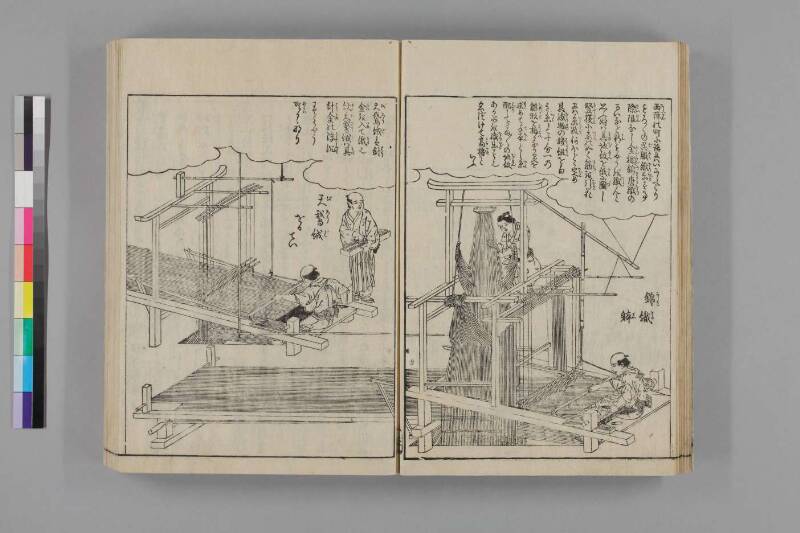
西陣の町の小路では、古くからさまざまな呉服(絹織物)を織り出すことが絶えることなく行われている。金襴・錦・唐織などの類で、新しい模様を織ろうと思う時は、その地紋を紙に図案として描き、縦横に糸のように筋を引き、花柄には糸の本数を何本と定め、その織物の機の組み立てを白い糸で十分の一の雛形(ひながた)を作るのである。これを手本として求め、糸を配してさまざまな地紋のある品を織り出すのである。これを「高機(たかはた)」と呼ぶ。
【錦織の図】
天鵞絨(ビロード)は、針金を入れて織るものである。紋天鵞絨(もんびろうど)は、その針金の浮き沈みによって模様が現れるのである。
【天鵞絨を織る図】
英語訳
In the alleyways of the Nishijin district, various types of silk fabrics have been woven without cease since ancient times. When weavers wish to create new patterns in fabrics such as kinran (gold brocade), nishiki (brocade), and karaori (Chinese-style weave), they first draw the ground pattern on paper, ruling lines both vertically and horizontally like threads, determining the exact number of threads for floral motifs, and then creating a one-tenth scale model of the loom's structure using white thread. This model is then used as a reference to arrange the threads and weave various items with different ground patterns. This method is called "takahata" (high loom).
[Illustration of Nishiki (brocade) weaving]
Velvet (birōdo/天鵞絨) is woven by inserting metal wires. In patterned velvet (mon-birōdo), the pattern emerges through the raising and lowering of these metal wires.
[Illustration of velvet weaving]