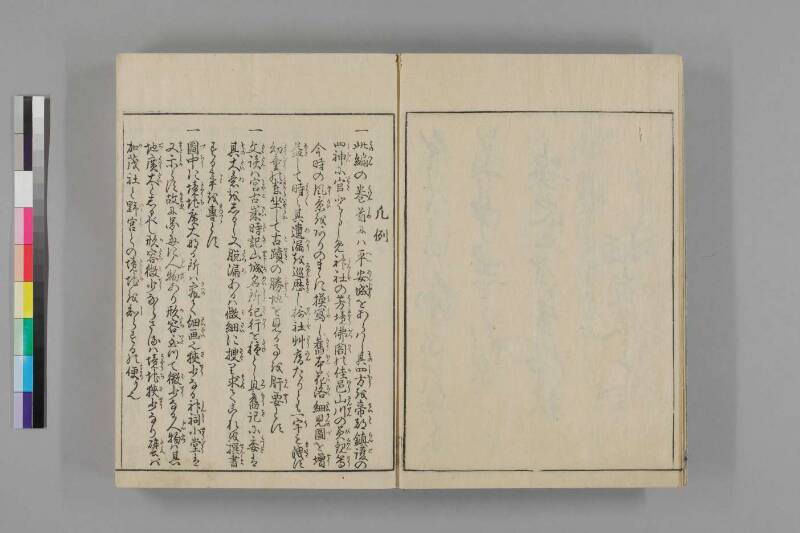
翻刻
【コマ6】
【右丁 文字無し】
【左丁】
凢例
一 此編(このへん)の巻首(くはんしゆ)には平安城(へいあんじやう)をあらはし其(その)四方(しほう)を帝都鎭護(ていとちんご)の
四神(しじん)に官(つかさ)とらしめ神社(しんしや)の芳境(はうきやう)佛閣(ぶつかく)の佳邑(かゆう)山川(さんせん)の美観等(びくはんとう)
今時の風景(ふうけい)をありのまゝに摸冩(もしや)し《振り仮名:𦾔本|きうほん》花洛細見圖(くはらくさいけんのづ)を增(ぞう)
益(ゑき)して時々(より〳〵)其 遺漏(ゐろう)を巡歴(しゆんれき)し摂社(せつしや)艸庵(さうあん)たりとも一宇( う)も洩(もらさ)す
幼童(ようだう)の軰(ともから)坐(いなからに)して古蹟(こせき)の勝地(しやうち)を見る事を肝要(かんやう)とす
一 文談(もんたん)は宮古歳時記(みやこさいじき)山城名所紀行(やましろめいしよきかう)を種(たね)とし且(かつ)《振り仮名:𦾔記|きうき》に委(くはしき)は
其(その)大意(たいゐ)をしるし又《振り仮名:脱漏|たつろ#1》あるは微細(みさい)に搜(さぐ)り求(もとめ)てこれを撰書(せんしよ)
する事(こと)を專(もつはら)とす
一 圖中(づちう)に境地(きやうち)廣大なる所は究(きはめ)て細画(さいぐは)也 狹少(させう)なる神祠小堂(しんしせうだう)は
又(また)尓(しか)らす故(かるかゆへ)に圖毎に人物(じんぶつ)あり形容(かたち)至(いた)つて微少(みせう)なる人物(じんふつ)は其
地(ぢ)廣大(くわうだい)としるべし形容(かたち)微少(みせう)ならさるは境地(きやうち)狹少(させう)なり譬(たとへ)ば
加茂社(か )と野宮(のゝみや)との境地(きやうち)を知(し)らするの便(たより)り#2也
現代語訳
## 凡例(はんれい)
一、この書の巻頭には平安城(京都)を示し、その四方を帝都を守護する四神に司らせ、神社の清らかな境内、仏閣の美しい地域、山川の美しい景観などを、現在の風景をありのままに模写し、旧本である『花洛細見図』を増補して、その都度、漏れた箇所を巡り歩き、摂社・草庵であっても一棟も漏らすことなく、子供たちが家にいながらにして古跡の名勝を見ることができるようにすることを主な目的とする。
一、文章については、『宮古歳時記』・『山城名所紀行』を基本資料とし、また旧記に詳しいものはその大意を記し、さらに脱漏のある箇所は細かく調べ求めて、これを選んで書き記すことを専らとする。
一、図の中で、境内・敷地が広大な場所は、極めて細かく描いている。狭い神社・小堂はそうではない。そのため、図ごとに人物が描かれており、人物の形が非常に小さい場合はその土地が広大であると理解すべきであり、人物の形が小さくない場合は境内・敷地が狭いということである。たとえば、賀茂社と野宮の境内の広さの違いを示すための方便である。
英語訳
## Editorial Notes (Hanrei)
Item 1: At the beginning of this volume, we present Heianjo (Kyoto), with its four directions entrusted to the four guardian deities (Shijin) that protect the imperial capital. The scenic beauty of shrine precincts, the pleasant surroundings of Buddhist temples, and the magnificent views of mountains and rivers are depicted faithfully as they appear today. Building upon the earlier work *Karaku Saiken no Zu*, we have personally visited locations to supplement any omissions, leaving out not a single structure, even branch shrines or hermitages, with the primary purpose of allowing even children to view famous historic sites and scenic spots from the comfort of their own homes.
Item 2: For the written descriptions, *Miyako Saijiki* and *Yamashiro Meisho Kiko* serve as the primary source materials. Where older records contain detailed information, we summarize their main points; where omissions exist, we have carefully researched and sought out the details, making it our principal aim to compile and record these findings.
Item 3: Places with vast precincts or grounds are depicted in extremely fine detail within the illustrations. Small shrines and minor halls are not treated in this way. For this reason, human figures appear in each illustration, and where the figures are depicted very small, the reader should understand that the site is expansive; where the figures are not small, the precincts are narrow. This is offered as a guide to understanding the difference in scale between, for example, the Kamo Shrine and Nonomiya Shrine.