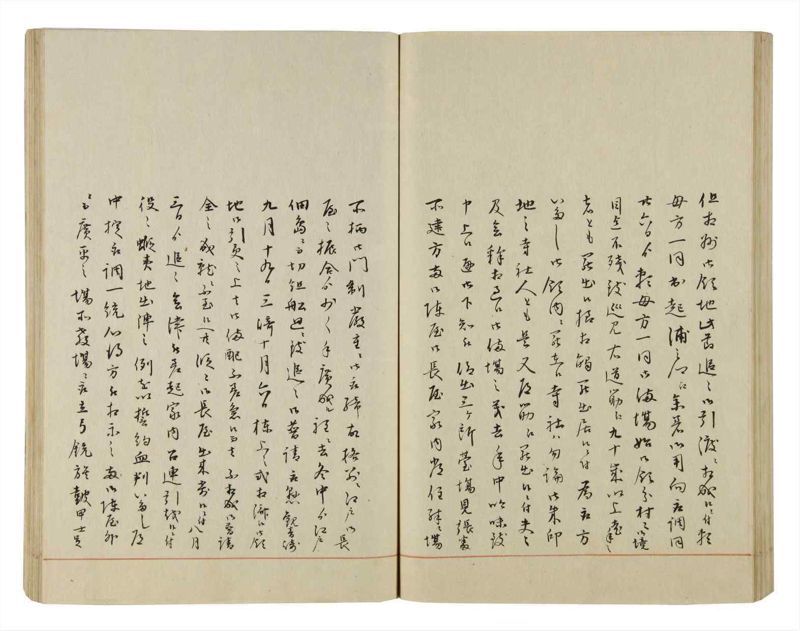
翻刻
但相州御領地此節追々御引渡ニ相成候ニ付頼
母方一同出起浦之郷江参着御用向取調同
廿六日ゟ頼母方一同御備場始御領分村々御境
目迄不残致巡見右道筋江九十歳以上老年之
者とも罷出候様相触罷出居候ニ付為取方
いたし御領内ニ罷在候寺社ハ勿論御朱印
地之寺社人とも是又道筋江罷出候ニ付夫々
及会釈相過候御備場之義去年中吟味致
申上候通御下知被 仰出三ケ所台場見張番
所建方両御陣屋御長屋家内常住殊ニ場
所柄御門制厳重ニ御取締故格別ニ江戸御長
屋々振合ゟ少く手広成ル程ニ去冬中ゟ江戸
佃島ニ而切組船廻ニ致追々御普請取懸観音崎
九月十九日三崎十月六日棟上之式相済候御領
地御引受之上者御備配不差急候而者不相成御普請
全之成就ニ不至候へ共段々御長屋出来寄候ニ付八月
三日ゟ追々会津被差起家内召連引越候ニ付
役々蝦夷地出陣之例を以誓約血判いたし道
中掟取調一統心得方被相示之両御陣屋外
ニ而広平之場所教場ニ取立弓銃旗鼓甲士足
現代語訳
但し、相州御領地がこの節(時期)に追々(次第に)御引き渡しになるにつき、頼母の方と一同、出立して浦之郷へ参着し、御用向きを取り調べ、同二十六日より頼母の方と一同、御備え場を始め、御領分の村々・御境目まで残らず巡見を行った。右(前述の)道筋に、九十歳以上の老年の者どもが罷り出るよう相触れたところ、罷り出て居ったにつき、取り方(接遇・表敬)をいたした。また、御領内に罷り在る寺社はもちろん、御朱印地の寺社の人々もまたこれ、道筋へ罷り出たにつき、それぞれ会釈に及び相過ぎた。御備え場については、去年中に吟味し申し上げた通り、御下知を仰せ出され、三か所の台場・見張番所の建て方、両御陣屋の御長屋・家内の常住、殊に場所柄から御門制を厳重に御取締のため、格別に江戸の御長屋の棟割り(間取り)よりも少なく、手広くなる程に、去冬中より江戸佃島において切り組み(材木を加工・組み立て)、船廻し(船で輸送)にて、追々御普請に取り掛かり、観音崎においては九月十九日、三崎においては十月六日に棟上げの式が相済んだ。御領地の御引き受けの上は、御備えの配置を急がずにはいられず、御普請の全き成就には至らなかったものの、段々と御長屋が出来てきたにつき、八月三日より追々、会津より(家族を)差し起こし、家内を召し連れ引っ越してきたにつき、役々(役人たち)は蝦夷地出陣の例をもって誓約・血判をいたし、道中の掟を取り調べ、一統(全員)に心得方を相示した。両御陣屋の外において広く平らな場所を教場に取り立て、弓・銃・旗・鼓・甲士の足(並み)…
英語訳
Note: As the domain lands (*go-ryōchi*) in Sagami Province were being handed over in succession at this time, [he and his party] departed together with Tanomo and arrived at Ura-no-gō, where they investigated the official matters at hand. From the twenty-sixth day of the same month, Tanomo's entire party conducted a thorough inspection (*junken*) of all the defensive positions (*go-sonae-ba*), the villages throughout the domain territory (*go-ryōbun*), and as far as the boundary markers (*go-sakaime*). Along the inspection route, word had been put out (*ai-fure*) that elderly persons aged ninety and above should present themselves, and indeed they came forth, whereupon [he] performed the appropriate ceremonial greetings (*tori-kata*). Furthermore, as the shrines and temples (*jisha*) within the domain territory came out to the roadside — including those of the *go-shūin-chi* (temple and shrine lands held under shogunal seal) — [he] exchanged appropriate courtesies (*e-shaku*) with each as [the party] passed along the route. Regarding the defensive positions, just as had been investigated and reported the previous year, orders (*go-gechi*) were issued, and [construction work commenced on] the building of three battery emplacements (*daiba*) and watchtower guard posts (*miharibanjo*), long-house residential quarters (*o-nagaya*) at both garrison headquarters (*go-jin'ya*), and permanent family quarters (*kainai jōjū*). In particular, given the nature of the location, in order to maintain strict control of the gate regulations (*go-monsei*), the structures were designed to be somewhat more spacious than the Edo long-houses (*o-nagaya*) — smaller in number of units yet more generous in width. Since the previous winter, the timber had been cut and pre-assembled (*kirikumi*) on Tsukishima in Edo, transported by ship (*funemaわし*), and construction was gradually undertaken. The ridge-raising ceremony (*mune-age no shiki*) was completed at Kannonzaki on the nineteenth day of the ninth month, and at Misaki on the sixth day of the tenth month. Upon formally taking charge of the domain lands, it was not possible to delay the deployment of the defensive garrison (*go-sonae haichi*). Although the full completion of all construction had not yet been achieved, as the long-house quarters were being progressively completed, from the third day of the eighth month, families (*kainai*) were dispatched from Aizu in succession and moved in with their households. Accordingly, the various officials (*yaku-yaku*) took oaths and signed in blood (*seiyaku keppan*) following the precedent established for the Ezo expedition (*Ezochi shussin*), the regulations for conduct during travel (*dōchū okite*) were drawn up, and the code of conduct was made known to all. At a wide, flat location outside both garrison headquarters, a training ground (*kyōjō*) was established, [for the practice of] archery, gunnery, flag-bearing, drum [signaling], and mounted warrior (*kōshi*) foot drills...