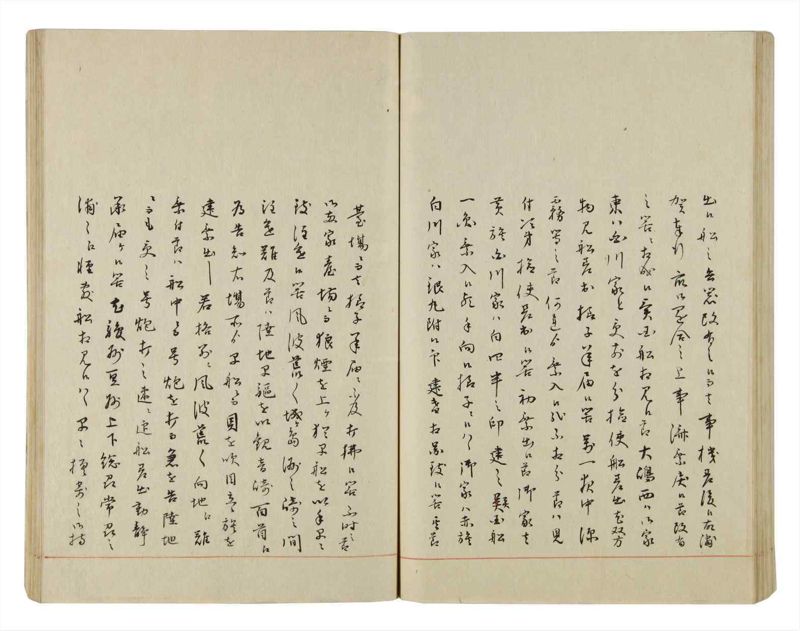
翻刻
出候船之兵器改有之候而者事機差後候故浦
賀奉行衆御懸合之上事済乗戻候節改有
之筈ニ相成候異国船相見候節大島西ハ御家
東ハ白川家と受前を分検使船差出尤双方
物見船差出様子承届候筈万一夜中深
霧等之節何れゟ乗入候哉不相分節ハ見
付次第検使差出候筈初乗出候節御家者
黄旗白川家ハ白四半之印建之《見せ消ち:異|異》国船
一円乗入候歟手向候様子ニ候ハヽ御家ハ赤旗
白川家ハ銀丸附候印建替相図致候筈其節
台場ニ而者様子承届ニ不及打払候筈不時之節
御両家台場ニ而狼煙を上ケ猶早船を以手早ニ
致注進候筈風波荒く城ケ島洲之崎之間
注進難及節ハ陸地早駆を以観音崎百首江
為告知右場所ゟ早船ニ而貝を吹目立候旗を
建乗出し若格別ニ風波荒く向地江難
乗付節ハ船中ニ而号炮を打而急を告陸地
ニ而も受之号炮打之速ニ迎船差出動静
承届ケ候筈尤駿州豆州上下総州常州之
浦々江軽敷船相見候ハヽ早々模寄之御持
現代語訳
出候船の兵器改めがあっては事機(事の機会・タイミング)が遅れるため、浦賀奉行衆と御懸け合い(交渉・協議)の上、事が済んで乗り戻る(帰港する)節に改めがある筈に相成った。異国船が相見え(現れ)た節には、大島より西は御家(会津藩)、東は白川家と受け前(担当区域)を分け、検使船を差し出し、もっとも双方から物見船を差し出して様子を承り届ける筈。万一、夜中・深霧等の節、いずれより乗り入れたか相分からぬ節は、見付け次第検使を差し出す筈。初めて乗り出す節、御家は黄旗、白川家は白四半の印を建て、異国船が一円(全面的に)乗り入れるか、手向かう(抵抗・攻撃する)様子に候はば、御家は赤旗、白川家は銀丸付きの印に建て替え、相図(合図)を致す筈。その節、台場においては様子を承り届けるには及ばず、打ち払う筈。不時(不意・緊急)の節は、御両家の台場において狼煙を上げ、なお早船をもって手早に注進致す筈。風波荒く、城ケ島・洲の崎の間、注進に及び難い節は、陸地の早駆けをもって観音崎・百首(ひゃくしゅ)へ告げ知らせ、右場所より早船にて貝を吹き、目立つ候旗を建て、乗り出し、若し格別に風波荒く向かいの地へ乗り付け難い節は、船中にて号砲を打って急を告げ、陸地においても受けの号砲を打ち、速やかに迎え船を差し出し、動静を承り届ける筈。もっとも、駿州・豆州・上下総州・常州の浦々へ軽しく(不審な)船が相見え候はば、早々と模寄り(最寄り)の御持…
英語訳
...should there be an inspection of weapons aboard ships departing [from the garrison], it would cause delay in operational timing (*jiki*); therefore, following consultations (*o-kakiai*) with the Uraga Magistrates (*bugyō-shū*), it was arranged that such inspections would take place upon returning after the matter had been concluded. When a foreign ship (*ikoku-sen*) was sighted, the area to the west of Ōshima Island would be the responsibility of our domain (*o-ie*, i.e., the Aizu domain), and the area to the east would be the responsibility of the Shirakawa domain (*Shirakawa-ke*), with each dispatching an inspection vessel (*kenshi-sen*); furthermore, both sides were to dispatch scout vessels (*monomi-bune*) to ascertain the situation. In the event that, during the night or in dense fog and the like, it could not be determined from which direction a vessel had entered, an inspection vessel was to be dispatched as soon as it was sighted. Upon initial sortie, our domain would display a yellow flag (*ki-hata*), and the Shirakawa domain would display a white quarter-flag (*shiro-shihan no shirushi*). Should the foreign ship appear to be entering in full force or to be offering resistance (*temuka*), our domain would switch to a red flag (*aka-hata*), and the Shirakawa domain would switch to a flag bearing a silver circle (*gin-maru*) as its mark, thus signaling to one another. At that point, the shore batteries (*daiba*) would not need to wait for further reports on the situation but were to open fire and repel [the vessel]. In the event of a sudden emergency (*fuji*), both domains' shore batteries were to fire signal rockets (*noroshi*), and additionally dispatch fast boats (*hayabune*) to deliver urgent reports without delay. Should wind and waves be rough, making it difficult to send reports between Jōgashima Island and Sunosaki Cape, fast land couriers (*riku hayagake*) were to be sent to notify Kannonsaki and Hyakushu; from those locations, fast boats were to set out blowing conch shells (*kai*) and displaying conspicuous signal flags (*medatsu hata*). If the wind and waves were particularly severe and it proved impossible to land on the opposite shore, a signal gun (*gōhō*) was to be fired from aboard ship to signal the emergency, and upon hearing it, a corresponding signal gun was to be fired on land, with a reception boat (*mukae-bune*) promptly dispatched to receive and ascertain the situation. Furthermore, should a suspicious vessel (*karushiku fune*) be sighted along the coastal areas of Suruga Province (*Sunshū*), Izu Province (*Zushū*), Upper and Lower Shimōsa Provinces (*Kami-Shimo Sōshū*), and Hitachi Province (*Jōshū*), the nearest [domain] (*moyori no o-mochi*) was to be promptly...