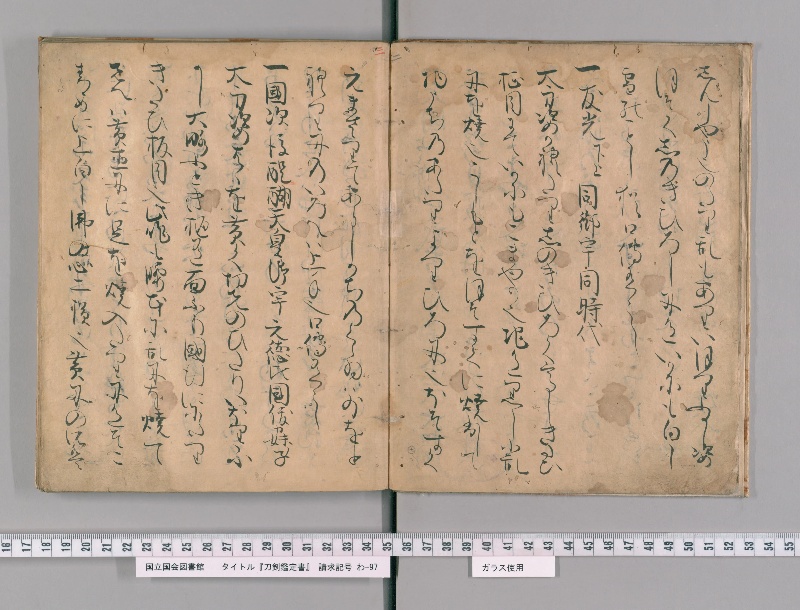
翻刻
しんしやう也のたり乱もありいほりふるし姿
ほそくしのきひろし刃色いかにも白し
雪のことし猶口伝有之
一友光《割書:下上》同御宇同時代
太刀姿かれたりしのきひろく高しきたひ
柾目にていかにもこまやか也地色黒し小乱
刃を焼也こしもとをほそすくに焼出して
物うちのあたりよりひろ刃也ほそすく
元まさりてありしかちのくらゐは少をと
れり刃のいろへは上手也口伝有之
一国次後醍醐天皇御宇元徳比国後か妹の子
太刀姿はくを黄く切先のひたりいほりふ
かし大略ふとき樋有面ふり国行ににたり
きたひ板目也此作りも腰本に乱刃を焼て
先へは黄直刃に足を焼入たり刃色そこ
青めに上向し佛の心二様也黄刃の所は
現代語訳
(前ページより続き)真正(しんしょう)である。のたり乱れもあり、庵(いほり)は古い。姿は細く、鎬(しのぎ)は広い。刃色はいかにも白く、雪のようである。なお口伝がある。
一、友光《割書:下上》同じ御代、同時代
太刀の姿は枯れており、鎬は広く高い。鍛えは柾目で、いかにも細やかである。地色は黒い。小乱れ刃を焼いている。腰元を細くまっすぐに焼き出して、物打ちのあたりより広刃となっている。細くまっすぐな元(もと)が勝っており、刃の位(くらい)は少し劣っている。刃の色映りは上手である。口伝がある。
一、国次 後醍醐天皇の御代、元徳年間頃、国後(くにのち)の妹の子
太刀の姿は白みがかって黄色く、切先の左(ひたり)は庵(いほり)が深い。おおよそ太い樋(ひ)があり、面(おもて)ふりは国行に似ている。鍛えは板目である。この作りも腰元に乱れ刃を焼いて、先へは黄色みを帯びた直刃(すぐは)に足を焼き入れてある。刃色は底から青みがかって上向きであり、仏(ほとけ)の心の二様である。黄刃の所は
英語訳
(Continued from previous page) ...is genuine/authentic. There is also a notarimidare (gently undulating irregular) pattern, and the iori (ridgeline of the kissaki) is of an old style. The shape is slender, with a wide shinogi (ridge). The hamon color is remarkably white, like snow. Further oral tradition exists.
1. Tomomitsu 《Marginal note: Lower-Upper [rank]》 Same reign, same period
The shape of the tachi is withered/austere in character, with a wide and high shinogi. The forging is masame-hada (straight grain pattern), extremely fine. The ground color is dark. It has a ko-midare-ba (small irregular temper pattern). From the base (koshimoto), it is tempered out in a narrow, straight line, and from around the monouchi (striking area) it broadens into a wide temper line (hiro-ha). The narrow straight base is dominant, while the rank/quality of the hamon is slightly inferior. The color reflection of the hamon is skillfully done. Oral tradition exists.
1. Kunitsugu From the reign of Emperor Go-Daigo, around the Gentoku era (1329–1331), child of the younger sister of Kunigo
The shape of the tachi appears whitish-yellow, the left side of the kissaki has a deep iori (ridge). There is generally a thick hi (groove), and the overall appearance resembles that of Kuniyuki. The forging is itame-hada (wood grain pattern). In this work as well, midare-ba (irregular temper pattern) is tempered at the base, and toward the tip it transitions into a yellowish suguha (straight temper line) with ashi (extensions) tempered in. The hamon color has a bluish tint from the base that faces upward — it is of two characters, like the heart of Buddha. At the section with the yellow hamon...