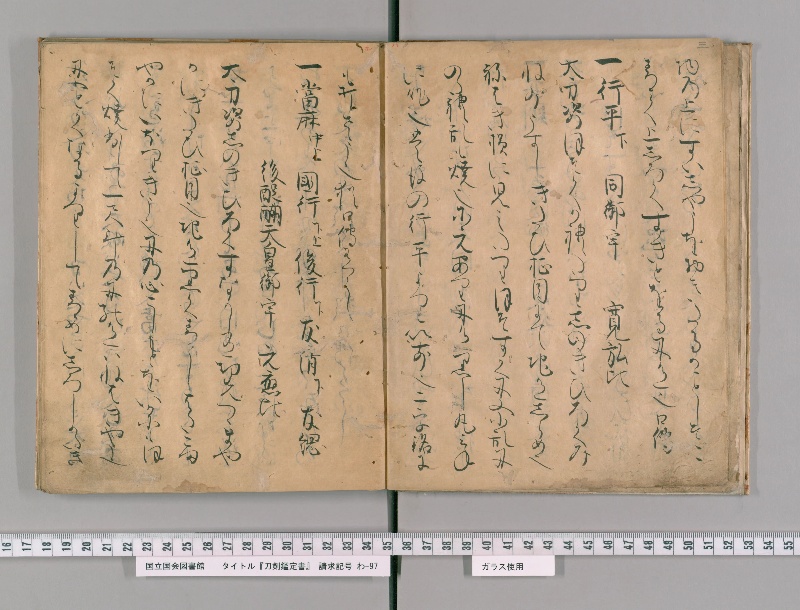
翻刻
物の上にすいしやうをおきたるかことしそこ
青く上しろくすきとをる刃色也口伝
一行平《割書:下|》 同御宇 寛弘比
太刀姿ほそくかれたりしのきひろくみ
ね少うすしきたひ柾目にて地色しらめ也
ねはき様に見えたりほそすく刃又小乱刃
のたれ乱も焼也にえあり刃色黒し丸みね
に作也豊後の行平より以前也二字銘に
も打さう也猶口伝有之
一当麻《割書:中上|》国行《割書:下上|》後行《割書:下|》友清《割書:下|》友総
後醍醐天皇御宇 元応比
太刀姿しのきひろくすなかし有切先つゝまや
かにきたひ柾目也地色黒く青しはたこま
やかにいほりきう也刃の心こしもとをいかにもほ
そく焼出して一尺計の刃の色はねはきやう也
刃ふとくなるよりして青めにしろしかたき
現代語訳
(前頁より続き・安則の刀の説明)
青い物の上に水晶を置いたようなものである。底は青く、上は白く透き通る刃の色である。(以下、口伝あり)
一、行平【下位】 同御宇(一条院) 寛弘年間頃
太刀の姿は細くやつれており、鎬は広く、棟は少し薄い。鍛えは柾目で、地色は白みがかっている。沸出来のように見える。細直刃、また小乱刃のたれ乱も焼いている。沸があり、刃色は黒い。丸棟に作られている。豊後の行平よりも以前の作である。二字銘(「行平」のみ)を切る場合もある。なお口伝がある。
一、当麻【中上位】 国行【下上位】 後行【下位】 友清【下位】 友総
後醍醐天皇御宇 元応年間頃
太刀の姿は鎬が広く、鎬地が長く、切先は詰まりやか(やや小ぶり)で、鍛えは柾目である。地色は黒く青みがかり、肌はこまやかで、庵棟(いおりきう)造りである。刃の心は腰元(刃の基部)をいかにも細く焼き出して、一尺ほどの刃の色は沸出来のようである。刃が太くなるにつれて、青みがかった白さで、硬い(ページ続く)
英語訳
(Continued from previous page — description of Yasunori sword)
It is as if crystal has been placed upon something blue. The blade color is blue at the base and white and translucent above. (Oral transmission follows.)
One: Yukihira [Lower rank] — Same reign (Emperor Ichijō), Kankō era (1004–1012)
The tachi's form is slender and lean, the shinogi (ridge line) is wide, and the mune (back edge) is slightly thin. The kitae (forging) is masame-hada (straight grain), and the ji-color (surface color) is whitish. It appears to be of a nie-deki (crystalline nie) quality. It is forged with a fine straight temper line (hoso-suguha), and also features ko-midareba (small irregular) and notare-midare (undulating irregular) temper patterns. There is nie (crystalline activity), and the ha-iro (blade color) is dark. It is made with a round mune (back ridge). This is an earlier work than Yukihira of Bungo Province. In some cases, a two-character signature ("Yukihira") is struck. There is further oral transmission.
One: Tōma [Middle-upper rank] Kuniyuki [Lower-upper rank] Nochiyuki [Lower rank] Tomokiyo [Lower rank] Tomofusa
Reign of Emperor Go-Daigo, Gennō era (1319–1321)
The tachi's form has a wide shinogi and a long shinogi-ji (area between the shinogi and the mune), with a compact kissaki (tip). The kitae is masame-hada. The ji-color is dark and bluish, the hada (surface texture) is fine, and it is constructed in the iori-mune (ridged back) style. The heart of the temper line is drawn out very narrowly from the base (koshi), and for about one shaku the ha-iro resembles nie-deki. Where the temper becomes wider, it is a bluish-white, hard... (page continues)