翻刻
而得兎
一云王所佩剣叢雲自抽之薙攘王之傍草因是
得免故号其剣曰草薙也叢雲此云武羅玖毛
王同殆被欺則悉焚其賊衆而滅之故号其処曰焼
津亦進相模欲往上総望海高言曰是小海耳可立
跳渡乃至干海中暴風忽起王船漂蕩而不可渡時
有従王之妾曰弟橘媛穂積氏忍山宿祢之女也啓
王曰今風起浪泌王船欲没是必海神心也願以妾
之身贖王之命而入海言訖乃被瀾入之暴風即止
船得著岸故時人号其海曰馳水《割書:下略》
相生樟(あいをひのくすのき) 《割書:本社(ほんしや)の前(まへ)右(みき)の方(かた)にあり世に連理(れんり)と称(しよう)するものにして一根(いつこん)二幹(にりん)なりわつかに|地(ち)を離(はな)るゝ事四尺はかりにして二股にわかる社記(しやき)に往古(そのかみ)日本武尊(やまとたけのみこと)弟橘媛(おとたちはなひめ)の神霊(しんれい)を》
《割書:鎮(しつめ)まゐらせ御 食(しき)し給ひし時樟(くすのき)の御箸(おんはし)をもて末代平天下(まつたいへいてんか)ならんには此箸(このはし)二本共に栄(さか)ふへし|と宣(のたま)ひ御手自(みてつから)御廟(こひやう)の東(ひかし)の地(ち)にさゝせ給ひしに》
《割書:後(のち)枝葉(しえふ)を生(しやう)し今に至(いた)りて栄茂(えいも)す又|
其傍(そのかたはら)に同し樟(くす)の蘗(き)あり是も一根二幹(いつこんにけん)なり》
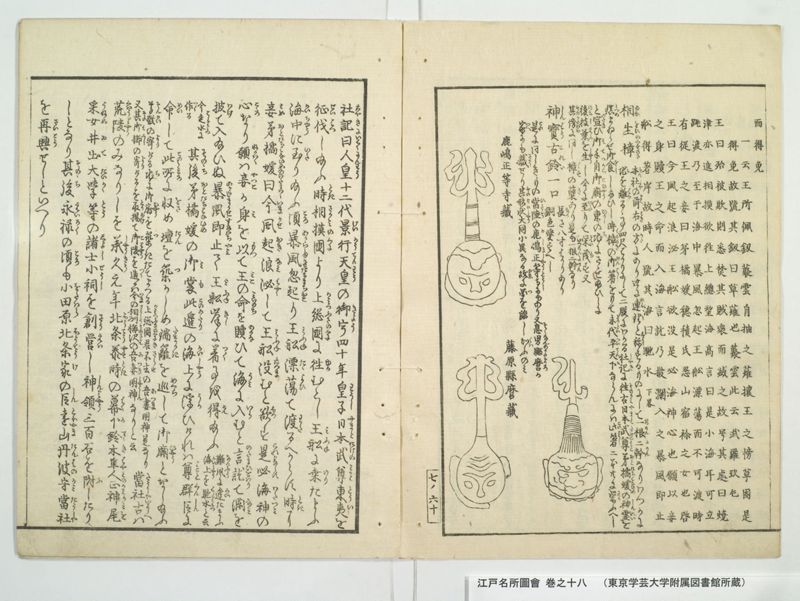
神宝(しんはう)古鈴(これい)一口 《割書:長(なか)さ八寸はかりあり|銅色愛すへし》【挿し絵1】
《割書:是(これ)に同しきもの常陸(ひたち)の鹿島正等寺(かしましやうとうし)にもあり又 息男県麿(そくなんあかたまろ)か|家(いへ)にも蔵(さう)せり其形状(そのけいしやう)大同小異なる故(ゆゑ)に図を臨し加(くは)ふのみ》
【挿し絵2】
鹿島正等寺蔵
【挿し絵3】
藤原県麿蔵
社記(しやき)曰(いはく)人皇(にんわう)十二代 景行天皇(けいかうてんわう)の御宇(きよう)四十年 皇子(わうし)日本武尊(やまとたけのみこと)東夷(とうい)を
征伐(せいはつ)し給ふ時(とき)相模国(さかみのくに)より上総国(かみつふさのくに)に往(ゆか)むとし王船(みふね)に乗(のり)たまふ
海中(かいちゆう)に至(いた)り給ふ頃(ころ)暴風(あからしまかせ)忽(たちまち)起(おこ)り王船(みふね)漂蕩(たゝよひ)て渡(わた)るへからす時(とき)に
妾(ひめ)弟橘媛(おとたちはなひめ)曰(のたまはく)今(いま)風(かせ)起(おき)浪(なみ)泌(はやく)して王船(みふね)没(しつま)むと欲(ほつ)す是(これ)必(かならす)海神(わたつみ)の
心(こゝろ)なり願(へかはく)は妾(やつこ)の身(み)を以(もつ)て王(みこ)の命(いのち)を贖(あかな)ひて海(うみ)に入(いら)むと言訖(のたまひをはり)て瀾(なみ)を
披(わけ)て入給ひぬ暴風(あからしまかせ)即(すなはち)止(やみ)て王船(みふね)岸(きし)に着(つく)事を得(え)給ふ 《割書:難風(なんふう)に逢(あい)たまふ|海上(かいしやう)を馳水(はしりみつ)と云》
《割書:今 走水(はしりみつ)に|作(つく)る》 其後(そのゝち)弟橘媛(おとたちはなひめ)の御裳(みも)此辺(このあたり)の海上(かいしやう)に浮(うか)ひけれは尊(みこと)群臣(くんしん)に
命(めい)して此所(このところ)に収(をさ)め壇(たん)を築(つ)かしめ瑞籬(たまかき)を巡(めくら)して御 廟(ひやう)となし給ふ
《割書:尊骸(そんかい)の寄(より)ける地(ち)に御 廟(ひやう)を築(つ)きたてまつる上総国(かみつふさのくに)君不去(きさらす)の吾妻(あつま)明神是なり|又 其(その)御櫛(みくし)の寄(より)けるを取揚(とりあけ)て御陵(こりやう)を造(つく)るは今(いま)の相州梅沢(さうしううめさは)の吾妻明神(あつまみやうしん)なりと云》 当社(たうしや)古(いにしへ)は
荒陵(くはうりやう)のみなりしを承久(しやうきう)元年 北条泰時(ほうてうやすとき)の幕下(はくか)鈴木隼人正(すゝきはやとのかみ)神尾(かみを)
采女(うねめ)井出(ゐて)大学(たいかく)等(とう)の諸士(しよし)小祠(しようし)を創営(さうえい)し神領(しんりやう)三百石を付(ふ)したり
しとなり其後(そのゝち)永禄(えいろく)の頃(ころ)も小田原(をたはら)北条家(ほうてうけ)の臣(しん)遠山丹波守(とほやまたんはのかみ)当社(たうしや)
を再興(さいこう)せしといへり
現代語訳
而して兔を得たり。
一説には、王の佩いている剣の叢雲が自ら抜けて王の傍らの草を薙ぎ払ったため、これによって免れることができた。故にその剣を草薙と号した。叢雲をこれは武羅玖毛という。
王は欺かれそうになったが、その賊衆をことごとく焼き滅ぼした。故にその処を焼津と号す。また相模に進み上総に往こうとして、海を望んで高らかに言った「これは小さな海だ、立ち跳んで渡れるだろう」。そこで海中に至ったが暴風が忽ち起こり、王の船は漂流して渡ることができなかった。時に王に従っていた妾で弟橘媛という者がいた。穂積氏忍山宿祢の女である。王に申し上げて言うには「今風が起こり波が激しく、王の船が沈もうとしています。これは必ず海神の心です。願わくは妾の身をもって王の命に代え、海に入りましょう」と言い終わって、波を被って海に入った。暴風は即座に止み、船は岸に着くことができた。故に時の人はその海を馳水と号した。(以下略)
相生樟 本社の前右の方にある。世に連理と称するもので、一根二幹である。わずかに地を離れること四尺ばかりで二股に分かれる。社記によると、往古、日本武尊が弟橘媛の神霊を鎮め申し上げ、御食事をされた時、樟の御箸をもって「末代平天下であるならば、この箸二本とも栄えるであろう」と宣い、御手自ら御廟の東の地に挿されたところ、後に枝葉を生じ今に至って栄え茂っている。またその傍らに同じ樟の蘖があり、これも一根二幹である。
神宝 古鈴一口 長さ八寸ばかりあり、銅色美しい。
これに同じきもの、常陸の鹿島正等寺にもあり、また息男県麿の家にも蔵されている。その形状は大同小異であるため、図を写し加えるのみ。
社記に曰く、人皇十二代景行天皇の御世四十年、皇子日本武尊が東夷を征伐された時、相模国より上総国に往こうとして王船に乗られた。海中に至った頃、暴風が忽ち起こり、王船が漂流して渡ることができなかった。時に妾の弟橘媛が仰せられるには「今風が起こり波が激しくて王船が沈もうとしています。これは必ず海神の心です。願わくは妾の身をもって王の命を贖い、海に入りましょう」と言い終わって、波を分けて入られた。暴風は即座に止み、王船は岸に着くことができた。(難風に遭われた海上を馳水という。今は走水に作る。)
その後、弟橘媛の御裳がこの辺りの海上に浮かんだので、尊は群臣に命じてこの所に収め、壇を築かせ瑞籬を巡らして御廟となされた。(尊骸の寄った地に御廟を築き奉る。上総国君不去の吾妻明神これなり。またその御櫛の寄ったのを取り上げて御陵を造るのは今の相州梅沢の吾妻明神なりという。)
当社は古くは荒陵のみであったが、承久元年、北条泰時の幕下の鈴木隼人正、神尾采女、井出大学等の諸士が小祠を創営し、神領三百石を付したという。その後、永禄の頃にも小田原北条家の臣、遠山丹波守が当社を再興したという。
英語訳
And thus he obtained a rabbit.
One account says that the sword Murakumo (Ame-no-Murakumo) that the prince wore drew itself and cut down the grass around the prince, and by this he was able to escape. Therefore, that sword was called Kusanagi (Grass-Cutting). Murakumo is pronounced "Murakumo."
When the prince was about to be deceived, he burned and destroyed all those bandits. Therefore, that place was called Yaizu (Burnt Harbor). He then advanced to Sagami and, intending to go to Kazusa, looked out over the sea and declared loudly, "This is just a small sea - I can leap across it standing." When he reached the middle of the sea, a violent storm suddenly arose, and the prince's ship was tossed about and could not proceed. At that time, there was a concubine accompanying the prince called Princess Ototachibana, daughter of Oshiyama Sukune of the Hozumi clan. She addressed the prince, saying, "Now the wind has risen and the waves are fierce, and the royal ship is about to sink. This must surely be the will of the sea god. I pray that I may substitute my life for that of the prince and enter the sea." Having finished speaking, she was covered by the waves and entered the sea. The violent storm immediately ceased, and the ship was able to reach shore. Therefore, the people of that time called that sea Hashirimizu (Running Water). (Remainder omitted)
The Paired Camphor Trees - Located to the right front of the main shrine. These are what the world calls "joined trees" (renri), being two trunks from one root. They separate into two branches about four feet above ground. According to the shrine records, in ancient times, when Prince Yamato Takeru enshrined the divine spirit of Princess Ototachibana and took his meal, he used camphor chopsticks and declared, "If peace reigns in the realm until the end of time, both these chopsticks shall flourish," and with his own hands planted them in the ground east of the mausoleum. Later they sprouted branches and leaves and have flourished to this day. Nearby there are also camphor saplings, which are likewise two trunks from one root.
Sacred Treasure - One ancient bell, about eight inches long, with beautiful bronze coloring.
Similar bells exist at Shōtōji Temple in Kashima, Hitachi Province, and are also kept in the house of Agatamaro. Since their forms are largely similar with minor differences, I have merely copied and added their illustrations.
The shrine records state: In the 40th year of the reign of the 12th Human Emperor Keikō, when Prince Yamato Takeru was subduing the eastern barbarians, he boarded the royal ship to travel from Sagami Province to Kazusa Province. When he reached the middle of the sea, a violent storm suddenly arose, the royal ship was tossed about and could not proceed. At that time, the concubine Princess Ototachibana said, "Now the wind has risen and the waves are fierce, and the royal ship is about to sink. This must surely be the will of the sea god. I pray that I may offer my body to redeem the prince's life and enter the sea." Having finished speaking, she parted the waves and entered. The violent storm immediately ceased, and the royal ship was able to reach shore. (The sea where they encountered the difficult wind is called Hashirimizu. Now it is written as Hashirimizu.)
Afterward, Princess Ototachibana's skirt floated on the sea surface in this area, so the prince commanded his retainers to recover it at this place, had an altar built and sacred fences erected around it to make a mausoleum. (A mausoleum was built at the place where the sacred remains washed ashore - this is Azuma Myōjin of Kisarazu in Kazusa Province. Also, where her sacred comb washed ashore was recovered and made into a tomb - this is said to be Azuma Myōjin of Umezawa in present Sagami Province.)
This shrine was originally only a rough mound, but in the first year of Jōkyū (1219), various retainers under Hōjō Yasutoki's command - Suzuki Hayato-no-kami, Kamio Uneme, Ide Daigaku and others - established a small shrine and endowed it with 300 koku of shrine lands. Later, during the Eiroku period (1558-1570), Tōyama Tamba-no-kami, a retainer of the Hōjō family of Odawara, is said to have rebuilt this shrine.