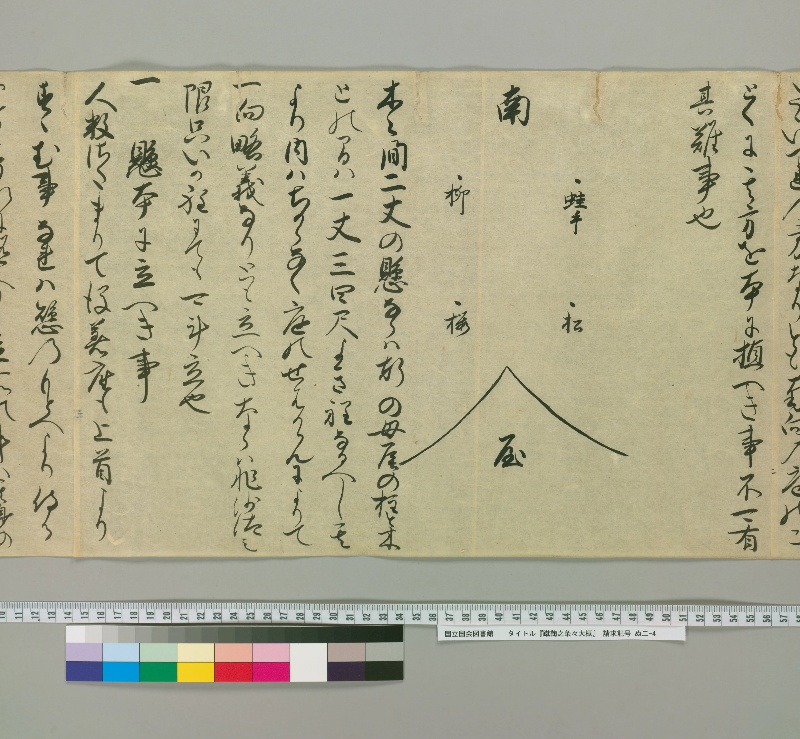
翻刻
【前コマ重複略】
・蛙手 ・松
南 屋#1
・柳 ・桜
木々間二丈の懸ならは軒の母屋の柱と木
との間は一丈三四尺よき程なるへし其
より内はちからなく庭のせはからんによりて
一向略義なりとも立へきならは非沙汰之
限只いか程にても可計立也
一 懸本に立へき事
人数さたまりて後美座も上首より
すゝむ事なれは懸のもとへより侍る
【切れ目略】
現代語訳
【前ページの重複部分省略】
・鶏冠木 ・松
南 屋敷
・柳 ・桜
木々の間が二丈の懸であれば、軒の母屋の柱と木
との間は一丈三、四尺がよい程度であろう。それ
より狭いのはやむを得ず、庭が狭いことによって
全く略式であっても建てるべきであれば、言語道断の
極みではあるが、どれほど狭くても計らって建てるべきである。
一 懸の根元に立つべき事
人数が決まった後、座の配置も上席より
進めることであるから、懸の根元へと参る
【区切り省略】
英語訳
【Previous page duplication omitted】
・Cockscomb tree ・Pine
South Estate/Building
・Willow ・Cherry
If the spacing between trees is 2 jō for the suspended arrangement, then the distance between the eaves' main pillar and the trees should ideally be about 1 jō 3-4 shaku. Anything narrower than this is unavoidable, and if one must construct due to the garden being narrow, even if it is completely simplified, though it would be utterly inexcusable, one should measure and construct no matter how narrow it may be.
1. Regarding Standing at the Base of the Suspended Trees
After the number of people is determined, the seating arrangement also proceeds from the highest-ranking position, so one approaches the base of the suspended trees.
【Section break omitted】