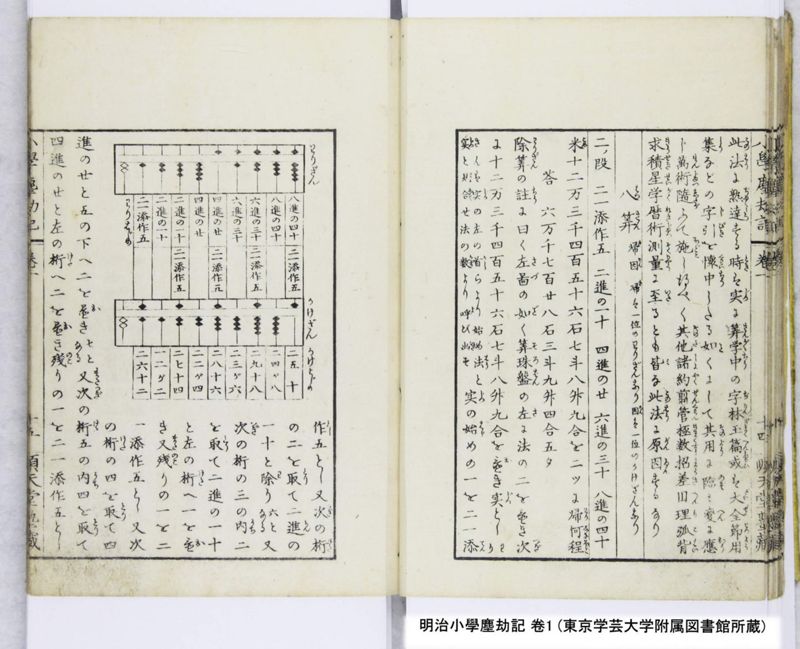
翻刻
【右丁】
此法(このはう)に熟達(ぢゆくたつ)する時(とき)は実(じつ)に算学中(さんがくちう)の字林玉篇(ぢりんぎよくへん)或(あるひ)は大全節用(だいぜんせつよう)
集(しう)などの字引(じびき)を懐中(くわいちう)したる如(こと)くにして其用(そのよう)に臨(のそ)み変(へん)に応(おう)
じ万術(まんじゆつ)随(したが)ふて施(ほどこ)し得べく其他(そのた)諸約翦管(しよやくせんくわん)極数招差(きよくすうしようさ)円理弧背(へんりこはい)
求積(きうせき)星学(せいがく)暦術(れきじゆつ)測量(そくりやう)に至(いた)るとも皆(み)な此法(このはう)に原因(げんゐん)するなり
八算(はつさん)《割書:帰因(きゐん) 帰(き)は一位のわりざんなり因(ゐん)は一位のかけざんなり》
二《割書:ノ》段 二一添作五 二進の一十 四進の廿 六進の三十 八進の四十
米(こめ)十二万三千四百五十六石七斗八升九合を二ッに帰(わり)何程(なにほと)
答 六万千七百廿八石三斗九升五勺
除算(わりざん)の註(ちう)に曰く左図(さづ)の如(ごと)く算珠盤(そろばん)の左(さ)に法の二を置き次(つぎ)
に十二万三千四百五十六石七斗八升九合を置(お)き実(じつ)とし《割書:わ|り》
《割書:さんは実(じつ)の左の首(かし)らより始め法(はう)と|実(じつ)と見合(みあわ)せ法の数(かず)より呼(よ)び出(いだ)す》実(じつ)の始(はじ)めの一を二一 添(てん)
【左丁】
【図解の下と左】
作(さく)五とし又 次(つぎ)の桁(けた)
の二を取(とり)て二 進(ちん)の
一十と除(わ)り《割書:六と|なる》又
次(つぎ)の桁の三の内(うち)二
を取(とり)て二進の一十
と左の桁(けた)へ一を置(お)
き又(また)残(のこ)り一を二
一添作五とし又次
の桁(けた)の四を取(とり)て四
進の廿と五の下へ二を置(お)き《割書:七と|なる》又(また)次(つぎ)の桁(けた)五の内(うち)四を取(とり)て
四進の廿と左の桁(けた)へ二を置(お)き残(のこ)りの一を二一添作五とし
【2個の算珠盤図の夫々の下】
わりざん かけざん かけはじめ
八進の四十 二一添作五 二五 十
八進の四十 二四《割書:が》八
六進の三十 二一添作五 二九十八
六進の三十 二三《割書:が》六
四進の廿 二一添作五 二八十六
四進の廿 二二《割書:が》四
二進の一十 二一添作五 二七十四
二進の一十 一二《割書:が》二
二一添作五 二六十二
わりはじめ
現代語訳
【右丁】
この法に熟達する時は、実に算学中の字林玉篇あるいは大全節用集などの字引を懐中したるごとくにして、その用に臨み変に応じ、万術したがって施し得べく、その他、諸約・翦管・極数・招差・円理・弧背・求積・星学・暦術・測量に至るとも、みなこの法に原因するなり。
八算《帰因:「帰」は一位の割り算なり、「因」は一位の掛け算なり》
二の段 二一添作五 二進の一十 四進の廿 六進の三十 八進の四十
米十二万三千四百五十六石七斗八升九合を二つに帰(わり)、何程(なにほど)か。
答 六万千七百二十八石三斗九升五勺
割り算の注に曰く、左図のようにそろばんの左に法の二を置き、次に十二万三千四百五十六石七斗八升九合を置いて実とし、《割り算は実の左の頭より始め、法と実と見合わせ法の数より呼び出す》実の始めの一を「二一添
【左丁】
作五」とし、また次の桁の二を取りて「二進の一十」と除り《六となる》、また次の桁の三の内、二を取りて「二進の一十」とし左の桁へ一を置き、また残り一を「二一添作五」とし、また次の桁の四を取りて「四進の廿」とし五の下へ二を置き《七となる》、また次の桁の五の内、四を取りて「四進の廿」とし左の桁へ二を置き、残りの一を「二一添作五」とし、
【二個のそろばん図それぞれの下】
割り算 掛け算 掛け始め
八進の四十 二一添作五 二五 十
八進の四十 二四が八
六進の三十 二一添作五 二九十八
六進の三十 二三が六
四進の廿 二一添作五 二八十六
四進の廿 二二が四
二進の一十 二一添作五 二七十四
二進の一十 一二が二
二一添作五 二六十二
割り始め
英語訳
【Right Page】
When one becomes proficient in this method, it is truly as if one carries in one's pocket a dictionary such as the Jilin Yupian or the Daizen Setsuyōshū for mathematics — ready to meet any situation, respond to any variation, and apply any of the myriad techniques accordingly. Furthermore, all other topics, including various reductions (shoyaku), pipe-cutting problems (senkan), extreme numbers (kyokusū), method of finite differences (shōsa), circle theory (enri), arc-length calculations (kohai), area-finding (kyūseki), astronomy (seigaku), calendar calculation (rekijutsu), and surveying (sokuryō), all originate from this method.
The Eight Operations (Hassan) 《Kiin: "Ki" refers to single-digit division; "In" refers to single-digit multiplication》
Row of 2: "Ni'ichi ten sakugo" (2÷2=0.5, add 5) "Ni-shin no ittō" (2 goes into 2 once, i.e., ÷2 gives 10) "Shi-shin no nijū" (4÷2=20) "Roku-shin no sanjū" (6÷2=30) "Hachi-shin no shijū" (8÷2=40)
[Problem] If 123,456 koku, 7 to, 8 shō, 9 gō of rice is divided by 2, how much is it?
Answer: 61,728 koku, 3 to, 9 shō, 5 shaku
The commentary on division states: As shown in the figure on the left, place the divisor 2 on the left side of the soroban (abacus), then place 123,456 koku, 7 to, 8 shō, 9 gō as the dividend (jitsu). 《In division, begin from the leftmost digit of the dividend, compare the divisor and dividend, and call out starting from the divisor's value.》 Apply "Ni'ichi ten
【Left Page】
sakugo" to the first digit 1 of the dividend (making it 5); then take the 2 in the next column and apply "Ni-shin no ittō" to divide it 《yielding 6》; then from the 3 in the next column, take 2 and apply "Ni-shin no ittō," placing 1 in the column to the left, then apply "Ni'ichi ten sakugo" to the remaining 1; then take the 4 in the next column and apply "Shi-shin no nijū," placing 2 below the 5 《yielding 7》; then from the 5 in the next column, take 4 and apply "Shi-shin no nijū," placing 2 in the column to the left, and apply "Ni'ichi ten sakugo" to the remaining 1;
【Below each of the two soroban diagrams】
Division Multiplication Start of multiplication
Hachi-shin no shijū Ni'ichi ten sakugo 2×5 = 10
Hachi-shin no shijū 2×4 = 8
Roku-shin no sanjū Ni'ichi ten sakugo 2×9 = 18
Roku-shin no sanjū 2×3 = 6
Shi-shin no nijū Ni'ichi ten sakugo 2×8 = 16
Shi-shin no nijū 2×2 = 4
Ni-shin no ittō Ni'ichi ten sakugo 2×7 = 14
Ni-shin no ittō 1×2 = 2
Ni'ichi ten sakugo 2×6 = 12
Start of division