翻刻
【右丁】
と法(はう)の次(つぎ)の桁(けた)と見合(みあわ)せ九々に呼(よ)び引払(ひきはら)ひ次第(しだい)に法(はう)の末(すへ)
の桁(けた)まで見合(みあわ)せ引払(ひきはら)へは次商(じしやう)は除(のぞ)き済(す)むなり又(また)残数(ざんすう)あ
る時(とき)は前(まへ)の如(ごと)くにして三商(さんしやう)の商(しやう)を求(もと)むべし
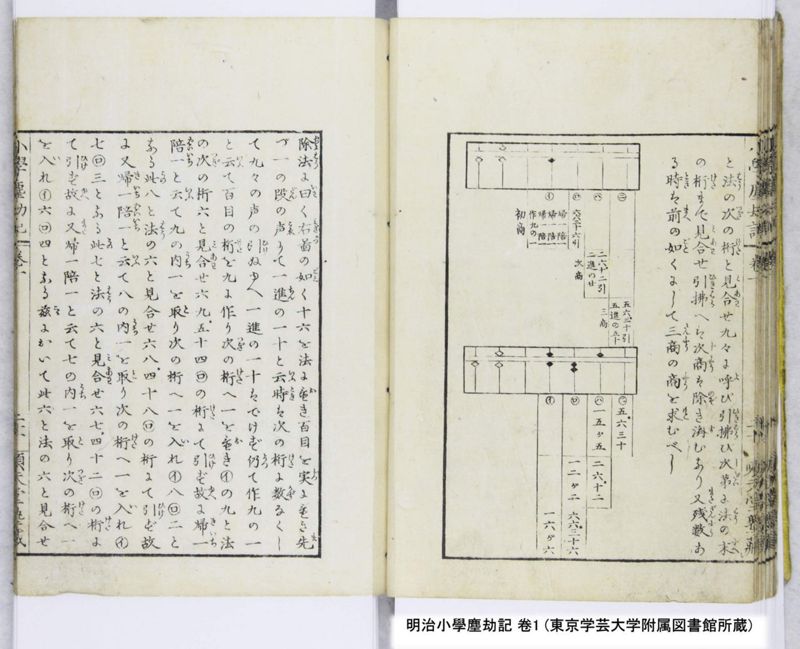
【2個の算珠盤図の夫々の下】
㋥ 《割書:五六.三十引|五進の五十|三商》 ㋥五.六三十
㋩ 《割書:二六.十二引|二進の廿|次商》 ㋩一五《割書:が》五 二六.十二
㋺ 《割書:六六三十六引》 ㋺ 一二《割書:が》二 六六.三十六
㋑ 《割書:帰一賠一|帰一賠一|帰一賠一|作九の一|初商》 ㋑ 一六《割書:が》六
【左丁】
除法(ぢよはう)に曰(いわ)く右図(みぎづ)の如(ごと)く十六を法に置(お)き百目を実(じつ)に置き先(ま)
づ一の段(だん)の声(こゑ)にて一 進(ちん)の一十と云時(いふとき)は次の桁(けた)に数(かず)なくし
て九々の声の引(ひけ)ぬゆへ一進の一十はでけず仍(よつ)て作九の一
と云(いふ)て百目の桁(けた)を九に作り次(つぎ)の桁(けた)へ一を置(お)き㋑の九と法
の次(つぎ)の桁六と見合(みあわ)せ六九.五十四㋺の桁(けた)にて引(ひけ)ず故(ゆへ)に帰一(きいち)
賠一(ばいいち)と云(いふ)て九の内(うち)一を取(と)り次の桁へ一を入(い)れ㋑八㋺二と
なる此(この)八と法(はう)の六と見合せ六八.四十八㋺の桁にて引(ひけ)ず故
に又 帰一陪一(きいちばいいち)と云(いふ)て八の内(うち)一を取(と)り次の桁(けた)へ一を入(い)れ㋑
七㋺三となる此(この)七と法(はう)の六と見合(みあわ)せ六七.四十二㋺の桁(けた)に
て引(ひけ)ず故(ゆへ)に又(また)帰一陪一と云て七の内(うち)一を取(と)り次(つぎ)の桁(けた)へ一
を入(い)れ㋑六㋺四となる茲(こゝ)において此六と法の六と見合せ
現代語訳
【右丁】
と法の次の桁と見合わせて九九に呼んで引き払い、順次法の末の桁まで見合わせて引き払えば、次商の割り算は済む。また残数がある時は、前と同じようにして三商の商を求めるべきである。
【2個の算盤図のそれぞれの下】
(図㋥) 五六・三十引、五進の五十(三商) ㋥ 五・六三十
(図㋩) 二六・十二引、二進の二十(次商) ㋩ 一五が五 二六・十二
(図㋺) 六六・三十六引 ㋺ 一二が二 六六・三十六
(図㋑) 帰一賠一・帰一賠一・帰一賠一・作九の一(初商) ㋑ 一六が六
【左丁】
除法の説明:右図のように、十六を法(割る数)に置き、百目を実(割られる数)に置く。まず一の段の声で「一進の一十」と言う時は、次の桁に数がなく、九九の声で引けないため、一進の一十はできない。そこで「作九の一」といって、百目の桁を九に作り、次の桁へ一を置く。㋑の九と法の次の桁の六と見合わせ、「六九・五十四」を㋺の桁で引こうとするが引けないため、「帰一賠一」といって九の内から一を取り、次の桁へ一を入れ、㋑が八、㋺が二となる。この八と法の六と見合わせ、「六八・四十八」を㋺の桁で引こうとするが引けないため、また「帰一賠一」といって八の内から一を取り、次の桁へ一を入れ、㋑が七、㋺が三となる。この七と法の六と見合わせ、「六七・四十二」を㋺の桁で引こうとするが引けないため、また「帰一賠一」といって七の内から一を取り、次の桁へ一を入れ、㋑が六、㋺が四となる。ここにおいてこの六と法の六と見合わせ……
英語訳
【Right Page】
Match [the quotient] with the next digit of the divisor, recite using the multiplication table, and subtract accordingly. Continue matching through to the final digit of the divisor and subtracting; then the division for the next quotient is complete. If there is a remainder, follow the same process as before to find the quotient of the third iteration.
【Below each of the two abacus diagrams】
(Diagram ㋥) Five-six: subtract thirty, five-advance fifty (third quotient) ㋥ 5 · 6×3=30
(Diagram ㋩) Two-six: subtract twelve, two-advance twenty (next quotient) ㋩ 1×5=5 Two-six: twelve
(Diagram ㋺) Six-six: subtract thirty-six ㋺ 1×2=2 Six-six: thirty-six
(Diagram ㋑) Return-one compensate-one × 3, make-nine one (initial quotient) ㋑ 1×6=6
【Left Page】
Explanation of the division method: As shown in the diagram on the right, place 16 as the divisor (hō) and 100 me as the dividend (jitsu). First, using the recitation of the ones table, when one says "one-advance one-ten," there is no number in the next digit and subtraction using the multiplication table is impossible, so "one-advance one-ten" cannot be performed. Therefore, applying the rule "make-nine one" (sakukyū no ichi), the digit of 100 me is turned into 9, and one is placed in the next digit. Matching the 9 at position ㋑ with the 6 in the next digit of the divisor, "six-nine: fifty-four" cannot be subtracted at the ㋺ digit, so applying "return-one compensate-one" (ki'ichi bai'ichi), one is taken from the 9 and placed in the next digit, making ㋑ equal to 8 and ㋺ equal to 2. Matching this 8 with the divisor's 6, "six-eight: forty-eight" still cannot be subtracted at ㋺, so once again applying "return-one compensate-one," one is taken from the 8 and placed in the next digit, making ㋑ equal to 7 and ㋺ equal to 3. Matching this 7 with the divisor's 6, "six-seven: forty-two" still cannot be subtracted at ㋺, so once again applying "return-one compensate-one," one is taken from the 7 and placed in the next digit, making ㋑ equal to 6 and ㋺ equal to 4. At this point, matching this 6 with the divisor's 6…