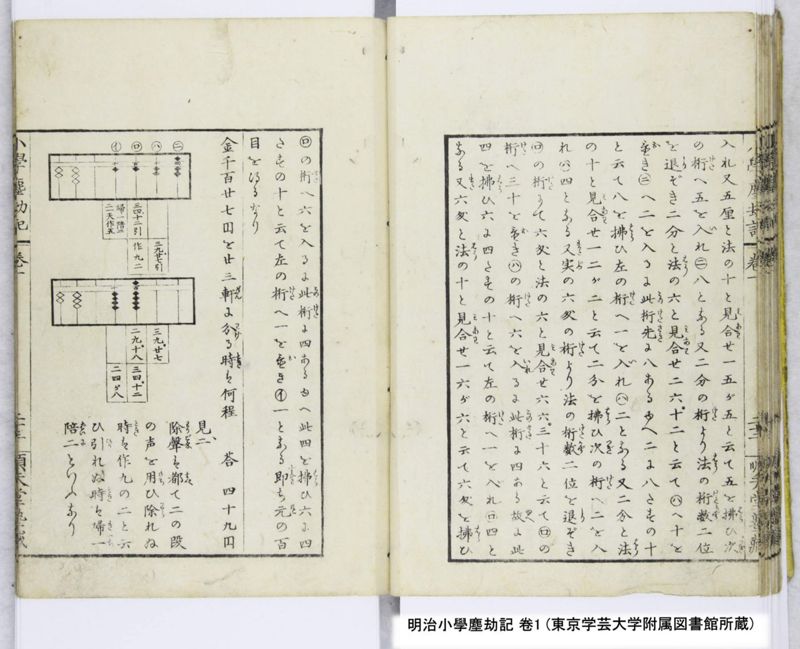
翻刻
【右丁】
入れ又五厘と法の十と見合(みあわ)せ一五が五と云て五を払(はら)ひ次(つぎ)
の桁(けた)へ五を入(い)れ㋥八となる又二分の桁(けた)より法(はう)の桁数(けたかず)二位
を退(しり)ぞき二分と法(はう)の六と見合(みあわ)せ二六.十二と云て㋩へ十を
置(お)き㋥へ二を入るに此桁(このけた)先(さき)に八あるゆへ二に八たすの十
と云て八を払(はら)ひ左の桁(けた)へ一を入(い)れ㋩二となる又二分と法(はう)
の十と見合(みあわ)せ一二が二と云て二分を払(はら)ひ次(つぎ)の桁(けた)へ二を入
れ㋩四となる又(また)実(じつ)の六匁の桁(けた)より法の桁数(けたかず)二位を退(しり)ぞき
㋺の桁(けた)にて六匁と法の六と見合(みあわ)せ六六.三十六と云て㋺の
桁(けた)へ三十を置(お)き㋩の桁(けた)へ六を入(いれ)るに此桁(このけた)に四ある故(ゆへ)に此
四を払(はら)ひ六に四たすの十と云て左の桁(けた)へ一を入(い)れ㋺四と
なる又(また)六匁と法(はう)の十と見合(みあわ)せ一六が六と云て六匁を払(はら)ひ
【左丁】
㋺の桁(けた)へ六を入るに此桁(このけた)に四あるゆへ此四を払(はら)ひ六に四
たすの十と云て左の桁(けた)へ一を置(お)き㋑一となる即(すなわ)ち元(もと)の百
目を得るなり
金千百廿七円を廿三 軒(げん)に分(わけ)る時(とき)は何程 答 四十九円
【2個の算珠盤図を挟み上中下】
㋥ 両
㋩ 十 三九.廿七引 三九.廿七
㋺ 百 三四.十二引 作九二 百 二九.十八 三四.十二
㋑ 千 《割書:帰一陪二|二一天作五》 十 二四が八
【図解の下】
見、二#1
除声(わりごゑ)は都(すべ)て二の段
の声を用(もち)ひ除(わら)れぬ
時(とき)は作九の二と云
ひ引(ひか)れぬ時(とき)は帰一(きいち)
陪二(ばいに)といふなり
現代語訳
【右丁】
(五厘の桁の計算を続けて)入れ、また五厘と法(のり)の十の位を見合わせ、「一五が五」と唱えて五を払い、次の桁へ五を入れ、㋥(両)の桁が八になる。次に二分の桁から法の桁数二位を退いて、二分と法の六を見合わせ「二六、十二」と唱えて㋩(十)の桁へ十を置き、㋥(両)の桁へ二を入れるが、この桁にはすでに八があるので、「二に八たして十」と唱えて八を払い、左の桁へ一を繰り上げ、㋩(十)の桁は二になる。また二分と法の十を見合わせ「一二が二」と唱えて二分を払い、次の桁へ二を入れ、㋩(十)の桁は四になる。また実(じつ)の六匁の桁から法の桁数二位を退いて、㋺(百)の桁にて六匁と法の六を見合わせ「六六、三十六」と唱えて㋺の桁へ三十を置き、㋩の桁へ六を入れるが、この桁にすでに四があるので、この四を払い「六に四たして十」と唱えて左の桁へ一を繰り上げ、㋺(百)の桁が四になる。また六匁と法の十を見合わせ「一六が六」と唱えて六匁を払い、
【左丁】
㋺(百)の桁へ六を入れるが、この桁にすでに四があるので、この四を払い「六に四たして十」と唱えて左の桁へ一を置き、㋑(千)の桁が一になる。すなわち元の百目(ひゃくもんめ)を得る。
金千百二十七円を二十三軒に分けるときは何ほどか。 答:四十九円
【算盤図(2つ)を挟み、上中下の表示】
㋥ 両
㋩ 十 三九、廿七引 三九、廿七
㋺ 百 三四、十二引 作九で二 百 二九、十八 三四、十二
㋑ 千 (帰一陪二・二一天作五) 十 二四が八
【図解の下】
見:二(#1)
割り声(わりごえ)はすべて二の段の声を用い、割り切れないときは「作九の二」と唱え、引けないときは「帰一陪二(きいちばいに)」という。
英語訳
**[Right page]**
(Continuing the calculation from the previous column:) Place (the result) in (the column), then align the 5-*rin* place with the "ten" position of the divisor and call out "one-five makes five (一五が五)," strike off the five, and carry five to the next column — the ㋥ (ryō) column becomes eight. Next, retreat two places (the number of digits in the divisor) from the 2-*bu* column; align 2-*bu* with the 6 of the divisor and call out "two-six, twelve (二六十二)": place ten in the ㋩ (tens) column and add two to the ㋥ column. Since that column already holds eight, call out "two plus eight makes ten (二に八たして十)," strike off the eight and carry one to the left column, making the ㋩ column two. Then align 2-*bu* with the ten of the divisor and call out "one-two makes two (一二が二)": strike off the 2-*bu* and place two in the next column, making the ㋩ column four. Next, retreat two places from the 6-*monme* column; at the ㋺ (hundreds) column, align 6-*monme* with the 6 of the divisor and call out "six-six, thirty-six (六六三十六)": place thirty in the ㋺ column and add six to the ㋩ column. Since that column already holds four, strike off the four and call out "six plus four makes ten (六に四たして十)," carrying one to the left column, making the ㋺ column four. Then align 6-*monme* with the ten of the divisor and call out "one-six makes six (一六が六)": strike off the 6-*monme*,
**[Left page]**
and add six to the ㋺ (hundreds) column. Since that column already holds four, strike off the four and call out "six plus four makes ten (六に四たして十)," place one in the left column, making the ㋑ (thousands) column one. Thus one obtains the original 100 *monme* (匁).
*Problem:* When 1,127 yen is to be divided equally among 23 households, how much does each receive? **Answer: 49 yen**
**[Surrounding two soroban diagrams, with upper/middle/lower labels:]**
- ㋥ *ryō* (ones)
- ㋩ tens "three-nine, subtract 27" "three-nine, 27"
- ㋺ hundreds "three-four, subtract 12" make-nine: 2 hundreds "two-nine, 18" "three-four, 12"
- ㋑ thousands (*ki-ichi bai-ni* / *ni-ichi ten-saku-go*) tens "two-four makes eight"
**[Below the diagrams:]**
*Mi*: 2 (#1)
All division calls (*wari-goe*) use the two-times table; when division does not go evenly, say "make-nine, two (*saku-kyū no ni*)"; when subtraction is not possible, say "*ki-ichi bai-ni* (帰一陪二, return one, double two)."