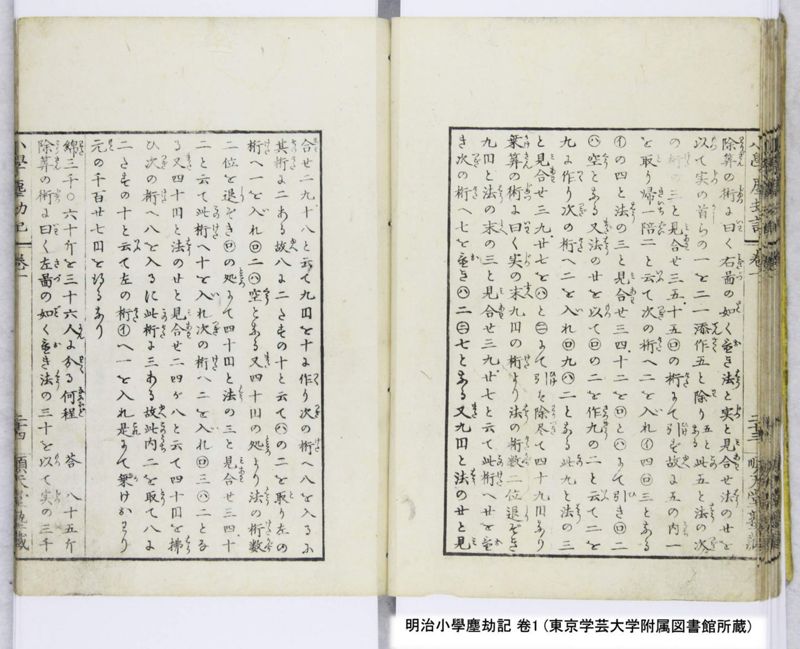
翻刻
【右丁】
除算(わりざん)の術(じゆつ)に曰(いわ)く右図(みぎづ)の如(ごと)く置(お)き法(はう)と実(じつ)と見合(みあわ)せ法(はう)の廿を
以(もつ)て実(じつ)の首(かし)らの一を二一 添作(てんさく)五と除(わ)り《割書:五と|なる》此(この)五と法(はう)の次(つぎ)
の桁(けた)の三と見合(みあわ)せ三五.十五㋺の桁(けた)にて引(ひけ)ず故(ゆへ)に五の内(うち)一
を取(と)り帰一陪(きいちばい)二と云(いふ)て次(つぎ)の桁(けた)へ二を入(い)れ㋑四㋺三となる
㋑の四と法(はう)の三と見合(みあわ)せ三四.十二を㋺と㋩にて引(ひ)き㋺二
㋩空(くう)となる又(また)法(はう)の廿を以(もつ)て㋺の二を作九(さつきう)の二と云(いふ)て二を
九に作(つく)り次(つぎ)の桁(けた)へ二を入(い)れ㋺九㋩二となる此(この)九と法(はう)の三
と見合(みあわ)せ三九.廿七を㋩と㋥にて引(ひけ)は除尽(わりつき)て四十九円なり
乗算(かけさん)の術(じゆつ)に曰(いわ)く実(じつ)の末(すへ)九円の桁(けた)より法(はう)の桁数(けたかず)二位 退(しり)ぞき
九円と法(はう)の末(すへ)の三と見合(みあわ)せ三九.廿七と云て此桁(このけた)へ廿を置(お)
き次(つぎ)の桁(けた)へ七を置(お)き㋩二㋥七となる又(また)九円と法(はう)の廿と見(み)
【左丁】
合(あわ)せ二九.十八と云て九円を十に作(つく)り次(つぎ)の桁(けた)へ八を入るに
其桁(そのけた)に二ある故(ゆへ)八に二たすの十と云て㋩の二を取(と)り左の
桁(けた)へ一を入(い)れ㋺二㋩空(くう)となる又(また)四十円の処(ところ)より法(はう)の桁数(けたかず)
二位を退(しり)ぞき㋺の処(ところ)にて四十円と法(はう)の三と見合(みあわ)せ三四.十
二と云て此桁(このけた)へ十を入(い)れ次(つぎ)の桁(けた)へ二を入(い)れ㋺三㋩二とな
る又(また)四十円と法(はう)の廿と見合(みあわ)せ二四が八と云て四十円を払(はら)
ひ次(つぎ)の桁(けた)へ八を入るに此桁(このけた)に三ある故(ゆへ)此内(このうち)二を取(とり)て八に
二たすの十と云(いふ)て左の桁(けた)㋑へ一を入れ是(これ)にて乗(か)けおわり
元(もと)の千百廿七円を得るなり
綿(わた)三千〇六十斤を三十六 人(にん)に分(わく)る何程(なにほど) 答 八十五斤
除算(わりさん)の術(じゆつ)に曰(いわ)く左図(さづ)の如(ごと)く置(お)き法(はう)の三十を以(もつ)て実(じつ)の三千
現代語訳
【右丁】
除算の術に言う。右図のように置き、法と実とを見合わせ、法の20を用いて実の最上位の1を「二一添作五」と割り、この5と法の次の桁の3とを見合わせ「3×5=15」を㋺の桁にて引けないので、5の内1を取り「帰一陪二」と言って次の桁へ2を入れ、㋑は4、㋺は3となる。㋑の4と法の3とを見合わせ「3×4=12」を㋺と㋩にて引き、㋺は2、㋩は空となる。また法の20を用いて㋺の2を「作九の二」と言って2を9に作り、次の桁へ2を入れ、㋺は9、㋩は2となる。この9と法の3とを見合わせ「3×9=27」を㋩と㋥にて引けば割り切れて49円なり。
乗算の術に言う。実の末尾9円の桁より法の桁数2位退き、9円と法の末尾の3とを見合わせ「3×9=27」と言ってこの桁へ20を置き、次の桁へ7を置き、㋩は2、㋥は7となる。また9円と法の20とを
【左丁】
見合わせ「2×9=18」と言って9円を10に作り、次の桁へ8を入れるが、その桁に2があるので「8に2足すの10」と言って㋩の2を取り、左の桁へ1を入れ、㋺は2、㋩は空となる。また40円の位置より法の桁数2位を退き、㋺の位置にて40円と法の3とを見合わせ「3×4=12」と言ってこの桁へ10を入れ、次の桁へ2を入れ、㋺は3、㋩は2となる。また40円と法の20とを見合わせ「2×4=8」と言って40円を払い、次の桁へ8を入れるが、この桁に3があるので、この内2を取って「8に2足すの10」と言って左の桁㋑へ1を入れ、これにて掛け算が終わり、元の1127円を得るのである。
綿3060斤を36人に分けるといくらか 答 85斤
除算の術に言う。左図のように置き、法の30を用いて実の3千
英語訳
【Right Page】
The method of division states: Place as shown in the right diagram, match the divisor with the dividend, using the divisor's 20 to divide the highest digit 1 of the dividend with "two-one complement makes five," match this 5 with the next digit 3 of the divisor, "3×5=15" cannot be subtracted at position ㋺, so take 1 from 5 and say "return one, double two," enter 2 into the next position, making ㋑ equal to 4 and ㋺ equal to 3. Match ㋑'s 4 with the divisor's 3, subtract "3×4=12" at positions ㋺ and ㋩, making ㋺ equal to 2 and ㋩ empty. Also, using the divisor's 20 with ㋺'s 2, say "complement of 9 for 2," change 2 to 9, enter 2 into the next position, making ㋺ equal to 9 and ㋩ equal to 2. Match this 9 with the divisor's 3, subtract "3×9=27" at positions ㋩ and ㋥, and it divides evenly to get 49 yen.
The method of multiplication states: Retreat 2 positions (the number of digits in the divisor) from the last digit of 9 yen in the multiplicand, match 9 yen with the last digit 3 of the divisor, say "3×9=27," place 20 in this position, place 7 in the next position, making ㋩ equal to 2 and ㋥ equal to 7. Also, match 9 yen with the divisor's 20 and
【Left Page】
match them, saying "2×9=18," change 9 yen to 10, enter 8 into the next position, but since there is 2 in that position, say "8 plus 2 makes 10," take the 2 from ㋩, enter 1 into the left position, making ㋺ equal to 2 and ㋩ empty. Also, retreat 2 positions from the position of 40 yen, at position ㋺ match 40 yen with the divisor's 3, say "3×4=12," enter 10 into this position, enter 2 into the next position, making ㋺ equal to 3 and ㋩ equal to 2. Also match 40 yen with the divisor's 20, say "2×4=8," clear the 40 yen, enter 8 into the next position, but since there is 3 in this position, take 2 from this, say "8 plus 2 makes 10," enter 1 into the left position ㋑, and thus the multiplication is completed, obtaining the original 1,127 yen.
When 3,060 kin of cotton is divided among 36 people, how much is it? Answer: 85 kin
The method of division states: Place as shown in the left diagram, using the divisor's 30 with the dividend's 3 thousand