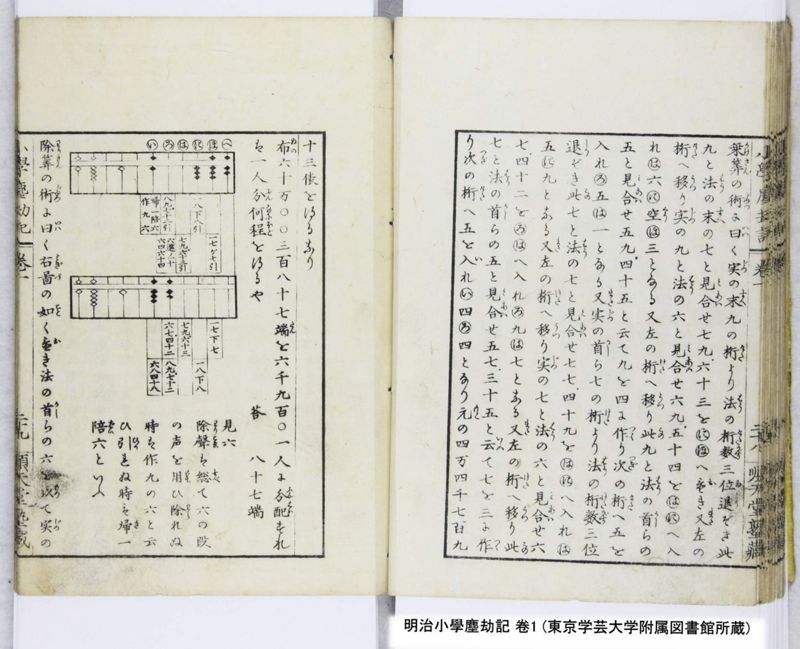
翻刻
【右丁】
乗算(かけさん)の術(じゆつ)に曰(いは)く実(じつ)の末(すへ)九の桁(けた)より法(はう)の桁数(けたかず)三 位(ゐ)退(しり)ぞき此
九と法(はう)の末(すへ)の七と見合(みあは)せ七九.六十三を㋥㋭へ置(お)き又(また)左の
桁(けた)へ移(うつ)り実(じつ)の九と法(はう)の六と見合(みあは)せ六九.五四を㋩㋥へ入
れ㋩六㋥空(くう)㋭三となる又左の桁(けた)へ移(うつ)り此(この)九と法(はう)の首(かし)らの
五と見合(みあは)せ五九.四十五と云て九を四に作(つく)り次(つぎ)の桁(けた)へ五を
入れ㋺五㋩一となる又(また)実(じつ)の首(かし)ら七の桁(けた)より法(はう)の桁数(けたかず)三位
退(しり)ぞき此(この)七と法(はう)の七と見合(みあは)せ七七.四十九を㋩㋥へ入れ㋩
五㋥九となる又(また)左の桁(けた)へ移(うつ)り実(じつ)の七と法(はう)の六と見合(みあは)せ六
七.四十二を㋺㋩へ入れ㋺九㋩七となる又(また)左の桁(けた)へ移(うつ)り此(この)
七と法(はう)の首(かし)らの五と見合(みあは)せ五七.三十五と云(いふ)て七を三に作(つく)
り次(つぎ)の桁(けた)へ五を入(い)れ㋑四㋺四となり元(もと)の四万四千七百九
【左丁】
十三俵を得るなり
布(ぬの)六十万〇〇三百八十七#1端(たん)を六千九百〇一人に分配(ふんはい)すれ
は一人 分(ぶん)何程(なにほど)を得るや 答 八十七端
【2個の算珠盤図を挟み上中下】
㋬
㋭ 一七が七引 一七下七
㋥ 一八下八引 一八下八
㋩ 七九.六十三引 七九.六十三
㋺ 八九.七十二引 《割書:六進ノ一十|六四六十四》 六七.四二 八九.七十二
㋑ 《割書:帰一陪六|作九六》 六八.四十八
【図解の下】
見六
除声(わりこゑ)は総(すべ)て六の段
の声を用(もち)ひ除(わら)れぬ
時は作九の六と云
ひ引(ひか)れぬ時は帰(き)一
陪(ばい)六といふ
【図解の左】
除算(わりさん)の術(じゆつ)に曰(いは)く右図(みぎづ)の如(こと)く置(お)き法の首(かし)らの六を以(もつ)て実(じつ)の
現代語訳
【右丁】
乗算の術に言う。実(被乗数)の末の9の桁より、法(乗数)の桁数3位を退き、この9と法の末の7と見合わせ「七九・六十三」を㋥㋭へ置き、また左の桁へ移り、実の9と法の6と見合わせ「六九・五十四」を㋩㋥へ入れ、㋩6・㋥空・㋭3となる。また左の桁へ移り、この9と法の最上位の5と見合わせ「五九・四十五」と言って9を4に作り、次の桁へ5を入れ、㋺5・㋩1となる。また実の最上位7の桁より法の桁数3位を退き、この7と法の7と見合わせ「七七・四十九」を㋩㋥へ入れ、㋩5・㋥9となる。また左の桁へ移り、実の7と法の6と見合わせ「六七・四十二」を㋺㋩へ入れ、㋺9・㋩7となる。また左の桁へ移り、この7と法の最上位の5と見合わせ「五七・三十五」と言って7を3に作り、次の桁へ5を入れ、㋑4・㋺4となり、元の44,793
【左丁】
俵を得るなり。
布600,387端を6,901人に分配すれば、1人分は何ほどを得るか。 答 87端
【算盤図(2図)を挟んで、上中下】
㋬
㋭ 一七が七引 一七下七
㋥ 一八下八引 一八下八
㋩ 七九・六十三引 七九・六十三
㋺ 八九・七十二引 《割注:六進の一十|六四六十四》 六七・四十二 八九・七十二
㋑ 《割注:帰一陪六|作九六》 六八・四十八
【図解の下】
見六(けんろく)
除声はすべて六の段の声を用い、割られぬときは「作九の六」と言い、引かれぬときは「帰一陪六」という。
【図解の左】
除算の術に言う。右図のように置き、法の最上位の6をもって実の
英語訳
【Right Page】
The method of multiplication states: Starting from the digit of 9 at the end of the dividend (*jitsu*), move back three places (the number of digits in the divisor (*hō*)), match this 9 with the last digit 7 of the divisor, say "7×9=63," and place the result at ㋥㋭. Then move to the next digit to the left, match the 9 of the dividend with the 6 of the divisor, say "6×9=54," enter it at ㋩㋥, making ㋩6, ㋥empty, ㋭3. Again move to the next digit to the left, match this 9 with the leading digit 5 of the divisor, say "5×9=45," change 9 to 4 and enter 5 into the next digit, making ㋺5, ㋩1. Then, starting from the leading digit 7 of the dividend, move back three places (the number of digits in the divisor), match this 7 with the 7 of the divisor, say "7×7=49," enter it at ㋩㋥, making ㋩5, ㋥9. Move to the next digit to the left, match the 7 of the dividend with the 6 of the divisor, say "6×7=42," enter it at ㋺㋩, making ㋺9, ㋩7. Again move to the next digit to the left, match this 7 with the leading digit 5 of the divisor, say "5×7=35," change 7 to 3 and enter 5 into the next digit, making ㋑4, ㋺4, thus recovering the original 44,793
【Left Page】
bales of rice.
If 600,387 tan of cloth are distributed among 6,901 people, how much does each person receive? Answer: 87 tan
【Between the two abacus diagrams, top/middle/bottom】
㋬
㋭ 1×7=7, subtract 1×7 lower 7
㋥ 1×8 lower 8, subtract 1×8 lower 8
㋩ 7×9=63, subtract 7×9=63
㋺ 8×9=72, subtract 《annotation: advance six by one ten|6×4=64》 6×7=42 8×9=72
㋑ 《annotation: return-one double-six|make-nine's six》 6×8=48
【Below the diagram】
*Ken-roku* (見六: "see six")
All division calls use the multiplication table of 6; when division is not possible, say "make-nine's six" (*sakukyū no roku*); when subtraction is not possible, say "return-one double-six" (*ki-ichi bai-roku*).
【Left of diagram】
The method of division states: Set up as in the right diagram, using the highest digit 6 of the divisor to match against the dividend's…