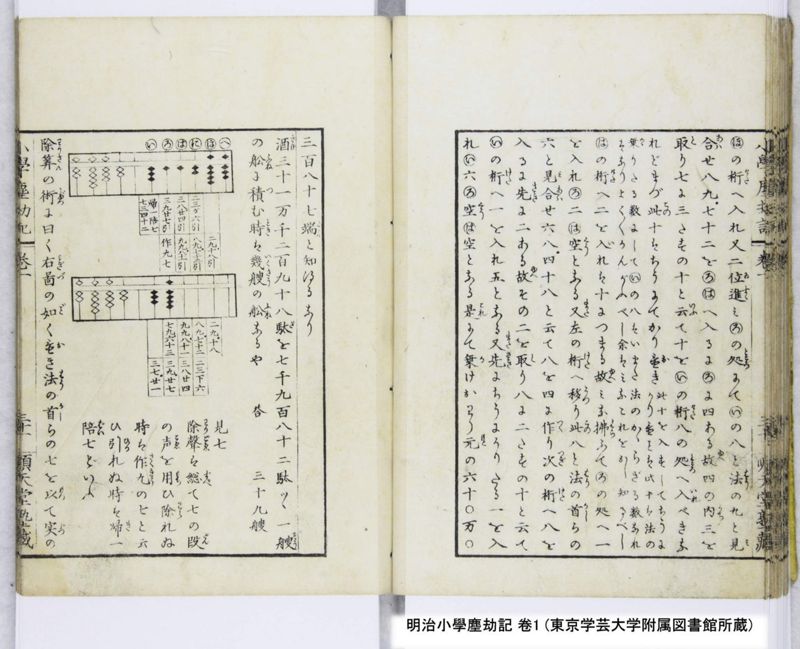
翻刻
【右丁】
㋭の桁(けた)へ入れ又二 位(ゐ)進(すゝ)み㋺の処(ところ)にて㋑の八と法(はう)の九と見(み)
合(あは)せ八九.七十二を㋺㋩へ入るに㋺に四ある故(ゆへ)四の内(うち)三を
取(と)り七に三たすの十と云(いふ)て十を㋑の桁(けた)八の処(ところ)へ入(いれ)べきな
れどまづ此(この)十はちうにてかり置(お)き《割書:此十を入すしてちうに|かり置ことは此十は法の》
《割書:乗(かゝ)りたる数にして㋑の八はいまた法のかゝらざる数なれ|はなりよく〳〵かんがふべし余はみなこれをおし知るべし》
㋩の桁(けた)へ二を入(い)れは十につまる故(ゆへ)みな払(はら)ふて㋺の処へ一
を入れ㋺二㋩空(くう)となる又(また)左の桁(けた)へ移(うつ)り此(この)八と法(はう)の首(かし)らの
六と見合(みあは)せ六八.四十八と云て八を四に作(つく)り次(つぎ)の桁(けた)へ八を
入るに先(さき)に二ある故(ゆへ)その二を取(と)り八に二たすの十と云て
㋑の桁(けた)へ一を入れ五となる又(また)先(さき)にちうにかりたる一を入
れ㋑六㋺空(くう)㋩空となる是(これ)にて乗(か)けおわり元(もと)の六十〇万〇
【左丁】
三百八十七 端(たん)と知得るなり
酒(さけ)三十一万千二百九十八 駄(だ)を七千九百八十二駄ツヽ一 艘(そう)
の船(ふね)に積(つ)む時(とき)は幾艘(いくさう)の船(ふね)なるや 答 三十九艘
【2個の算珠盤図を挟み上中下】
㋬
㋭ 二九.十八引 二九.十八
㋥ 二三が六引 八九.七十二引 八九.七十二 二三下六
㋩ 三八.廿四引 九九.八十一引 九九.八十一 三八廿四
㋺ 三九廿七引 作九七 七九.六十三 三九.廿七
㋑ 《割書:帰一陪七|七三四十二》 三七.廿一
【図解の下】
見七
除声(わりごゑ)は総(すべ)て七の段(だん)
の声(こゑ)を用(もち)ひ除(わら)れぬ
時は作九(さくきう)の七と云
ひ引(ひか)れぬ時は帰(き)一
陪(ばい)七といふ
【図解の左】
除算(わりさん)の術(じゆつ)に曰く右図(みぎづ)の如(ごと)く置(お)き法(はう)の首(かし)らの七を以(もつ)て実(じつ)の
現代語訳
【右丁】
㋭の桁へ入れ、また2位進んで㋺の所にて㋑の8と法の9と見合わせ「8×9=72」を㋺㋩へ入れようとすると㋺に4があるゆえ、4の内3を取り「七に三たすの十」と言って、十を㋑の桁の8の所へ入れるべきであるが、まずこの十は中(宙)にて借り置き、《割書:この十を入れずに中(宙)に借り置くことは、この十は法の掛かりたる数にして、㋑の8はいまだ法の掛からざる数であるからなり。よくよく考えるべし。その余はみなこれを推して知るべし。》㋩の桁へ2を入れると十につまるゆえ、みな払って㋺の所へ1を入れ、㋺2㋩空となる。また左の桁へ移り、この8と法の最上位の6と見合わせ「6×8=48」と言って8を4に作り、次の桁へ8を入れようとすると先に2があるゆえ、その2を取り「八に二たすの十」と言って㋑の桁へ1を入れ5となる。またさきに中(宙)に借りたる1を入れ、㋑6㋺空㋩空となる。これにて掛け終わり、元の六十〇万〇
【左丁】
三百八十七端と知り得るなり。
酒三十一万千二百九十八駄を七千九百八十二駄ずつ一艘の船に積む時は、幾艘の船なるや。 答 三十九艘
【算盤図(2図を挟み上中下)】
㋬
㋭ 二九の十八を引く 二九の十八
㋥ 二三が六を引く 八九の七十二を引く 八九の七十二 二三が六
㋩ 三八の二十四を引く 九九の八十一を引く 九九の八十一 三八二十四
㋺ 三九二十七を引く 作九七 七九の六十三 三九の二十七
㋑ 《帰一陪七・七三四十二》 三七の二十一
【図解の下】
「見七」
割り声はすべて七の段の声を用い、割られぬ時は「作九(さくきゅう)の七」と言い、引かれぬ時は「帰一陪(きいちばい)七」と言う。
【図解の左】
除算の術に言う。右図のごとく置き、法の最上位の7を以て実の
英語訳
【Right Page】
Enter [the 8] into the ㋭ position, then advance 2 places to the ㋺ position, match the 8 at ㋑ with the multiplier's 9, and attempt to place "8×9=72" at ㋺㋩. Since there is a 4 at ㋺, take 3 from the 4 and say "seven plus three makes ten," which would mean entering the ten into the position of the 8 at ㋑; however, first hold this ten in suspension (temporarily set aside). 《Split notation: The reason this ten is not entered but held in suspension is that this ten is a number already affected by the multiplier, while the 8 at ㋑ has not yet been acted upon by the multiplier. Consider this carefully. All remaining cases should be understood by analogy from this.》 When 2 is entered into the ㋩ position it fills up to ten, so clear it all and enter 1 into the ㋺ position, giving ㋺2㋩empty. Then move to the left position, match this 8 with the multiplier's highest digit 6, say "6×8=48", change 8 to 4, and attempt to place 8 into the next position; since 2 is already there, take that 2 and say "eight plus two makes ten," enter 1 into the ㋑ position making it 5. Then also enter the 1 previously held in suspension, giving ㋑6㋺empty㋩empty. With this the multiplication is complete, and one learns that the original [quantity] is 600,
【Left Page】
387 tan (bolts of cloth).
When 311,298 *da* (packhorse loads) of sake are loaded onto ships at 7,982 *da* per vessel, how many ships are needed? **Answer: 39 ships**
【Abacus Diagram (upper, middle, lower sections flanking 2 diagrams)】
㋬
㋭ Subtract 2×9=18 2×9=18
㋥ Subtract 2×3=6 Subtract 8×9=72 8×9=72 2×3=6
㋩ Subtract 3×8=24 Subtract 9×9=81 9×9=81 3×8=24
㋺ Subtract 3×9=27 Saku-kyū 7 7×9=63 3×9=27
㋑ 《Ki-ichi bai-shichi / 7×3=21》 3×7=21
【Below the diagram】
"Ken-shichi" (Looking at 7)
All division calls use the seven times table; when division is not possible, say "saku-kyū no shichi" (make nine from seven); when subtraction is not possible, say "ki-ichi bai-shichi" (return one, accompany seven).
【Left of the diagram】
The method of division states: Set up [the numbers] as shown in the diagram on the right, and using the highest digit 7 of the divisor, [divide into the dividend]…